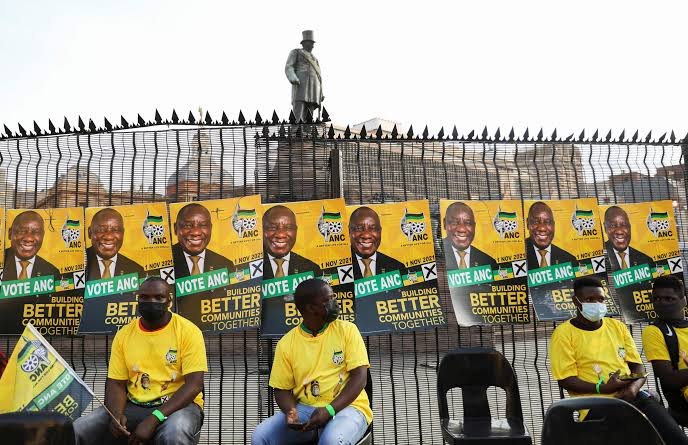
South Africa’s governing African National Congress (ANC) is facing another significant electoral challenge after early results from the country’s November 4, 2026 municipal elections showed its support falling to approximately 32 per cent.
The preliminary figures, released by the Electoral Commission of South Africa (IEC), placed the ANC narrowly ahead of its main opposition, the Democratic Alliance (DA), which had secured around 27 per cent of the vote.
By midday on Thursday, November 5, approximately 36 per cent of votes had been counted. Although the ANC maintained its lead nationally at that stage, the figures pointed to a potentially difficult election for the party that has dominated South African politics since the end of apartheid in 1994.
If the results remain around that level, the ANC would lose approximately 14 percentage points compared with its performance in the 2021 municipal elections.
The counting process was still ongoing, however, and the final outcome could change as more voting districts submitted their results.
ANC struggles to maintain support after years in power
The early election figures reflect the continuing decline in support for the ANC, which has governed South Africa since the country’s first democratic elections in 1994.
The party’s electoral strength has weakened over several election cycles, with voters increasingly expressing dissatisfaction over unemployment, corruption allegations, crime and problems with essential public services.
In the 2021 municipal elections, the ANC received approximately 46 per cent of the national vote, marking its weakest performance in local government elections at the time.
The party subsequently suffered another major setback in the 2024 general election, when it failed to secure an outright parliamentary majority for the first time since the end of apartheid.
That result forced President Cyril Ramaphosa’s party to enter a Government of National Unity with several political organisations, including the DA.
The latest municipal election figures suggest that the challenges facing the ANC remain significant, particularly at the local government level.
Poor municipal services dominate election concerns
The quality of public services emerged as one of the major issues influencing the November 4 elections.
Many South Africans have complained about unreliable water supplies, electricity disruptions, deteriorating roads, poor sanitation and inadequate waste collection.
These problems have affected communities across different municipalities, increasing pressure on local authorities to improve service delivery.
Crime and corruption allegations have also contributed to public dissatisfaction with political leadership.
The elections provided voters with an opportunity to express their views on how municipalities have been managed and whether existing administrations should remain in office.
Analyst Louw Nel of Oxford Economics Africa told Reuters that the early turnout figures suggested some ANC supporters had participated in the election but chosen alternative political parties.
He described a result around 32 per cent as a particularly difficult scenario for the governing party.
However, ANC chairman Gwede Mantashe urged caution, arguing that several important voting areas, including townships and other major communities, had yet to be fully counted.
He maintained that the party could improve its position as additional results became available.
Democratic Alliance makes gains in key cities
The Democratic Alliance recorded a strong performance in several major urban centres, strengthening its position as the ANC’s principal national competitor.
The party declared an early victory in Cape Town, where official results showed it receiving approximately 60 per cent of the votes counted at that stage.
Johannesburg also emerged as a major area of interest, with the DA leading the early count. However, the race remained too close to call, with only 17 per cent of votes counted in the city at the time of Reuters’ report.
Winning Johannesburg would represent an important achievement for the DA because of the city’s economic significance and large population.
Former DA leader Helen Zille, who was contesting the Johannesburg mayoral position, expressed confidence about the party’s performance.
The DA has campaigned on issues including municipal accountability, infrastructure maintenance and improving basic services.
Nevertheless, its ability to govern Johannesburg will depend not only on its final vote share but also on whether it can secure support from other parties in the council.
Jacob Zuma’s MK Party and IFP challenge ANC in KwaZulu-Natal
The election has also highlighted the growing influence of opposition parties in KwaZulu-Natal, a province that has traditionally been an important political stronghold for the ANC.
Former president Jacob Zuma’s uMkhonto weSizwe (MK) Party and the Inkatha Freedom Party (IFP) were both performing ahead of the ANC in the province during the early count, according to Reuters.
The MK Party’s performance is particularly significant because the 2026 municipal election represents its first participation in a local government election.
The party attracted considerable support during the 2024 national election, especially in KwaZulu-Natal, where Zuma retains a strong political following.
Its performance in the latest contest could influence the balance of power in several municipalities.
The IFP, which has maintained an established political presence in the province, is also seeking to strengthen its position in local government.
Meanwhile, the Economic Freedom Fighters (EFF), ActionSA and other smaller parties are competing for council seats and potential influence in coalition arrangements.
Coalition negotiations likely in Johannesburg and other cities
The possibility of hung councils has become one of the major issues emerging from the election.
In several municipalities, no single political party is expected to secure enough seats to govern independently. This means parties may need to negotiate partnerships before appointing mayors and establishing administrations.
Johannesburg is among the cities where coalition discussions could determine the next municipal leadership.
The DA’s performance in the city has put it in a competitive position, but the final distribution of council seats will determine which political combinations are possible.
ActionSA, founded by former Johannesburg mayor Herman Mashaba, could also become influential if its representation gives it leverage during negotiations.
The ANC and DA could potentially explore cooperation, similar to their participation in the national Government of National Unity. However, differences over important policy issues, including racial redress, could complicate any agreement.
Reuters reported that parties would have two weeks after the declaration of the results, which was expected on Sunday, to negotiate coalition arrangements.
Final results could shape South Africa’s political direction
The 2026 municipal elections are being closely watched because they offer an indication of public sentiment ahead of the next national election scheduled for 2029.
A continued decline in ANC support could increase pressure on the party to address concerns about municipal administration, corruption allegations and the delivery of essential services.
For the DA and other opposition parties, the results could provide opportunities to expand their influence beyond their established strongholds.
However, the final political picture will depend on the completed vote count and the coalition agreements reached in municipalities where no party secures an outright majority.
The IEC was expected to continue counting and verifying ballots before announcing the final results.
For now, the ANC remains ahead in the early national tally, but its reduced share highlights the increasingly competitive political environment in South Africa.