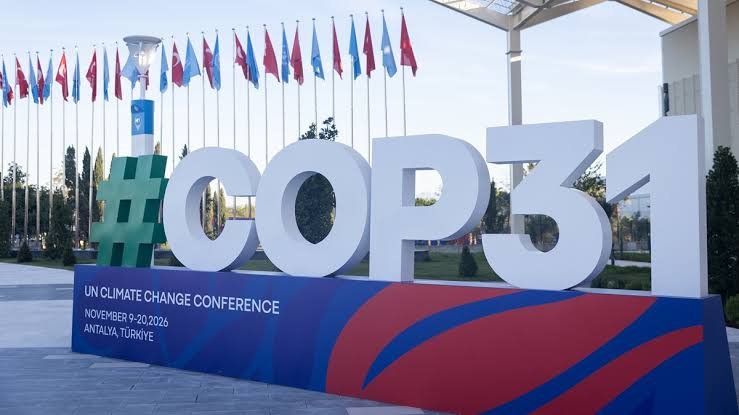
Libya has presented its national climate plans at the COP31 United Nations climate conference in Antalya, Türkiye, setting out proposals to reduce emissions and prepare for the effects of a changing climate. The documents were presented by Environment Minister Mohamed Sidi Ibrahim during a session attended by Oil and Gas Minister Khalifa Abdel-Sadig, Water Resources Minister Hosni Owaidan and international officials, Libya Herald reported.
The documents include Libya’s first Nationally Determined Contribution (NDC), its National Adaptation Plan and its First National Communication. Together, they describe the country’s emissions-reduction goals, climate risks and adaptation priorities under the Paris Agreement. The Ministry of Environment prepared them with input from national stakeholders and support from the United Nations Development Programme (UNDP) and Germany’s GIZ development agency.
At the COP31 presentation, the environment minister stressed that Libya must move from drafting plans to carrying out practical projects. He also called for stronger coordination between government institutions and expanded international cooperation to protect natural and water resources and reduce the harm caused by climate impacts. That implementation challenge is central to the plans: they set out objectives, but achieving them will depend on funding, institutional coordination and follow-through.
Libya’s first NDC sets a target for reducing carbon intensity by 2035. The plan aims for a 28 per cent reduction against 2023 levels using domestic resources, with a larger reduction of 49 per cent possible if international support is provided. Carbon intensity measures greenhouse-gas emissions in relation to economic output, so the target is intended to allow the economy to grow while reducing emissions per unit of production. It is not the same as a promise to cut the country’s total emissions by those percentages.
The plan places much of the mitigation effort in the energy sector. It identifies the recovery of gas currently burned off during oil production, changes in power generation and energy-efficiency improvements as major sources of potential reductions. Capturing gas that would otherwise be flared could both lower emissions and make more energy available for domestic use or export. The document also includes measures involving renewable energy, low-emission transport, tree planting and land restoration.
The financial scale of the proposed work is substantial. Libya’s NDC estimates that its mitigation measures will require about US$29.6 billion over the 2026–2035 period. It anticipates that roughly US$9.2 billion could come from domestic resources, while about US$20.4 billion would depend on external support. That makes international finance a key condition for achieving the more ambitious target. Without the funding and technical cooperation anticipated in the plan, the country’s stated climate goals may be harder to meet.
The documents also address adaptation: changes that can help communities and infrastructure withstand climate effects already being experienced or expected to worsen. UNDP says Libya faces rising temperatures, water scarcity, desertification, land degradation and pressure on coastal areas, biodiversity and essential infrastructure. Those risks affect areas such as food and water security, public health and livelihoods. The National Adaptation Plan identifies priorities across sectors including water, agriculture, health, coastal zones and ecosystems.
Libya had already launched its climate framework under the Paris Agreement in July. UNDP said the framework—comprising the NDC, National Adaptation Plan and First National Communication—was formally endorsed by the Government of National Unity and developed through a nationally led process involving public institutions and other stakeholders. The COP31 presentation therefore gave Libyan officials an international platform to explain plans already established at home and to underline the need for investment and cooperation to put them into practice.
COP31 is taking place in Antalya from November 9 to 20. Its agenda includes climate finance, adaptation and other matters covered by the UN climate process. For Libya, bringing its plans to the conference offers an opportunity to communicate its priorities to potential partners, including the need for support to strengthen resilience and reduce emissions.
The next measure of progress will be what happens after the presentation. Libya’s plans identify actions and estimate the resources required, but delivery will involve work across ministries and economic sectors, along with reliable monitoring of results. Projects to reduce gas flaring, improve power generation, expand efficiency and protect water and land resources will need to move from policy documents into funded programmes.
The minister’s call to focus on practical projects reflects that next step. Libya has now set out a framework for mitigation and adaptation and has presented it at COP31. Whether the country reaches its targets will depend on the resources it can mobilise, the cooperation it secures and the consistency with which the proposed measures are implemented over the coming years.