At least one person has died after a boat carrying migrants and refugees capsized off the coast of western Senegal, renewing concerns over the dangers facing people attempting to reach Europe through the Atlantic migration route.
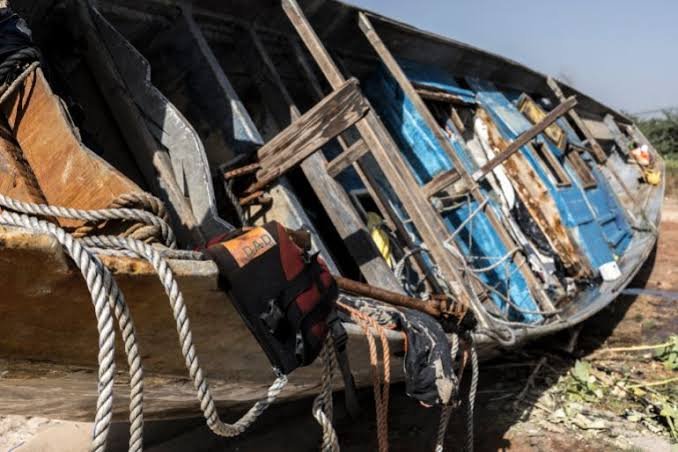
The incident occurred near Yenne, a coastal community in Senegal, after the wooden vessel, locally known as a pirogue, struck a rocky area and was washed ashore during the early hours of Wednesday, November 18, 2026.
Local authorities confirmed that a body had been recovered, although other sources indicated that the death toll could be higher. Rescue efforts and searches for possible additional victims were ongoing following the accident.
The tragedy comes barely 10 days after another migrant boat disaster off Senegal’s northwestern coast claimed 43 lives, highlighting the continuing risks associated with irregular migration across the Atlantic Ocean.
Around 100 People Reportedly Aboard the Boat
Details emerging from the incident suggest that the vessel was carrying a large number of passengers when it encountered difficulties near Yenne.
A survivor questioned by Senegalese gendarmes reportedly said approximately 100 people were aboard the boat, including five women. However, the exact number of passengers has not been independently confirmed.
Yenne Mayor Massamba Mbengue and local firefighters said one body had been recovered from the wreckage. Two other local sources, however, reported that the number of fatalities could be two.
Oumar Sow, a representative of the village chief, said the incident happened at about 2 a.m. local time. He described hearing cries from the vessel that could be heard from the beach.
The boat eventually reached the shoreline in a severely damaged condition after striking rocks. Its condition raised further concerns about the safety of the vessel and the circumstances under which the journey had been organised.
Personal Belongings and Identity Documents Recovered
Following the accident, local authorities and security personnel examined the damaged boat and recovered several items believed to have belonged to passengers.
Among the materials discovered were water sachets, mobile phones, eight identity documents and a school enrolment document belonging to a secondary school student from Kabrousse, a community in southern Senegal.
The discovery of the school document has raised concerns about the involvement of young people in dangerous migration journeys.
The recovered items may also help authorities establish the identities of some of the passengers and provide information about where they came from.
Local officials said a survivor was being questioned by the gendarmerie as part of efforts to understand what happened and gather further details about the journey.
Authorities were also searching for any additional bodies that might have been left in the surrounding area.
Yenne Emerges as a Departure Point for Migrants
The latest disaster has drawn attention to Yenne’s growing role in irregular migration along Senegal’s Atlantic coastline.
A local official said the community had increasingly become a departure point for people hoping to reach Europe by sea. He also alleged that smugglers were visiting the area to recruit individuals capable of piloting migrant boats.
The Atlantic route from West Africa to Spain’s Canary Islands is one of the most dangerous migration corridors in the world. Many people attempting the journey travel in wooden fishing boats that are frequently overloaded, poorly maintained and unsuitable for long-distance sea travel.
The journey can involve days at sea, exposing passengers to unpredictable weather, rough waters, mechanical failures, dehydration and shortages of food.
Despite these dangers, thousands of people continue to attempt the crossing, driven by unemployment, economic hardship, insecurity and the hope of finding better opportunities in Europe.
The latest incident demonstrates how quickly these journeys can turn into disasters, particularly when vessels are not equipped to handle difficult ocean conditions.
Senegal Still Reeling From Shipwreck That Killed 43
The Yenne accident occurred just 10 days after another migrant boat sank off the coast of Thieppe in northwestern Senegal, killing 43 people.
That disaster was described as one of the deadliest migration-related incidents in Senegal’s history and prompted renewed calls for stronger government action to prevent further deaths at sea.
The human rights organisation Action for Human Rights and Friendship (ADHA) called for a parliamentary investigation into the tragedy.
The organisation criticised what it considered insufficient progress in preventing dangerous migration journeys and urged authorities to take more effective measures.
The latest capsizing has added urgency to those demands, particularly as communities along Senegal’s coastline continue to be associated with departures by people seeking to reach the Canary Islands.
For families of those involved, repeated shipwrecks have brought uncertainty and grief, with some still waiting for information about relatives who attempted the dangerous journey.
More Migrants Continue to Reach Spain’s Canary Islands
Despite the risks, the number of people attempting the Atlantic crossing remains significant.
Spain declared a migration emergency in the Canary Islands on November 10, 2026, after more than 9,000 people arrived in the territory from the beginning of the month.
Spain’s Maritime Rescue Service also reported rescuing 1,488 migrants travelling in 14 small boats on November 14. Most of those rescued arrived on the island of El Hierro, which has become an important entry point for migrants travelling from West Africa.
The reported arrivals exceeded the previous November record of 1,461 people rescued in 2020.
Senegal remains one of the main departure countries for migrants attempting the Atlantic route, although people from other West African countries also undertake the journey.
The continued arrivals illustrate the scale of migration pressure facing Spain, while the repeated shipwrecks highlight the human cost of journeys organised through unsafe vessels and irregular networks.
Calls for Stronger Action to Prevent Migrant Deaths
The latest tragedy has renewed questions about what Senegal and other countries in the region can do to discourage dangerous sea crossings.
Measures could include stronger action against smuggling networks, improved coastal monitoring, public awareness campaigns and greater investment in employment and economic opportunities for young people.
Authorities also face the challenge of identifying vulnerable individuals who may be considering irregular migration and providing safer alternatives.
However, preventing these journeys requires cooperation beyond Senegal. Countries of origin, transit and destination need to work together to address the networks organising dangerous crossings and the conditions encouraging people to leave their communities.
For now, the immediate priority following the Yenne accident remains establishing the final number of casualties, identifying those involved and determining how the boat ended up on the rocky shoreline.
With the latest disaster following the deaths of 43 migrants off Thieppe, pressure is mounting on Senegalese authorities to strengthen efforts to prevent further loss of life along the country’s Atlantic coast.