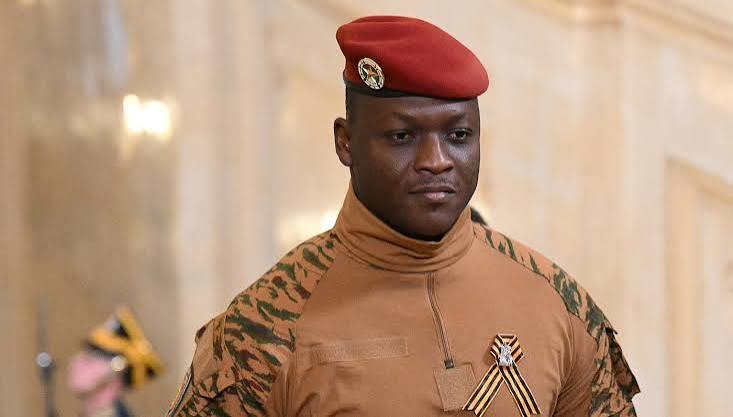
Burkina Faso has marked four years since Captain Ibrahim Traoré came to power, with the military-led government using the anniversary to highlight what it describes as progress in security, economic independence and national development.
The anniversary was commemorated in Ouagadougou on September 30 with a major gathering at the Place de la Révolution. Government officials and supporters attended events organised around the fourth anniversary of what authorities describe as the Popular Progressive Revolution.
Traoré came to power in September 2022 after a military takeover that removed Lieutenant Colonel Paul-Henri Sandaogo Damiba. His takeover was the country’s second coup in the same year, following Damiba’s removal of President Roch Marc Christian Kaboré in January 2022.
Four years later, Traoré remains at the centre of Burkina Faso’s political system as the country continues to be governed by a military administration.
Government highlights security and development
During the anniversary celebrations, Prime Minister Rimtalba Jean Emmanuel Ouédraogo presented what the government described as achievements recorded since Traoré assumed power.
According to the Burkinabè authorities, the period has been marked by efforts to strengthen national security while also pursuing projects in sectors including healthcare, education, infrastructure, industry and food security.
The government has also placed considerable emphasis on reducing dependence on foreign powers and strengthening what it calls national sovereignty.
That approach has extended to the country’s natural resources. In September 2026, Burkina Faso inaugurated its first gold refinery in Ouagadougou as part of efforts to process more of its gold domestically rather than exporting the resource in raw form. The facility was presented by the government as part of a broader economic-sovereignty strategy.
Security remains a central issue
The fight against armed groups continues to dominate Burkina Faso’s political and security landscape.
The country has faced years of attacks by armed groups linked to al-Qaeda and the Islamic State, particularly in northern and eastern areas. The violence has caused significant civilian displacement and placed enormous pressure on the country’s security forces.
Traoré’s government has made the fight against armed groups one of its main priorities, while increasing reliance on domestic forces and civilian auxiliaries known as Volunteers for the Defence of the Homeland.
At the anniversary gathering, Prime Minister Ouédraogo praised the country’s security forces and volunteers, while calling on citizens to remain vigilant. The government said it believed the security situation could improve but acknowledged that the threat had not disappeared.
A different approach to foreign relations
Traoré’s administration has also significantly changed Burkina Faso’s foreign-policy orientation.
Since taking power, the military government has moved away from several longstanding relationships with Western partners and promoted closer cooperation with countries outside the traditional Western sphere.
Burkina Faso, together with Mali and Niger, has also pursued greater regional cooperation through the Alliance of Sahel States after the three military-led governments distanced themselves from the Economic Community of West African States.
The changes have been presented by the governments involved as part of efforts to strengthen sovereignty and reduce external influence.
Traoré’s influence and the Sankara comparison
The anniversary has also generated comparisons between Traoré and former Burkinabè leader Thomas Sankara, whose government in the 1980s promoted self-reliance, national sovereignty and social reforms.
Africanews reported that Traoré has now spent the same length of time in power as Sankara did.
Supporters of Traoré have embraced aspects of Sankara’s legacy, particularly the emphasis on sovereignty and domestic production.
The comparison has nevertheless remained politically significant because Sankara’s government lasted only four years before he was killed in a 1987 coup.
Political transition remains a key question
Traoré’s continued rule has also raised questions about when Burkina Faso will return to civilian democratic government.
When he first took power in 2022, the military authorities spoke of a transition towards elections. The political timetable has since changed, and the authorities have extended military rule.
In April 2026, Africanews reported that Traoré had rejected a return to civilian democracy under the existing political framework and extended military rule.
The government has defended its position by pointing to the security situation and its stated need to complete what it describes as a national transformation.
For supporters, the four-year anniversary represents an opportunity to highlight the government’s sovereignty agenda, security efforts and development projects.
For critics, the extended military rule and restrictions on political activity and dissent remain important concerns.
As Burkina Faso enters another year under Traoré’s leadership, the government faces the continuing challenge of improving security while delivering the economic and social changes it has promised.
The four-year anniversary therefore represents more than a ceremonial milestone. It also provides an opportunity to assess the direction Burkina Faso has taken since the 2022 coup and the extent to which the military government’s promises of sovereignty, security and development translate into lasting changes for the country’s population.