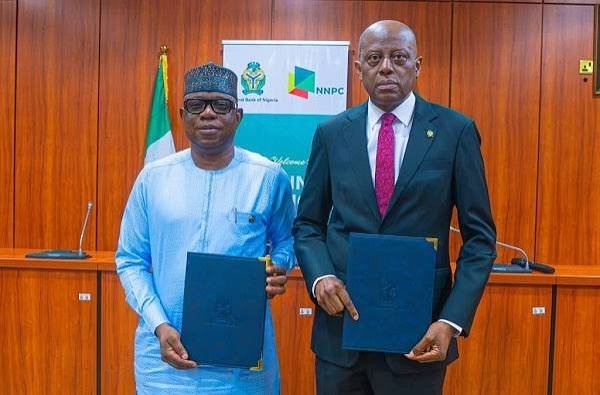
The Central Bank of Nigeria (CBN) and the Nigerian National Petroleum Company Limited (NNPC) have signed a memorandum of understanding (MoU) aimed at improving foreign exchange inflows, strengthening energy-sector financing and enhancing the management of oil and gas revenues.
The agreement was signed on Wednesday, November 18, 2026, at the CBN headquarters in Abuja. It establishes a more structured framework for cooperation between Nigeria’s monetary authority and its state-owned oil company.
The partnership is expected to improve coordination in the management of petroleum proceeds, support investment in energy projects and strengthen the financial systems used by both institutions.
The development comes as Nigeria continues efforts to increase foreign exchange earnings, improve its external reserves and attract investment into the oil and gas industry.
CBN Governor Olayemi Cardoso said better management of petroleum revenues and more predictable foreign exchange inflows were important for maintaining economic and currency stability.
According to him, closer cooperation between the two institutions would help improve account management, funds transfers and liquidity support, while ensuring that oil and gas proceeds are handled more efficiently.
The agreement also seeks to strengthen the relationship between Nigeria’s energy industry and financial system, recognising the importance of petroleum exports to government revenue and the country’s supply of foreign currency.
Agreement to Improve Management of Oil and Gas Revenues
One of the major objectives of the MoU is to improve the way proceeds from Nigeria’s oil and gas exports are managed and transferred into the economy.
The CBN plays an important role in overseeing key operational foreign currency accounts belonging to NNPC. The central bank is also involved in ensuring that petroleum revenues are transferred into the Federation Account and other designated government accounts.
Cardoso said stronger coordination in these areas would help make revenue flows more predictable and improve the management of funds generated from the country’s energy resources.
The agreement is expected to cover several areas, including hydrocarbon asset monetisation, foreign exchange operations, payment automation, regulatory compliance, cybersecurity and information sharing.
It will also provide a framework for faster coordination on operational approvals and financial transactions involving the two institutions.
By improving these processes, the government hopes to strengthen transparency, reduce delays and support more effective management of revenue from the petroleum industry.
NNPC Group Chief Executive Officer Bayo Ojulari described the agreement as an important step towards establishing a clearer relationship between the national oil company and the country’s monetary authority.
He said the arrangement would provide a structured system for cooperation rather than relying on occasional engagements to resolve financial and operational challenges.
NNPC Targets Higher Crude Oil Production
The agreement is also expected to support NNPC’s ambition to increase Nigeria’s crude oil production from approximately 1.8 million barrels per day to three million barrels per day.
NNPC Group Chief Financial Officer Adedapo Segun said stronger coordination with the CBN could help attract the investment required to expand production and develop the country’s energy resources.
He explained that the new arrangement would replace the previous approach, in which both institutions handled financial matters through separate, transaction-by-transaction engagements.
Segun added that NNPC would align domestic payments, contractor settlements and foreign exchange conversions with CBN regulations.
The objective is to improve financial discipline, support the use of the naira for domestic transactions and reduce unnecessary dollarisation within the company’s operations.
The agreement will also establish joint working groups, implementation timelines and accountability mechanisms to monitor progress. NNPC Group Treasurer John Etukudo will oversee implementation on behalf of the national oil company.
However, the three-million-barrel production target remains an ambition rather than an output level guaranteed by the agreement. Achieving it will depend on investment, operational improvements, security conditions and the resolution of challenges affecting oil production.
CBN Seeks International Investment for Nigeria’s Gas Industry
Beyond crude oil production, the partnership is expected to create opportunities for financing projects in Nigeria’s natural gas industry.
Cardoso said the CBN could use its relationships with international financial institutions to attract capital for the development of the country’s gas resources.
Nigeria possesses substantial natural gas reserves, but investment in infrastructure, processing facilities and transportation networks remains important to expanding production and increasing the sector’s contribution to the economy.
The proposed collaboration could help develop financing arrangements for energy projects and improve access to international capital.
The institutions are also expected to cooperate on the monetisation of oil and gas assets, payment systems, risk management and regulatory alignment.
These measures are intended to improve the financial environment for energy investments and encourage greater participation by domestic and foreign investors.
For Nigeria, stronger gas-sector financing could support industrial development, electricity generation and export earnings, provided the projects receive the necessary funding and are successfully implemented.
NNPC Seeks Better Financial Discipline and Investor Confidence
Ojulari said the agreement would help NNPC strengthen its financial discipline and improve its ability to raise capital using its balance sheet and assets.
He disclosed that the company faced considerable financial difficulties when he assumed office in April 2025, including weak liquidity, troubled projects, substantial loan obligations and challenges involving its refineries.
The company has since reviewed aspects of its financial position, including existing loans and proposed asset divestments.
According to Ojulari, the new framework will help create a more transparent and predictable relationship with the CBN, which is important for the company’s commercial operations.
The arrangement is also expected to strengthen investor confidence by improving the coordination of financial transactions and providing clearer accountability structures.
For NNPC, access to capital is particularly important as it seeks to expand oil production, develop gas resources and improve the performance of its wider operations.
The agreement does not itself provide a specific funding amount or guarantee new investment. Rather, it establishes a framework through which both institutions intend to improve financial coordination and support energy-sector financing.
Nigeria’s Foreign Exchange Reserves and Economic Stability
The CBN’s Deputy Governor for Operations, Emem Usoro, said Nigeria’s gross external reserves had exceeded $55 billion, attributing the improvement to increased oil production and sustained diaspora remittances.
She expressed confidence that closer cooperation with NNPC would help preserve and strengthen the reserves through improved export earnings and more reliable foreign exchange inflows.
Foreign exchange availability remains an important factor in Nigeria’s economic performance because businesses depend on access to dollars and other international currencies to pay for imports, machinery, industrial materials and other obligations.
Greater transparency in the management of petroleum proceeds could also improve confidence in Nigeria’s foreign exchange system.
The latest agreement builds on previous efforts to strengthen oversight of NNPC’s foreign currency transactions and improve the handling of oil revenue.
Both institutions are expected to monitor the new arrangement through joint committees and agreed performance indicators.
What the CBN-NNPC Agreement Means for Nigeria
The partnership represents an effort to strengthen cooperation between two institutions with significant influence over Nigeria’s energy industry and financial system.
If properly implemented, it could improve the management of petroleum export earnings, support foreign exchange inflows and make it easier to mobilise funds for oil and gas projects.
It could also help NNPC improve its financial operations while supporting the CBN’s broader responsibility for monetary and financial stability.
Nevertheless, the impact of the agreement will depend on how effectively the institutions implement their commitments and whether the expected improvements translate into higher production, increased investment and more reliable revenue flows.
For Nigeria, the central challenge remains turning its oil and gas resources into stronger export earnings, sustainable government revenue and improved economic opportunities.
The new MoU provides a framework for pursuing those objectives, but its success will ultimately be measured by the results delivered across the country’s energy and financial sectors.