Egypt and the United States have signed a five-year economic cooperation agreement valued at up to $625 million, with both countries seeking to expand investment, improve public services and support economic development.
The agreement, signed on Wednesday, November 4, 2026, establishes a framework for cooperation in areas including water management, energy, infrastructure, education, healthcare and artificial intelligence.
Egyptian and American officials described the arrangement as an effort to promote mutual prosperity by combining US technological expertise and institutional support with Egypt’s development priorities.
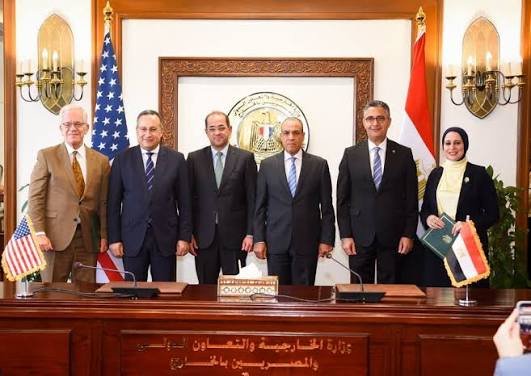
The signing ceremony took place at Egypt’s Foreign Ministry headquarters in the New Administrative Capital. Foreign Minister Badr Abdelatty attended alongside other senior government officials.
Egypt was represented by Deputy Foreign Minister for International Cooperation Samar Al-Ahdal, while Robert Silverman, the US Embassy’s Chargé d’Affaires in Cairo, signed on behalf of Washington.
US commits up to $625 million over five years
Al-Ahdal said the United States could provide as much as $625 million under the agreement over a five-year period.
The arrangement includes an initial commitment of $125 million in grants, with American officials describing the funding as the first instalment in a wider programme of cooperation.
Silverman said Washington hoped the agreement would become the first of a series of annual arrangements between the two countries.
He explained that the initiative was designed to support Egypt’s modernisation plans, particularly in high-technology industries, while creating additional opportunities for American businesses to invest in the country’s economy.
The funding is also expected to support programmes that encourage private-sector participation and strengthen economic ties between the two countries.
Water, energy and infrastructure among priority sectors
A major part of the agreement focuses on improving Egypt’s essential infrastructure through access to American technology and institutional expertise.
Water management is one of the key priorities, reflecting the importance of reliable water resources to Egypt’s population, agriculture and industrial activities.
The partnership also seeks to improve energy systems and infrastructure networks, areas considered important for economic expansion and the delivery of public services.
Artificial intelligence is another identified area of cooperation. The two governments are looking to encourage technological development and modernisation, potentially creating opportunities for Egyptian professionals and businesses operating in the digital economy.
Food security will also receive attention through science-based agricultural practices intended to improve food production and support the country’s agricultural sector.
These priorities reflect Egypt’s efforts to strengthen its productive capacity and address development challenges through international partnerships.
Education and healthcare included in the framework
Beyond infrastructure and technology, the agreement covers improvements to education, healthcare and governance.
Egyptian Foreign Ministry spokesperson Nader Zaki said the partnership was intended to promote measurable economic growth, develop professional skills and create employment opportunities.
Cooperation in education is expected to support the development of a workforce equipped for changing labour-market demands, particularly in technology-related industries.
In healthcare, the framework is intended to encourage improvements in systems and services through institutional and technological cooperation.
The governance component also reflects an interest in modernising public administration and improving the effectiveness of government institutions.
However, the signing announcement did not provide a detailed breakdown of how the funding would be distributed among the different sectors or identify all the individual projects expected to benefit.
Economic agreement separate from US military assistance
The new framework comes against the background of a longstanding relationship between Washington and Cairo, which includes substantial military and economic assistance.
The $625 million arrangement concerns economic cooperation and should not be confused with the separate US military assistance programme.
Egypt has received approximately $1.3 billion annually in American military aid since 1979, following the establishment of relations associated with the Egypt-Israel peace treaty.
The new economic agreement, meanwhile, focuses on development priorities such as infrastructure, water security, education, healthcare, technology and private-sector investment.
The distinction is important because the two funding arrangements serve different purposes within the broader bilateral relationship.
Egypt and US seek stronger investment ties
The agreement also comes as both countries look to deepen their commercial relationship.
For Washington, the framework provides an opportunity to expand the presence of American companies in Egypt and create additional business opportunities in sectors where US firms offer technology and expertise.
For Cairo, cooperation with the United States could provide access to financing, technical knowledge and investment that may support its modernisation plans.
The initiative also aims to strengthen Egypt’s economic self-reliance and improve the effectiveness of development assistance.
While the signing marks a new phase in bilateral economic cooperation, its overall impact will depend on how the two governments translate the framework into specific programmes and projects.
The coming years will therefore be important in determining how much of the proposed funding reaches priority sectors and whether the partnership delivers the expected improvements in employment, infrastructure and public services.
For now, the five-year agreement represents a renewed effort by Egypt and the United States to expand economic cooperation and pursue shared development objectives.