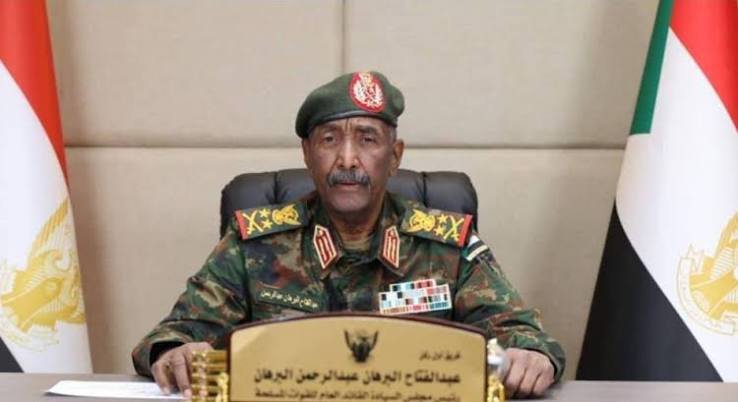
Sudan’s army chief, General Abdel Fattah al-Burhan, has ruled out negotiations with the Rapid Support Forces (RSF), insisting that the military will continue fighting until it regains control of territory held by the paramilitary group.
Al-Burhan made the declaration during a visit to the northern part of Sudan, where he addressed residents and reiterated the army’s commitment to what he described as a military solution to the country’s prolonged conflict.
The military leader said Sudan’s armed forces would press ahead with their campaign until the RSF was removed from all areas under its control. His remarks effectively rejected ongoing calls for the two sides to return to negotiations and pursue a political settlement.
According to reports, al-Burhan said the army intended to reclaim every part of Sudan currently controlled by the RSF. He also maintained that decisions concerning war and peace should be handled through state institutions rather than by individual political or military figures.
Army Pushes Into Conflict Zones
Al-Burhan’s comments come as fighting continues across several parts of Sudan, particularly in Kordofan, Darfur and Blue Nile.
The Sudanese Armed Forces have recently made advances in parts of North Kordofan and are seeking to expand their operations towards areas controlled by the RSF. The paramilitary group, meanwhile, retains significant influence across Darfur and has continued military operations in other parts of the country.
The latest escalation has raised concerns that Sudan’s territorial divisions could become even more entrenched as both sides attempt to consolidate their positions and gain control of strategically important areas.
The conflict began in April 2023 after a power struggle between the army and the RSF, particularly over plans to integrate the paramilitary force into Sudan’s regular military.
More than three years of fighting have devastated the country, with tens of thousands of people killed and roughly 13 million displaced, according to international estimates. The war has also created severe food shortages and a major humanitarian crisis.
Fresh Civilian Casualties Reported
Al-Burhan’s rejection of talks came as violence continued to affect civilians in several regions.
In West Kordofan, a local emergency committee reported that at least 10 civilians were killed in an RSF attack in Abu Ajal village. The group also alleged other violations against residents in the area.
Meanwhile, the International Organization for Migration reported that more than 5,500 people were displaced from villages in Sudan’s Blue Nile state over a three-day period because of worsening security conditions.
The new displacement highlights the continuing humanitarian consequences of the war, even as military operations intensify across the country.
International Pressure for a Ceasefire
Al-Burhan’s latest position also comes shortly after renewed international efforts to bring Sudan’s warring sides back to the negotiating table.
US President Donald Trump’s senior adviser for Arab and African affairs, Massad Boulos, recently met al-Burhan during an engagement in Egypt. Washington has been pushing for a humanitarian ceasefire and a broader political process aimed at ending the conflict.
Boulos has called for an inclusive, Sudanese-led national dialogue that could eventually lead to civilian government.
The United States and other mediators have been attempting to revive diplomatic efforts after previous ceasefire initiatives failed to produce a lasting agreement. However, the Sudanese army has maintained that any settlement must address the RSF’s presence in cities and its military position before meaningful negotiations can take place.
For now, al-Burhan’s latest statement suggests that the military leadership remains committed to battlefield gains rather than an immediate negotiated settlement.
With fighting continuing in Kordofan, Darfur and Blue Nile, the latest development could further complicate international efforts to secure a ceasefire and bring Sudan’s devastating war to an end.