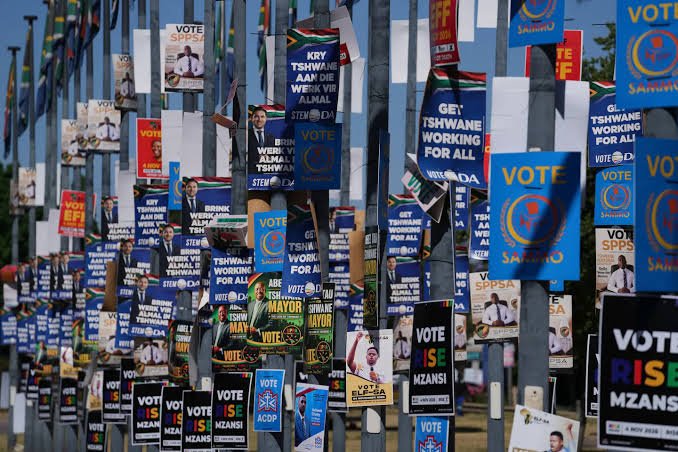
South Africa’s political parties have intensified their campaigns ahead of the November 4, 2026 local government elections, with the ruling African National Congress (ANC) facing growing pressure over declining public confidence and persistent failures in municipal service delivery.
The elections will determine which parties control municipalities across the country, including major economic centres where political instability, deteriorating infrastructure and financial challenges have become major concerns.
For the ANC, the vote represents another important test of its ability to retain political influence after losing its parliamentary majority in the 2024 national election. The party also suffered setbacks in the 2021 municipal elections, when it lost control of several major cities.
This time, opposition parties are hoping to turn public frustration into electoral gains by promising improvements in water supply, electricity, sanitation, road maintenance and local economic development.
The election campaign has also extended beyond municipal issues, with unemployment, crime and illegal immigration featuring prominently in political discussions.
Johannesburg emerges as a major political battleground
Johannesburg is expected to attract particular attention during the elections because of its economic importance and the political uncertainty that has affected its administration.
The city, which is home to nearly five million people and hosts much of South Africa’s corporate headquarters, has experienced repeated changes in political leadership.
Its fragile ANC-led coalition has struggled with accusations of poor financial management, infrastructure deterioration and inconsistent service delivery. Johannesburg has had nine mayors in the past decade, reflecting the difficulties of maintaining stable political arrangements.
Residents in several communities continue to experience burst water pipes, damaged roads, unreliable electricity, broken traffic lights and inadequate waste collection.
These problems have become central to the campaigns of parties seeking to replace the existing administration.
The Democratic Alliance (DA) has selected veteran politician Helen Zille as its mayoral candidate. At 75, Zille has returned to the centre of Johannesburg’s political contest, using an energetic campaign that has included unusual public appearances and direct engagement with residents.
The Economic Freedom Fighters (EFF) has nominated former United Nations special rapporteur on the right to health, Tlaleng Mofokeng, while ActionSA is backing former Johannesburg mayor Herman Mashaba in his attempt to return to the position.
The outcome could determine whether the ANC retains control of the city or whether opposition parties can negotiate a new governing coalition.
Water shortages dominate campaign discussions
Access to clean and reliable water has emerged as one of the most important issues confronting candidates across the country.
The crisis has affected both poorer townships and wealthier neighbourhoods, raising questions about infrastructure investment, municipal planning and accountability.
At a political debate in Pretoria, candidates faced criticism following reports that more than 500 people had received treatment for stomach-related illnesses after consuming contaminated water.
Residents questioned why parties were promising solutions to problems that had continued under successive municipal administrations.
Lesego Moshate, a resident of Mamelodi who attended a town hall debate, expressed frustration over the repeated campaign promises, arguing that the water problem had persisted while different parties participated in governing the city.
Similar complaints have emerged in the Eastern Cape, where residents have blamed inadequate drainage, leaking water infrastructure, blocked sewage systems and poor responses to flooding for worsening living conditions.
ANC provincial leader Oscar Mabuyane has faced criticism during campaign visits, with residents demanding improvements to basic services.
More than 110 students at a university in the province reportedly required medical attention following gastrointestinal illnesses. Mabuyane said an investigation had been initiated to establish whether the cases were connected to water quality.
The concerns underline how local government performance has become a decisive issue for voters, many of whom want practical improvements rather than another round of political promises.
Immigration becomes a major election issue
Illegal immigration has also become a prominent subject during the campaign, particularly as protests and tensions involving foreign nationals have spread across parts of South Africa.
More than 500 soldiers have reportedly been deployed to KwaZulu-Natal following incidents involving violence against foreign-owned businesses and foreign nationals.
Reports also indicate that more than 178,000 foreign nationals have left the country in recent months amid growing pressure surrounding immigration enforcement.
Opposition parties ActionSA and the Patriotic Alliance have made tougher action against illegal immigration a central part of their political messages.
Their campaigns have appealed to voters who associate irregular migration with competition for employment, pressure on public services and rising crime. However, such claims remain politically contested, and immigration status alone does not establish responsibility for criminal activity.
The EFF has faced criticism from some quarters because of its support for greater African integration and fewer restrictions on movement across the continent.
The debate has placed immigration alongside service delivery and unemployment as one of the issues likely to influence voter decisions.
ANC’s national decline adds pressure
The elections come at a difficult period for the ANC, which lost its parliamentary majority in 2024 for the first time since the end of apartheid.
The party subsequently entered a government of national unity with the DA and smaller political organisations.
Although the national coalition has allowed the ANC to remain part of government, its declining electoral support has encouraged opposition parties to challenge its influence at municipal level.
The ANC is now under pressure to convince voters that it can improve local administration and respond more effectively to the problems affecting communities.
Political analyst Sandile Mnguni of the University of KwaZulu-Natal noted that voters often judge local candidates according to their immediate experiences, even when national political developments influence the image of individual parties.
That distinction could become important in areas where candidates are attempting to separate their local records from the performance of their parties nationally.
What the elections mean for South Africa
The November 4 vote will determine the composition of municipal councils. The elected councillors will subsequently participate in choosing mayors who oversee local government administrations and the delivery of essential services.
The elections are therefore particularly important because municipalities have direct responsibilities involving areas such as refuse collection, local roads, sanitation and aspects of water and electricity provision.
For millions of residents, the most important question is whether the next administration can deliver improvements to everyday living conditions.
The ANC will be seeking to prevent further losses, while opposition parties hope to build on public dissatisfaction and strengthen their control of major urban centres.
However, coalition negotiations could again play a decisive role in municipalities where no party secures an outright majority.
Ultimately, the results will provide a clearer indication of how much confidence South Africans still have in the ANC and whether opposition parties can convert their campaign promises into stronger electoral support.
Beyond the political competition, voters will be looking for leaders capable of addressing the practical challenges affecting their communities.