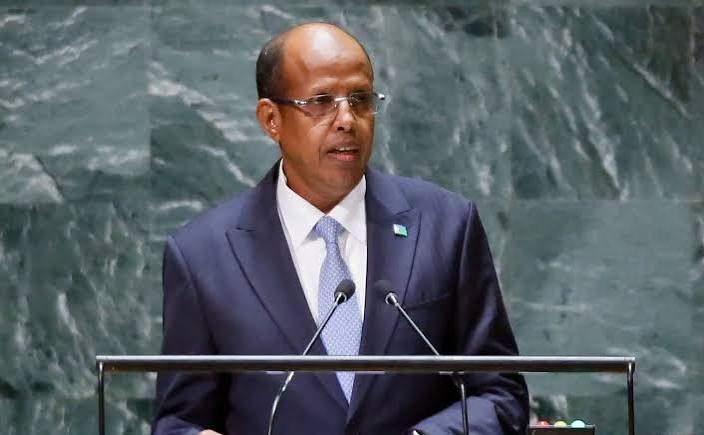
Sudan says it expects the chairperson of the African Union Commission, Mahamoud Ali Youssouf, to visit the country soon as Khartoum pushes for the restoration of its suspended membership of the continental body.
Sudanese Foreign Minister Mohieddin Salim disclosed the expected visit on Wednesday, saying discussions with the AU leadership would focus on removing the suspension and restoring Sudan’s participation in the organisation.
The African Union suspended Sudan following the October 2021 military takeover led by army chief Abdel Fattah al-Burhan. At the time, Burhan described the military intervention as a necessary “course correction.”
Khartoum Wants AU Suspension Reversed
Speaking in a televised interview with Sudan’s state news agency SUNA, Salim said he expected the AU commission chief to travel to Sudan shortly for talks.
The foreign minister has previously criticised the provisions of the AU Peace and Security Council’s charter that provide for the suspension of countries following unconstitutional changes of government.
According to Salim, he had already called on the council in February to reconsider Sudan’s suspension.
Khartoum’s push comes as the country remains engulfed in a devastating conflict between the Sudanese Armed Forces and the paramilitary Rapid Support Forces.
The government believes restoring its position within regional and international institutions would strengthen its diplomatic standing as efforts continue to find a political solution to the war.
Sudan Highlights Its Regional Importance
Salim also pointed to discussions with European officials held on the sidelines of the United Nations General Assembly.
According to the minister, European representatives stressed Sudan’s importance in addressing wider challenges affecting the Horn of Africa and neighbouring countries.
His comments reflect Khartoum’s argument that Sudan should have a stronger role in regional diplomatic efforts because of its geographical position and connections with several countries facing their own security and political challenges.
The minister also called on Washington to reconsider its approach to Sudan, arguing that US engagement with Khartoum has been too slow despite existing communication channels.
Dispute With Washington Grows
Relations between Sudan and the United States have also come under strain.
The disagreement intensified after Washington declined to grant General Abdel Fattah al-Burhan a visa to attend the UN General Assembly.
Reports cited by Sudan Tribune said the United States had linked Burhan’s possible entry to acceptance of a three-month humanitarian truce.
Khartoum has objected to what it views as pressure from foreign governments and has maintained that any settlement to Sudan’s conflict should take account of the country’s own political and security realities.
Government Criticises International Mediation Group
Salim also criticised the international diplomatic grouping known as the Quint.
The group brings together the United Nations, African Union, European Union, Intergovernmental Authority on Development and Arab League.
It has been involved in consultations involving Sudanese political forces and armed groups as part of efforts to establish a path towards a wider political transition.
However, Salim accused the group of excluding the Sudanese government from some of its engagements and argued that its approach does not adequately reflect conditions on the ground.
He said Khartoum remains willing to participate in peace initiatives, but insisted that any eventual settlement must be shaped by Sudanese stakeholders rather than imposed from outside.
Khartoum Sets Conditions for Ending the War
The Sudanese government has also reiterated what it considers necessary steps for ending the conflict.
Salim said these include the disarmament of the RSF, the concentration of its fighters in designated assembly areas and the removal of foreign mercenaries from the country.
He claimed that foreign fighters make up about 60% of RSF ranks, an allegation that is part of the government’s position on the conflict.
The RSF and other parties to the conflict have disputed various accusations made by their opponents, underscoring the difficulty of independently verifying claims emerging from Sudan’s war.
AU Visit Could Open New Diplomatic Channel
The anticipated visit by the African Union Commission chairperson could provide an opportunity for direct discussions between Khartoum and the continental organisation.
For Sudan, the immediate objective is clear: securing an end to its suspension and regaining a formal place within AU institutions.
Whether that happens will depend on the political and security circumstances surrounding the country’s ongoing conflict and the AU’s assessment of Sudan’s governance situation.
The proposed talks also come as international and regional actors continue searching for ways to halt the war, which has created a severe humanitarian crisis and destabilised parts of the wider region.
For now, Khartoum is signalling that it wants a greater role in the diplomatic process and a reassessment of its relationship with both the African Union and Western governments.