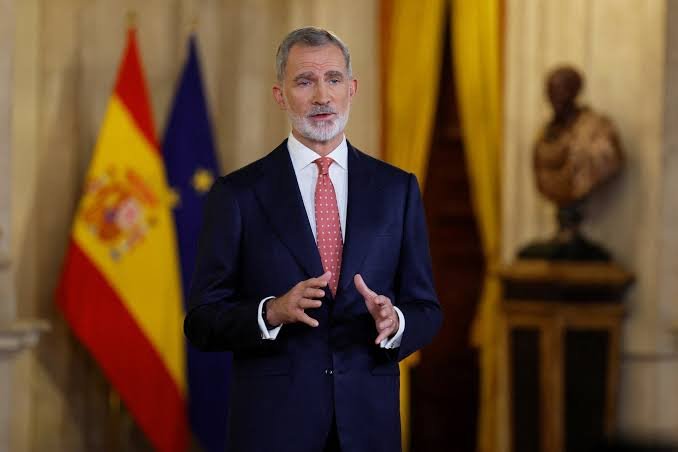
Spain’s King Felipe VI has reaffirmed his country’s claim over the North African territory of Ceuta, calling for stronger trust and cooperation with Morocco following a major migration crisis that has increased tensions between the neighbouring countries.
The monarch visited Ceuta alongside Queen Letizia on Tuesday, October 13, 2026, in a trip intended to demonstrate support for residents dealing with the consequences of a mass movement of migrants across the border from Morocco.
During his address, Felipe stressed that Ceuta forms part of Spain and, consequently, represents a European Union border. He said relations with Morocco should be guided by mutual respect, trust and a shared commitment to regional peace and security.
The visit comes at a sensitive time for relations between Madrid and Rabat, with questions surrounding border management and the disputed status of Ceuta and the nearby Spanish-controlled city of Melilla adding to diplomatic concerns.
Spain Reasserts Its Position on Ceuta
Speaking to representatives of Ceuta’s civil society, King Felipe emphasised that Spain considers the territory an integral part of its national territory and the European Union.
His remarks received strong applause from the audience, while crowds gathered in the city to welcome the royal couple. Residents waved Spanish flags and expressed their support for the monarchy’s visit.
Ceuta, which has approximately 84,000 residents, occupies a strategic position on the northern coast of Africa along the Mediterranean Sea. Although it is geographically surrounded by Morocco and the sea, Spain has controlled the territory for centuries.
Morocco, however, does not recognise Spain’s sovereignty over Ceuta or Melilla and considers both territories part of its own national territory.
The competing claims have remained a longstanding source of sensitivity in relations between the two countries. Royal visits to the cities are particularly significant because they publicly reinforce Spain’s position on their status.
Felipe’s trip is the first visit by a Spanish monarch to Ceuta and Melilla since his father, former King Juan Carlos I, travelled to both cities in 2007. That earlier visit provoked a diplomatic dispute, making the latest royal tour particularly important for observers of Spanish-Moroccan relations.
Mass Migration Puts Pressure on Ceuta
The royal visit follows a major migration emergency in July, when approximately 80,000 people crossed from Morocco into Ceuta, according to reports cited by The Associated Press.
The movement placed significant pressure on local services and triggered wider political debate in Spain over border security, migration management and the government’s relationship with Morocco.
More than 140 people reportedly died during the crossing, while thousands of migrants remained in Ceuta in the weeks that followed. Local authorities have faced challenges managing the continuing presence of migrants, including young people who lack stable accommodation.
The crisis has also increased public frustration among some residents, who believe the city has not received sufficient support from Spain’s central government.
Ceuta’s mayor, Juan Jesús Vivas, welcomed the royal couple and presented the visit as an important gesture of solidarity with the local population.
The continuing migration situation has also become a political issue ahead of Spain’s November 29 general election, with opposition parties criticising the government’s handling of the crisis.
Although most of those who crossed into Ceuta reportedly returned, the number who remain has continued to concern local officials. Estimates have varied, with the mayor previously suggesting that as many as 15,000 people could still be in the territory.
King Calls for Better Relations With Morocco
Despite his firm statement on Ceuta’s status, Felipe also stressed the importance of maintaining constructive relations with Morocco.
The Spanish monarch said cooperation between Madrid, Rabat and the European Union should be based on confidence, respect and a shared interest in maintaining regional stability.
His comments came amid questions about whether Moroccan authorities could have done more to prevent the large number of people from crossing into Ceuta in July.
Spain’s government has defended its communication with Morocco during the crisis, saying that contact between the two countries remained active during the period of heightened tension.
However, some Spanish politicians, police representatives and analysts have questioned whether Moroccan authorities were fully aware of the scale of the movement before it occurred.
These concerns have not established that Morocco directly organised the crossings. The circumstances surrounding the incident remain politically sensitive, with different interpretations of the events continuing to influence public debate.
Morocco has historically objected to Spanish royal visits to Ceuta and Melilla. Its response to the latest trip is therefore an important consideration for observers monitoring the relationship between the two countries.
Spanish Royals Honour Migrants Who Died
Beyond the political message, the royal couple also paid tribute to people who lost their lives during the attempted crossings.
Felipe and Letizia visited Sidi Embarek Cemetery, where dozens of migrants who died during the July events were buried. Some of the victims remained unidentified.
Religious representatives from Ceuta’s Catholic, Muslim, Jewish and Hindu communities accompanied the royals during the visit, reflecting the city’s diverse religious population.
The king expressed sympathy for those who died, describing the loss of life as a tragedy. He also called for migrants who remained in Ceuta to be treated with dignity and respect.
The humanitarian consequences of the crisis have remained a major concern. Some migrants, including minors, have reportedly been living in difficult conditions, while allegations of mistreatment by Spanish soldiers are being investigated by the authorities.
The Spanish government launched an investigation following allegations detailed in an Amnesty International report. The claims remain allegations and should not be treated as established findings before the investigation is concluded.
Visit to Melilla Expected to Continue Diplomatic Debate
After spending time in Ceuta, King Felipe and Queen Letizia are scheduled to travel to Melilla on Wednesday, October 14.
Melilla is Spain’s other North African exclave and shares the same fundamental territorial dispute with Morocco.
The two cities have strategic importance because of their location at the intersection of European and North African migration routes. Their land borders are frequently used by migrants hoping to enter Spanish territory and eventually reach mainland Europe.
The royal tour highlights Spain’s intention to maintain a visible presence in both territories despite the diplomatic sensitivities surrounding them.
For Morocco, the question of sovereignty remains unresolved. For Spain, the government continues to regard Ceuta and Melilla as Spanish cities and part of the European Union.
The latest visit therefore carries significance beyond a ceremonial royal engagement. It comes at a time when migration, territorial claims and regional security are testing the relationship between two neighbouring countries whose cooperation remains important to both sides.
Whether the visit leads to further diplomatic tension or encourages renewed dialogue will depend partly on how Madrid and Rabat manage the disagreements that have emerged from the migration crisis.