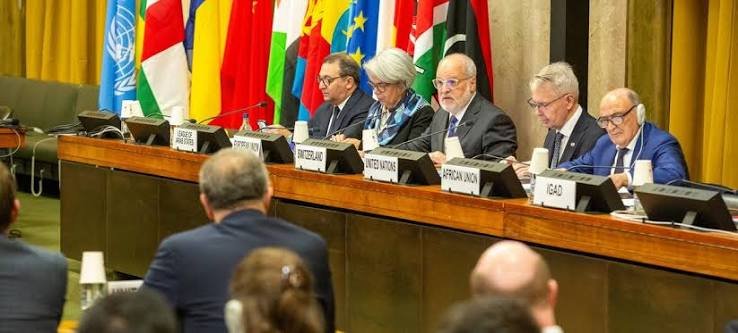
The United Nations and Switzerland have renewed diplomatic efforts to find a path towards peace in Sudan, bringing together representatives of nearly two dozen countries in Geneva to discuss ways of ending the conflict and easing the suffering of millions of civilians.
The meeting, held on Wednesday, October 21, 2026, focused on improving coordination between international peace initiatives, reducing hostilities and laying the groundwork for a political process that could lead to a more stable Sudan.
However, neither the Sudanese Armed Forces nor their rival paramilitary group, the Rapid Support Forces (RSF), was represented at the discussions. Their absence underlined the difficulty facing international mediators as they attempt to coordinate peace efforts without the two principal sides directly participating in the gathering.
The talks marked the sixth round of consultations organised to bring international and regional diplomatic initiatives closer together.
UN Envoy Calls for an End to the Fighting
Pekka Haavisto, the UN secretary-general’s personal envoy for Sudan, urged participants to make ending the war their central priority.
Haavisto said the voices and needs of Sudanese people must remain at the heart of diplomatic efforts, stressing that civilians across Sudan and in neighbouring countries have repeatedly called for the violence to stop.
He encouraged delegates to identify practical steps that could reduce tensions, build confidence between relevant parties and create conditions for a comprehensive ceasefire.
The discussions also considered how a reduction in fighting might open the door to a transitional political process led by Sudanese people. According to the UN envoy, any credible path forward should allow different communities and political perspectives to be represented.
The objective is not simply to pause the fighting but to support a process capable of addressing the country’s political crisis and helping establish lasting peace.
Switzerland Warns of Growing Humanitarian and Regional Risks
Swiss State Secretary for Foreign Affairs Alexandre Fasel warned that the conflict has evolved significantly since fighting began in April 2023.
He highlighted the increasing role of drone attacks, which have added another dangerous dimension to the war and contributed to the threat facing civilians and essential infrastructure.
Fasel also drew attention to severe food shortages and famine-like conditions affecting parts of Darfur, Kordofan and other areas. He argued that the continuing conflict is a major driver of hunger and that protecting civilians cannot be postponed until a political agreement is reached.
The Swiss official further cautioned that the war’s consequences are spreading beyond Sudan’s borders. Regional connections and the possibility of further instability in neighbouring countries have become important concerns for governments involved in the diplomatic process.
His remarks reinforced the need for a coordinated response that addresses both the immediate humanitarian emergency and the wider security implications of the conflict.
Millions of Sudanese Need Urgent Assistance
Sudan continues to face one of the world’s most serious humanitarian emergencies. UN figures cited during the meeting indicate that approximately 34 million people require humanitarian assistance.
The war has killed tens of thousands of people and forced around 11 million from their homes, according to figures reported by Africanews and the Associated Press. Displacement, food insecurity and the destruction of essential services have placed enormous pressure on communities already struggling to survive.
Children have also suffered severe disruption to their education. UNICEF has warned that millions of Sudanese children remain out of school, raising concerns about the long-term consequences for their welfare and the country’s recovery.
Humanitarian organisations face the challenge of reaching vulnerable communities while fighting continues and access to affected areas remains difficult. International officials have therefore stressed that civilian protection and humanitarian access must be treated as urgent priorities.
The crisis has also raised concerns about conflict-related sexual violence and other abuses against civilians, making respect for international humanitarian law a central issue in discussions about Sudan’s future.
International Partners Seek a Common Approach
The Geneva consultations were designed to improve cooperation among countries and organisations involved in attempts to resolve the conflict.
Participants included regional neighbours, major international powers and multilateral institutions working on diplomatic and humanitarian responses. The broader aim was to reduce duplication between separate initiatives and identify opportunities for more effective cooperation.
The discussions also involved consideration of a Sudanese-led political transition. International mediators have argued that any sustainable settlement must reflect the aspirations of Sudan’s population rather than simply impose an arrangement from outside the country.
Regional organisations and governments are particularly important because the conflict has consequences for security, displacement and stability across neighbouring states.
Nevertheless, the absence of representatives from the Sudanese military and the RSF remains a significant obstacle. Diplomatic coordination can help create conditions for negotiations, but a lasting ceasefire will require meaningful engagement from the parties involved in the fighting.
Can the Latest Talks Deliver Peace?
The meeting has renewed international attention on Sudan, but it has not, by itself, produced a confirmed ceasefire or a final political agreement.
The immediate challenge is to translate diplomatic discussions into concrete measures that reduce violence, improve humanitarian access and create space for negotiations. Mediators must also find ways to encourage the warring parties to engage with proposals aimed at ending the conflict.
The UN has emphasised the importance of maintaining regular consultations so participating countries and organisations can review progress, identify obstacles and coordinate their efforts.
With Sudan’s humanitarian needs continuing to grow, international officials face mounting pressure to move beyond statements of concern and support practical action.
For millions of Sudanese civilians, the outcome will ultimately depend on whether diplomatic efforts can help stop the fighting, protect communities and establish a credible route towards a peaceful political future.