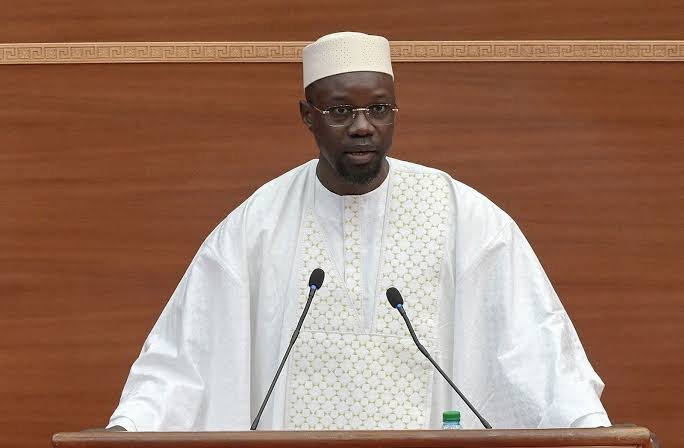
Senegal’s efforts to address its growing public debt have triggered fresh political tensions, with parliamentary leader Ousmane Sonko questioning the government’s decision to use a G20-backed debt mechanism.
Sonko argues that the country’s immediate difficulty is managing cash flow and repayment deadlines rather than reducing the total amount it owes. He has warned that relying on an international framework could make negotiations more complicated and risk creating a standoff between the government and its parliamentary majority.
The dispute comes as Senegal seeks to restore confidence in its public finances after revelations in 2024 that previous borrowing had been substantially underreported. The country is pursuing a financial arrangement with the International Monetary Fund (IMF) while negotiating with official lenders and private creditors.
Sonko, who leads the parliamentary majority, has also threatened that his group could refuse to support the government’s finance bill if the disagreement over the approach to debt management remains unresolved.
Sonko Challenges Senegal’s Use of the G20 Debt Framework
The government intends to use an enhanced version of the G20’s Common Framework, an international mechanism designed to coordinate debt treatment for countries facing financial distress.
The framework brings creditors together to negotiate solutions with governments struggling to meet their financial obligations. However, previous cases, including those involving Zambia and Ghana, have drawn criticism over lengthy negotiations and disagreements about how losses or adjustments should be shared.
Sonko believes Senegal should not have to rely on such a process simply to reorganise its repayment schedule. He has argued that creditors have already indicated they are unwilling to reduce the principal amount owed, making the government’s chosen route questionable in his view.
He also expressed concern about Senegal becoming the first country to test the improved version of the mechanism, saying the country should avoid taking on additional uncertainty while dealing with its existing financial pressures.
His position places the government under pressure to explain how the G20 process will help Senegal meet its obligations without creating further economic or political complications.
Cash-Flow Problems at the Centre of the Dispute
A key part of Sonko’s argument is the distinction between a country’s overall debt burden and its ability to make payments when they fall due.
Debt reprofiling generally involves changing the timing or structure of repayments, such as extending maturities, rather than necessarily reducing the total principal owed. Sonko maintains that Senegal’s immediate problem is liquidity and that a complicated restructuring process may not be the most appropriate response.
The government, however, faces pressure to demonstrate that its debt can be managed sustainably before international financing can fully resume. Creditors and institutions such as the IMF need confidence that Senegal can meet future payments while maintaining a credible budget.
Reuters has reported that Senegal is pursuing a proposed $2.2 billion IMF programme alongside a faster debt-treatment strategy intended to avoid the prolonged negotiations experienced by other countries. The success of that approach will depend on securing sufficient support from the country’s creditors.
The difference between Sonko’s position and the government’s approach reflects a wider policy question: how can Senegal reorganise its obligations without undermining investor confidence or placing excessive pressure on public services?
Disagreement Could Affect the 2027 Budget
The debt dispute has implications beyond negotiations with foreign lenders. It is also becoming a political challenge for the government as it prepares its 2027 finance bill.
Sonko has said his parliamentary group could refuse to vote for the bill if the government’s approach leads to a deadlock. His warning is significant because parliamentary support is essential for advancing the government’s financial plans.
A failure to secure approval could complicate the implementation of spending priorities and deepen uncertainty around the country’s economic programme.
Sonko insists that his position should not be interpreted as an attempt to obstruct the government. Instead, he has placed responsibility for any impasse on the executive, arguing that officials must reconsider their approach.
The disagreement highlights the difficulty of balancing debt repayment with spending on public services and development. Any financing plan will need to address creditors’ concerns while also considering the domestic political and economic consequences of the measures adopted.
How Senegal’s Debt Crisis Developed
Senegal’s current financial difficulties intensified in 2024, when the authorities disclosed borrowing that had not been properly reflected in earlier public accounts. Subsequent assessments substantially increased estimates of the country’s debt burden and raised questions about the reliability of its fiscal reporting.
The revelations damaged confidence in Senegal’s public finances and complicated its relationship with international lenders. The country has since been working to establish a clearer picture of its obligations and develop a plan to put its finances on a more sustainable footing.
The debt problem is substantial. Reuters reported in September 2026 that Senegal’s central government debt stood at approximately 25.2 trillion CFA francs, equivalent to about $44 billion, at the end of 2025. The government’s broader debt figures have also been affected by previously undisclosed liabilities and obligations linked to state-owned enterprises.
Senegal now faces the challenge of managing repayments, addressing outstanding financial commitments and maintaining economic activity while attempting to regain access to international funding.
IMF Support and Creditor Negotiations
Senegal is seeking a proposed $2.2 billion financing programme from the IMF as part of its efforts to stabilise the economy. Reaching a workable debt agreement is an important part of the broader process.
The negotiations involve both official lenders and private bondholders, whose cooperation will be needed to reach an arrangement that the government can sustain.
Dakar has expressed the ambition of reaching an agreement in principle with creditors by December 2026. The United States has also urged Senegal to complete its debt-treatment process within a year, putting additional pressure on the authorities to make progress.
The proposed use of an enhanced G20 framework is being watched closely because it could offer lessons for other countries facing similar financial pressures. If the process delivers a timely agreement, it may demonstrate that international debt negotiations can be conducted more efficiently. If it becomes prolonged or contentious, it could reinforce concerns about the difficulties of resolving sovereign debt crises.
What Happens Next?
The immediate challenge for Senegal is to find a path that satisfies creditors while preserving the government’s ability to finance essential services and support economic activity.
Sonko’s criticism adds a domestic political dimension to negotiations that are already financially complex. His warning over the finance bill means the government must contend not only with lenders and investors but also with questions about parliamentary backing for its economic strategy.
For now, the disagreement centres on whether the G20-backed process is the right way to address Senegal’s repayment pressures. The final outcome will depend on negotiations between the government and creditors, as well as whether political leaders can reach an understanding over the financial measures required.
Senegal’s experience could have implications beyond its borders, particularly for other African economies seeking debt relief while trying to protect development spending. The coming months will be important in determining whether the country can secure an agreement without prolonging financial uncertainty.