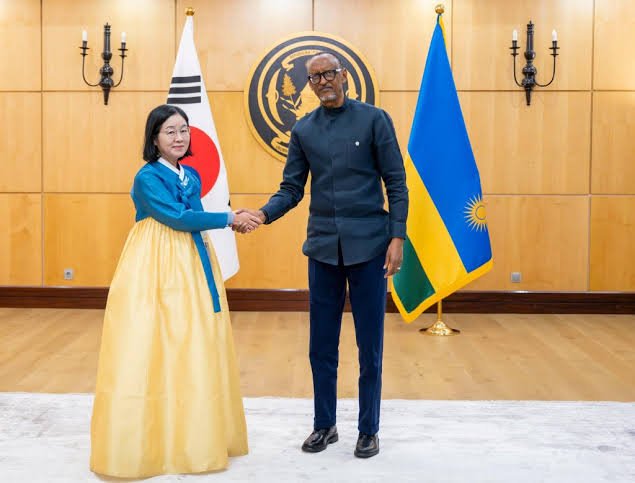
Rwanda is seeking to strengthen its international partnerships after President Paul Kagame received diplomatic representatives from South Africa, Sweden, South Korea, Mauritania and the European Union during a ceremony in Kigali.
The envoys presented their letters of credence on Friday, October 16, 2026, at Village Urugwiro, formally beginning their diplomatic assignments in the country.
During the engagements, the representatives expressed their commitment to expanding cooperation with Rwanda in areas including trade, investment, technology, infrastructure, education and people-to-people exchanges.
The appointments come as Kigali continues to pursue international partnerships aimed at supporting economic development, strengthening diplomatic relations and expanding opportunities for cooperation with countries across Africa, Europe and Asia.
Among the newly accredited diplomats are South Africa’s High Commissioner Tinyiko George Hlungwane, European Union Ambassador Jérémie Blin, South Korea’s Ambassador Huh Jung-ae, Sweden’s Ambassador Henrik Nilsson and Mauritania’s Ambassador El Houssein Ould Nagi.
Although the ceremony was a formal diplomatic event, the envoys outlined several practical areas where their respective countries and institutions hope to develop closer relations with Rwanda.
Rwanda and South Africa Seek to Rebuild Diplomatic Relations
One of the most closely watched appointments is that of Tinyiko George Hlungwane, South Africa’s new High Commissioner to Rwanda.
His arrival comes as the two countries seek to improve relations following years of diplomatic tensions that affected cooperation between Kigali and Pretoria.
Speaking after presenting his credentials, Hlungwane said his priority was to restore relations and take bilateral cooperation beyond the level achieved before the relationship deteriorated.
He noted that both countries had experienced difficult periods in their histories, with South Africa emerging from apartheid and Rwanda rebuilding after the 1994 Genocide against the Tutsi.
According to the high commissioner, these experiences provide a basis for mutual understanding and stronger cooperation.
He also stressed that improved relations could benefit the wider African continent, particularly as countries seek common solutions to international challenges.
South Africa Offers Support for Rwanda’s Formula One Ambitions
Hlungwane also expressed South Africa’s willingness to share its experience as Rwanda prepares for its planned Formula One Grand Prix.
Rwanda has been pursuing plans to bring the prestigious motorsport competition to the country in the early 2030s, an initiative expected to increase its international visibility and support tourism development.
South Africa previously hosted a Formula One race in 1993, giving it experience in motorsport organisation and the infrastructure required to stage major international events.
Hlungwane said his country could help Rwanda through technical expertise, infrastructure knowledge and opportunities for young Rwandans to gain experience through existing motorsport programmes.
He also referenced support expressed by South African President Cyril Ramaphosa for Rwanda’s Formula One ambitions.
The high commissioner described the proposed Grand Prix as an opportunity that could benefit the entire continent rather than Rwanda alone.
Closer cooperation between the two countries could therefore extend beyond diplomacy into tourism, infrastructure, sports development and technical training.
European Union Seeks More Investment Opportunities in Rwanda
The European Union’s newly accredited ambassador to Rwanda, Jérémie Blin, has identified economic cooperation and increased private-sector investment as important priorities.
Following his meeting with Kagame, Blin said the EU intended to build on existing cooperation while exploring additional opportunities to strengthen the partnership.
Areas of interest include healthcare, digitalisation, logistics and mobility, alongside efforts to encourage more European businesses to invest in Rwanda and the wider region.
Greater private-sector participation could support the development of local industries, create employment opportunities and improve access to technology and expertise.
For Rwanda, attracting European investors could help advance its economic ambitions while expanding commercial relationships beyond traditional development cooperation.
The EU’s engagement also provides an opportunity to strengthen business connections between European companies and regional markets in East and Central Africa.
However, converting diplomatic commitments into increased investment will depend on identifying commercially viable projects and establishing partnerships that deliver benefits for businesses and local communities.
Blin’s appointment provides a new diplomatic channel through which Rwanda and the EU can pursue these shared economic interests.
South Korea Prioritises Technology, Education and Skills Development
South Korea’s new ambassador, Huh Jung-ae, is expected to focus on expanding cooperation in technology, education, economic development and infrastructure.
She is the first woman to serve as South Korea’s ambassador to Rwanda, marking a notable development in the country’s diplomatic representation in Kigali.
Huh said Seoul intended to continue supporting Rwanda through development programmes, including initiatives backed by the Economic Development Cooperation Fund, official development assistance and technical cooperation.
The proposed areas of engagement include agricultural productivity, education, digital governance and infrastructure development.
South Korea’s experience in industrialisation and technological advancement could provide useful lessons for Rwanda as it seeks to build a more knowledge-driven economy.
The two countries also have opportunities to strengthen cooperation through scholarships, professional training and exchanges between their populations.
Such programmes could help Rwandan students and professionals acquire technical skills while encouraging closer cultural and educational relationships.
Technology cooperation is particularly relevant as Rwanda continues to invest in digital services, innovation and the development of a modern economy.
Huh’s appointment is expected to provide a platform for advancing these priorities and identifying further opportunities for collaboration.
Sweden Targets Trade Growth and Digital Cooperation
Sweden’s new ambassador to Rwanda, Henrik Nilsson, has identified stronger trade and commercial relations as central objectives of his diplomatic assignment.
Although economic exchanges between the two countries remain relatively limited, Nilsson believes there is considerable room to expand cooperation.
He highlighted digitalisation, electrification and artificial intelligence as areas where Swedish expertise could support Rwanda’s development goals.
Swedish companies already operating in Rwanda, including telecommunications firm Ericsson, provide a foundation on which the two countries could build additional commercial partnerships.
Nilsson said he wanted to strengthen existing business relationships and encourage more Swedish companies to explore opportunities in the Rwandan market.
Potential areas of cooperation include digital infrastructure, technology services and solutions that support economic modernisation.
Expanding trade could also help Rwanda diversify its international business relationships and attract expertise in sectors that require advanced technology.
For Sweden, closer engagement with Rwanda could create opportunities to establish stronger commercial connections in an increasingly important African market.
The ambassador’s priorities therefore extend beyond traditional diplomatic engagement to include practical initiatives that could benefit businesses and support economic development.
Mauritania Also Strengthens Its Diplomatic Presence
Mauritania’s newly accredited ambassador, El Houssein Ould Nagi, was the fifth representative to present credentials to President Kagame during Friday’s ceremony.
His appointment adds another dimension to Rwanda’s diplomatic engagement with African countries.
Relations between the two nations provide opportunities for dialogue on continental issues, cooperation through African institutions and broader efforts to strengthen political and economic connections across the continent.
While the reported ceremony provided limited details about specific new initiatives between Kigali and Nouakchott, the ambassador’s accreditation formally establishes the basis for official diplomatic engagement.
Closer relations could create opportunities to explore shared interests in regional cooperation, economic development and continental integration.
The appointment also reflects Rwanda’s continued engagement with diplomatic partners beyond its immediate neighbourhood.
Rwanda Looks to Turn Diplomatic Engagement Into Practical Results
The arrival of the five envoys comes as Rwanda continues to pursue partnerships that can support its economic ambitions and international engagement.
Each representative brings a different set of priorities, ranging from South Africa’s experience in major sporting events to Sweden’s technology expertise, South Korea’s development cooperation and the European Union’s investment opportunities.
Mauritania’s representation adds to Rwanda’s diplomatic engagement within Africa.
However, the long-term significance of the appointments will depend on whether the commitments made during the diplomatic engagements translate into practical cooperation.
Potential outcomes include increased investment, stronger commercial exchanges, educational opportunities, technology partnerships and improved diplomatic communication.
The proposed Formula One Grand Prix could also provide a platform for cooperation between Rwanda and other African countries, particularly in infrastructure, training and tourism.
For the newly accredited envoys, the next stage will involve working with Rwandan authorities and other stakeholders to identify priorities and develop initiatives that produce tangible results.
The ceremony therefore marks the beginning of a new phase of engagement rather than the conclusion of negotiations on specific projects.
As Rwanda strengthens its international relationships, the ability to convert diplomatic goodwill into sustainable economic and social benefits will remain an important measure of success.