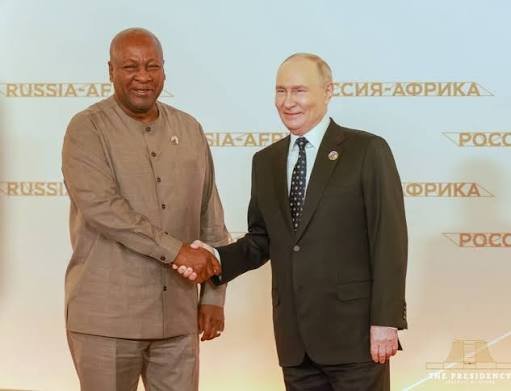
Russian President Vladimir Putin has agreed to stop the recruitment of Ghanaian citizens to participate in the war against Ukraine following diplomatic discussions with Ghanaian President John Dramani Mahama.
Ghana’s Foreign Affairs Minister, Samuel Okudzeto Ablakwa, announced the development after the two leaders met in Moscow on October 30, 2026, during the Third Russia-Africa Summit.
According to Ablakwa, Putin gave an assurance that Ghanaians would no longer be permitted to join the conflict, whether through irregular recruitment arrangements or voluntary enlistment.
The commitment represents an important diplomatic development for Ghana, which has been increasingly concerned about reports of its citizens being recruited to fight alongside Russian forces.
The issue has attracted attention across Africa, with several governments raising concerns about nationals who travelled to Russia under questionable employment arrangements before finding themselves involved in military operations in Ukraine.
Mahama Raises Concerns Over Ghanaian Citizens Fighting in Ukraine
The recruitment of Ghanaians into the Russia-Ukraine conflict has become a major concern for the Mahama administration.
During a visit to Ukraine in February 2026, Foreign Affairs Minister Ablakwa disclosed that approximately 272 Ghanaian nationals were believed to have been recruited to fight for Russia since the war began.
At the time, he said at least 55 Ghanaians had reportedly died, while two others were believed to have been captured.
The figures provided by the minister indicated that recruitment increased significantly over three years. According to the information presented, 17 Ghanaians were recruited in 2023, followed by 53 in 2024 and 202 in 2025.
The situation became more concerning as families struggled to obtain reliable information about relatives who had travelled abroad and subsequently lost contact with them.
During a later diplomatic engagement in August, Ablakwa said the number of Ghanaian deaths had increased to 62, while 15 other citizens were missing.
These developments prompted the government to intensify diplomatic efforts to protect Ghanaians and address the networks allegedly responsible for recruiting them.
Russia Previously Promised to Address Illegal Recruitment
The latest commitment from Putin follows earlier discussions between Ghana and Russia over the recruitment issue.
In August 2026, Ablakwa held talks with Russian Foreign Minister Sergey Lavrov and received assurances that Moscow would work to end illegal recruitment involving Ghanaian citizens.
However, concerns continued over the reported involvement of Ghanaians in the conflict.
Russia has previously maintained that it does not unlawfully recruit African nationals. Its embassy in Ghana has argued that foreign citizens can legally enter military service through voluntary contractual arrangements under Russian law.
Russian officials have also said that cases involving deception, coercion or fraudulent employment arrangements should be treated differently and investigated.
The distinction between voluntary military enlistment and recruitment through alleged fraudulent schemes has remained central to the disagreement.
For Ghana, the priority has been ensuring that citizens are not misled into travelling abroad under false promises of civilian employment before being drawn into military service.
Putin’s Commitment Forms Part of Wider Ghana-Russia Agreements
The recruitment issue was one of several matters discussed during Mahama’s meeting with Putin.
According to Ablakwa, the two presidents secured a series of commitments intended to strengthen relations between Ghana and Russia.
One of the major agreements involves cooperation on a proposed 2,000-megawatt nuclear power plant in Ghana.
The project is expected to support the country’s long-term energy security and provide additional electricity capacity for industrial development. It also revives an ambition associated with Ghana’s first president, Kwame Nkrumah, whose administration explored nuclear energy development before the 1966 coup.
The countries also agreed to deepen defence cooperation through a new pact covering the acquisition of strategic military equipment for the Ghana Armed Forces.
Agriculture was another area covered by the discussions, with both governments expressing interest in cooperation aimed at increasing grain production and improving access to fertilisers.
Russia also agreed to increase scholarship opportunities for Ghanaian students seeking to study at Russian institutions.
Additionally, the two countries plan to reactivate their Permanent Joint Commission for Cooperation, with Moscow expected to host the next meeting in the coming weeks.
The commitments demonstrate that the discussions extended beyond the Ukraine conflict and covered several areas of economic, educational and security cooperation.
Ghana Joins Other African Countries Concerned About Recruitment
Ghana’s concerns form part of a wider African challenge involving citizens who have travelled to Russia and subsequently become involved in the war against Ukraine.
Several African governments have sought information about their nationals, particularly individuals who reportedly signed military contracts after being promised civilian jobs or other employment opportunities.
Kenya and South Africa have been among the countries seeking assistance to bring citizens home, while other governments have raised concerns about nationals who were recruited or captured during the conflict.
A report cited by Bloomberg indicated that Ukraine had identified nearly 46,000 foreign nationals from 151 countries who had signed contracts with the Russian military, including more than 5,000 Africans.
The figures underline the international dimension of the recruitment issue and the difficulties African governments face when trying to establish the circumstances under which their citizens joined foreign military forces.
For Ghana, Putin’s reported commitment could help strengthen efforts to prevent further recruitment and improve protection for citizens considering overseas employment opportunities.
What Putin’s Agreement Means for Ghana
The Russian president’s commitment is an important diplomatic development, but its effectiveness will depend on how it is implemented.
Ghana will need to monitor recruitment activities, strengthen cooperation with Russian authorities and continue investigating suspected fraudulent employment networks.
Public awareness will also be important. Jobseekers should be cautious about overseas employment offers that lack verifiable information about the employer, job responsibilities, visa arrangements and contractual conditions.
The government may also need to provide support for families of missing citizens and continue seeking information about those believed to have been taken to the battlefield.
Although the agreement offers hope that fewer Ghanaians will become involved in the conflict, questions remain about the fate of citizens already serving in Russian forces.
For President Mahama, the outcome of the Moscow meeting provides an opportunity to demonstrate that diplomatic engagement can address concerns affecting Ghanaian citizens abroad.
The coming months will show whether Russia’s commitment translates into a meaningful halt to recruitment and greater cooperation over Ghanaians already caught up in the war.
Ultimately, the government’s objective is to prevent more young citizens from losing their lives in a conflict that is not Ghana’s own.