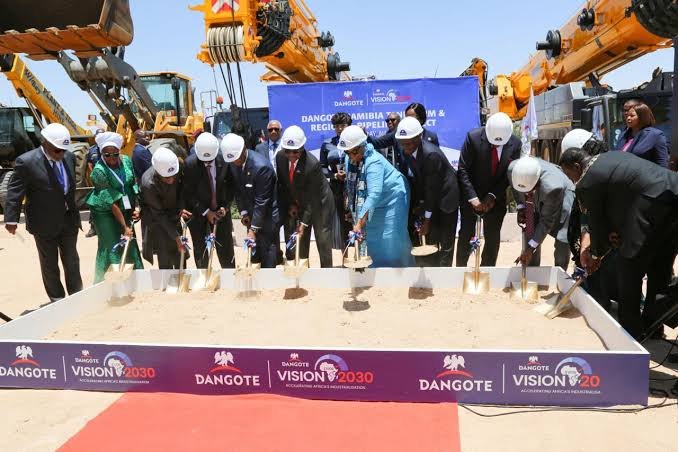
Nigerian billionaire and industrialist Aliko Dangote has launched a major petroleum storage and pipeline project in Namibia, marking another expansion of his investments in Africa’s energy sector.
The $2.5 billion project, located in Walvis Bay, is designed to improve fuel storage, strengthen distribution networks and reduce the cost of transporting petroleum products across Southern Africa.
The launch took place on Wednesday, November 4, 2026, with Namibian President Netumbo Nandi-Ndaitwah in attendance. The project is expected to position Walvis Bay as an important regional centre for the storage and movement of refined petroleum products.
According to reports, the facility will have a storage capacity of approximately 600 million litres, equivalent to around four million barrels of fuel. It will include 360 million litres of diesel storage, while the remaining 240 million litres will be allocated to petrol.
Once completed, the tank farm will have about eight times the capacity of Namibia’s existing 75-million-litre National Oil Storage Facility, operated by the state-owned National Petroleum Corporation of Namibia, commonly known as Namcor.
Dangote said the development would help address some of the challenges affecting fuel supply in Namibia, particularly high transportation expenses, shipping costs and vulnerabilities in the country’s energy distribution system.
He indicated that the project would take between 18 and 20 months to complete.
1,700-kilometre pipeline to connect African markets
A major component of the investment is a proposed regional pipeline network extending approximately 1,700 kilometres from Namibia into neighbouring countries.
The planned infrastructure is expected to connect Walvis Bay with markets in Botswana, Zimbabwe and Zambia, with the possibility of extending the network to the Democratic Republic of Congo.
The pipeline is intended to provide landlocked countries with an alternative route for accessing petroleum products, reducing their dependence on lengthy road transportation and other costly distribution arrangements.
Dangote has presented the project as part of a broader effort to improve energy access and strengthen economic connections between African countries.
For Namibia, the development could make Walvis Bay more important to regional trade by expanding the port’s role beyond conventional shipping and logistics activities.
The country’s location along the Atlantic coast provides a potential entry point for fuel shipments destined for inland Southern African markets.
The project could also help reduce the number of fuel tankers travelling long distances by road, although the extent of these benefits will depend on the pipeline’s final route, construction and operational arrangements.
Namibia targets stronger energy security
Namibia’s participation in the project comes as the government seeks to improve its energy infrastructure and reduce exposure to disruptions in international fuel markets.
Like several African countries, Namibia relies significantly on imported refined petroleum products to meet domestic demand. This makes fuel availability and distribution costs important issues for businesses, households and the wider economy.
The proposed tank farm is expected to provide additional storage capacity, allowing petroleum products to be held closer to regional markets before being distributed to customers.
President Nandi-Ndaitwah welcomed the investment, describing it as an important development for Namibia’s industrial and economic ambitions.
Her administration has also indicated that government institutions will coordinate efforts to support the project’s implementation.
The investment is expected to create opportunities for local contractors, suppliers, transport operators and other businesses involved in construction and petroleum distribution.
There may also be opportunities for Namibian workers to acquire technical experience in storage operations, pipeline maintenance and energy logistics.
However, the actual employment and economic benefits will depend on how much of the project’s construction and long-term operations are handled by local companies and workers.
Dangote expands his African energy ambitions
The Namibia investment forms part of Dangote’s wider strategy to establish a stronger presence in Africa’s petroleum production, storage and distribution markets.
His most prominent energy asset is the Dangote Petroleum Refinery in Nigeria, a major industrial facility with a stated capacity of 700,000 barrels per day.
The refinery has expanded Nigeria’s domestic fuel-processing capacity and created opportunities for the country to export refined petroleum products to international markets.
By investing in storage and distribution infrastructure outside Nigeria, the Dangote Group is seeking to develop additional routes through which its petroleum products can reach customers across the continent.
The Namibian facility could therefore serve as an important distribution point for refined fuel moving into Southern African markets.
The group has also announced plans for other major energy investments in Africa, including a proposed refinery project in Kenya.
Industry analysts say developing storage and pipeline infrastructure could help Dangote diversify the markets for its petroleum products. It could also reduce reliance on traditional export destinations as global energy consumption patterns change.
What the project could mean for Southern Africa
The proposed pipeline and storage facility could influence how petroleum products are transported across parts of Southern Africa.
Countries without direct access to the sea often face additional costs when importing fuel because products must be moved through ports in neighbouring states before being transported overland.
A pipeline connection through Namibia could offer some of these countries another supply route and potentially reduce transportation expenses.
For businesses, lower distribution costs could improve the economics of fuel-dependent activities, including mining, manufacturing, agriculture and road transport.
Nevertheless, the launch does not mean that fuel prices will immediately fall across the region. The final impact will depend on construction costs, operating expenses, supply arrangements, government regulations and movements in international petroleum prices.
The pipeline’s proposed connections must also be developed before its full regional benefits can be realised.
For Dangote, the Namibia project represents a significant step in building an interconnected African energy network. For Namibia, it offers an opportunity to strengthen Walvis Bay’s position as a regional logistics hub while attracting investment into critical infrastructure.
If successfully completed, the development could become an important part of Southern Africa’s petroleum distribution system and deepen commercial links between African markets.