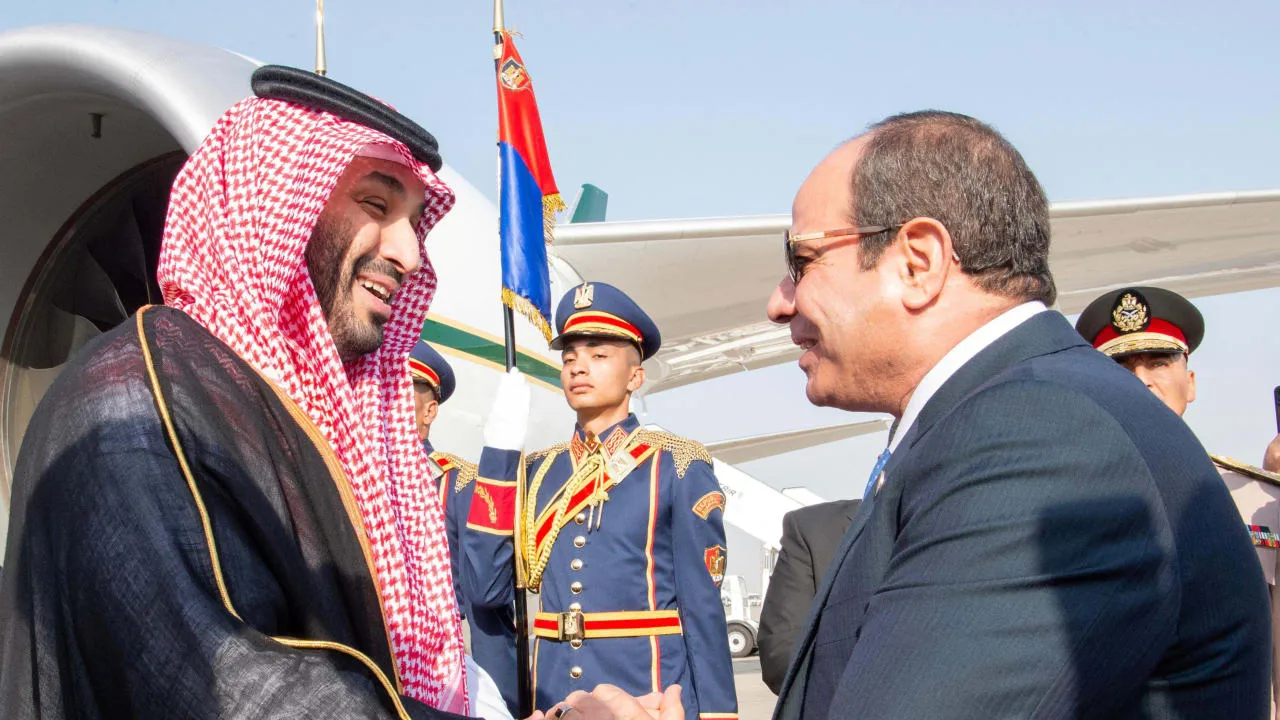
CAIRO — Saudi Crown Prince Mohammed bin Salman and Egyptian President Abdel Fattah al-Sisi have called for uninterrupted and secure maritime traffic through the Red Sea and other strategic waterways amid growing concerns over attacks linked to Yemen’s Houthi movement.
The two leaders made the call during discussions in Cairo on Tuesday, where they examined the security situation around the Bab al-Mandab Strait and its implications for regional trade and energy supplies.
According to Egypt’s presidency, both sides stressed the need to safeguard freedom of navigation through the Bab al-Mandab and the Strait of Hormuz, two major maritime corridors connecting the Middle East with global markets.
Sisi also expressed Egypt’s backing for measures adopted by Saudi Arabia to safeguard its national security and stability, according to the presidency.
The talks come as the Houthis’ growing presence along Yemen’s Red Sea coastline raises fresh concerns for international shipping and the economies of Saudi Arabia and Egypt.
The Bab al-Mandab serves as the southern entrance to the Red Sea and provides access to the Suez Canal, making it particularly important to the movement of goods and energy between Asia and Europe.
Its strategic importance for Riyadh has increased following disruption in the Strait of Hormuz during the wider Middle East conflict. With Gulf shipping routes facing restrictions, Saudi Arabia has increasingly depended on alternative routes through the Red Sea to maintain access to overseas markets.
The security situation deteriorated further last week after the Houthis claimed control of Yemen’s Red Sea coast and the Bab al-Mandab area. The development has heightened fears that commercial vessels and energy shipments could face additional risks along the route.
Since the group announced a naval blockade targeting Saudi Arabia in July, Riyadh has also increased its reliance on Egypt’s infrastructure for moving crude oil.
One of the key alternatives is the Sumed pipeline system. Oil can be moved from Saudi Arabia’s Red Sea port of Yanbu to Ain Sokhna in Egypt before being transported across the country through the pipeline network to Sidi Kerir on the Mediterranean coast.
However, Saudi Arabia’s energy infrastructure has also come under pressure. A drone strike that Riyadh attributed to Iraq recently prompted the closure of the East-West pipeline supplying Yanbu. The disruption contributed to a sharp increase in international oil prices, which moved above $100 a barrel.
Egypt Faces Economic Pressure
For Cairo, the security of the Red Sea is not only a strategic concern but also a major economic issue.
Egypt relies heavily on income generated by the Suez Canal, one of the country’s most important sources of foreign currency. Any prolonged decline in shipping traffic through the waterway could therefore put further pressure on the Egyptian economy.
Suez Canal revenues have already fallen significantly since Houthi attacks on commercial vessels began disrupting shipping in the Red Sea in 2023. The attacks were described by the Houthis as part of their campaign in support of Palestinians during the war between Israel and Hamas in Gaza.
Egypt collected about $4.67 billion from the canal during the 2025/2026 financial year, compared with $8.8 billion in 2022/2023.
Data analysed by AFP from the International Monetary Fund’s PortWatch platform also indicated that the number of vessels passing through the canal each day remains slightly above half the level recorded before the Gaza war.
Egyptian Foreign Minister Badr Abdelatty said last week that the country had suffered approximately $11 billion in losses from the decline in Suez Canal activity.
Analysts say the issue has therefore become increasingly important to both Cairo and Riyadh, whose economic interests are directly connected to the security of the Red Sea.
Mirette Mabrouk of the Washington-based Middle East Institute said the Saudi crown prince could be seeking assurances that Egypt would support efforts to secure the Bab al-Mandab if the situation worsens.
Her comments came after reports in US media that US President Donald Trump had declined a request from Prince Mohammed to become involved in the conflict.
Mabrouk noted that Egypt has traditionally pursued a cautious foreign policy and frequently seeks diplomatic solutions to regional disputes.
She said Cairo would be unlikely to enter a military confrontation unless Egyptian authorities considered such action necessary and believed it could not be avoided.