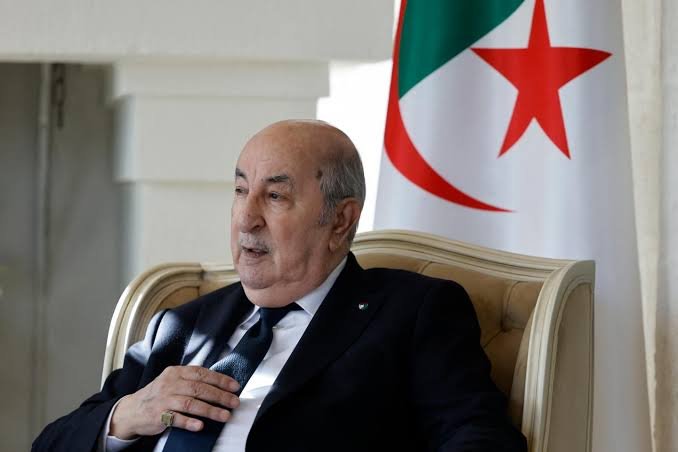
Algeria deployed fighter aircraft to neighbouring Niger during a military mutiny in August after authorities in Niamey requested assistance, Algerian President Abdelmadjid Tebboune has disclosed.
Tebboune said Algeria’s intervention was aimed at helping Niger’s government contain what he described as an attempted coup, revealing details of the operation in excerpts from an interview with local media broadcast on Saturday, October 3, 2026.
The revelation provides further insight into the international response to the unrest that erupted in Niger’s capital, Niamey, at the end of August.
Fighter jets deployed to Niamey
Algeria’s military had previously confirmed that it sent four Sukhoi Su-30 fighter jets to Niger following the unrest.
The aircraft arrived in two patrols at Niamey’s airport, accompanied by an aerial refuelling aircraft. Algeria said the deployment was carried out at the request of Nigerien authorities to support the country’s armed forces in confronting efforts to destabilise the government.
The operation was ordered by Algeria’s Army Chief of Staff, General Said Chengriha, under instructions from President Tebboune.
Algeria presented the deployment as part of its broader security cooperation with Niger and its efforts to support stability in the region.
Mutiny challenged Niger’s military government
The unrest began at a military installation near Diori Hamani International Airport in Niamey before spreading to other strategic locations.
Mutinous soldiers attacked Air Base 101, a key military facility, while fighting and explosions were reported in parts of the capital.
Niger’s government eventually regained control of the facility. The incident represented a significant challenge to General Abdourahamane Tiani, who seized power in the July 2023 coup that removed President Mohamed Bazoum.
The mutiny also exposed continuing tensions within Niger’s armed forces, which have been fighting armed groups affiliated with al-Qaeda and Islamic State in different parts of the country.
Russia also assisted Niger
Algeria was not the only foreign power involved in supporting Niger’s military government during the crisis.
Russian personnel from the Africa Corps, a Kremlin-controlled force that has taken over many of the functions previously associated with the Wagner Group in Africa, also assisted Nigerien forces.
Reuters reported that Russian personnel played a significant role in helping government forces regain control of the military base. Russia subsequently said it would continue supporting Niger in its fight against armed extremist groups.
The involvement of both Algeria and Russia demonstrates the changing pattern of security partnerships in the Sahel following the withdrawal of French and US forces from Niger.
Algeria’s growing security relationship with Niger
Algeria has maintained close relations with Niger, particularly over border security and regional stability.
The two countries share a long border in the Sahara, making developments in Niger an important security concern for Algeria.
By sending military aircraft at the request of Nigerien authorities, Algiers signalled its willingness to provide direct support when instability threatens its neighbour.
The Algerian government said the deployment was also intended to reinforce strategic cooperation between the two countries, particularly in defence and security.
Niger’s Prime Minister Ali Mahamane Lamine Zeine reportedly received the Algerian military mission and expressed appreciation for the support.
Mutiny exposes deeper pressure on Niger’s military
Although the uprising was contained, the incident highlighted the difficulties facing Niger’s military government.
Niger’s armed forces continue to battle jihadist groups operating across the country’s western regions. The persistent insecurity has placed significant pressure on frontline troops and contributed to concerns about morale within the military.
The failed mutiny was followed by changes in Niger’s senior military leadership. In September, the government announced a reshuffle of the armed forces command and appointed General Mamane Sani Kiaou as the new head of the military.
The changes came only weeks after the unrest, underlining the seriousness with which authorities viewed the challenge.
A changing security landscape in the Sahel
The episode also reflects the broader transformation of Niger’s foreign and security relationships since the 2023 coup.
The military government has moved away from traditional Western partners, particularly France and the United States, while strengthening ties with Russia and neighbouring military-led governments in Mali and Burkina Faso.
Niger, Mali and Burkina Faso have also joined together under the Alliance of Sahel States, seeking closer security and political cooperation outside the framework of the Economic Community of West African States.
For Algeria, developments in Niger carry particular importance because of the countries’ geographical proximity and shared security concerns.
Tebboune’s latest comments therefore offer a clearer picture of how Algeria responded when Niger’s military government came under direct internal pressure.
While the mutiny was ultimately contained, the episode demonstrated that Niger’s political stability remains fragile and that its security partnerships are undergoing a major transformation.