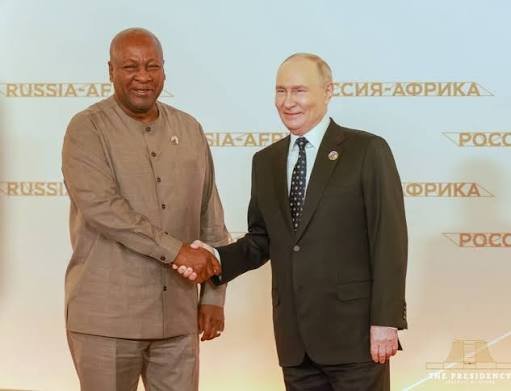
Ghanaian President John Dramani Mahama has called on African countries to become active participants in the development of artificial intelligence (AI), warning that the continent must not remain a passive consumer of technologies created elsewhere.
Mahama made the appeal while addressing the Third Russia-Africa Summit in Moscow, where he encouraged stronger cooperation between African nations and Russia in digital innovation, scientific research and technology development.
He argued that artificial intelligence is already changing how businesses operate, governments deliver services and people access education. According to him, Africa needs the infrastructure, technical expertise and investment required to participate meaningfully in this global transformation.
The Ghanaian leader also proposed the establishment of a Russia-Africa Digital Innovation and Artificial Intelligence Programme to bring together universities, research institutions, businesses and government agencies.
Mahama Identifies Key Sectors for AI Development
Mahama highlighted several areas where artificial intelligence could help address practical challenges across African countries.
These include agriculture, healthcare, education, transport management, municipal administration, tax collection and environmental monitoring.
In agriculture, AI-powered tools could help farmers improve productivity, monitor crops and make better decisions using weather and agricultural data.
In healthcare, the technology could support medical research, improve diagnostic processes and strengthen the delivery of health services, particularly in areas with limited medical resources.
The President also identified education as an important area for investment, noting that digital technologies could support teaching, learning and skills development.
He said cooperation should focus on solutions that respond to Africa’s development priorities rather than simply importing technology without adapting it to local conditions.
Ghana Proposes Russia-Africa Artificial Intelligence Programme
A major part of Mahama’s address was his proposal for a joint digital innovation and artificial intelligence initiative involving Russia and African countries.
The proposed programme would create opportunities for universities, researchers, private businesses and public institutions to work together on technology development.
It could support collaborative research, test pilot projects and provide training to prepare young Africans for emerging opportunities in the digital economy.
The initiative would also encourage technology transfer and stronger links between African expertise and Russia’s scientific and technological institutions.
Mahama said the objective should be to translate international partnerships into practical outcomes that improve people’s lives and strengthen economic development.
President Calls for Stronger Technology and Research Partnerships
Beyond artificial intelligence, Mahama called for closer cooperation between Ghana, Russia and other African countries in scientific research, technical education and skills development.
He pointed to the longstanding educational relationship between Ghana and Russia, recalling that he studied in Moscow on a full scholarship between 1986 and 1988.
The President acknowledged Russia’s historical contribution to the education and professional training of African students, arguing that such relationships could help prepare young people for the changing demands of the global economy.
He encouraged both countries to strengthen cooperation between universities, research institutions and businesses to promote knowledge exchange and develop technical expertise.
The proposed partnerships could also create opportunities for young Africans to acquire specialised skills in science, engineering, computing and other technology-related fields.
Ghana’s Wider Ambition to Become an African AI Hub
Mahama’s comments are consistent with Ghana’s broader ambition to establish itself as an important centre for artificial intelligence development in West Africa.
In April 2026, he launched Ghana’s National Artificial Intelligence Strategy, which aims to encourage local innovation, improve public services and expand the country’s digital economy.
The strategy includes plans for a $250 million national AI computing centre and an additional $20 million to support its short- and medium-term implementation.
It also focuses on developing local expertise, promoting responsible AI use and ensuring that technology reflects Ghana’s cultural and linguistic diversity.
The government has identified agriculture, education, healthcare, finance and public administration as important sectors for AI adoption. Its One Million Coders Programme is another initiative intended to equip young people with digital skills.
Challenges Facing Africa’s AI Ambitions
Despite the opportunities associated with artificial intelligence, African countries face several obstacles that could limit their ability to compete in the global technology industry.
Limited computing infrastructure, unreliable electricity supply, inadequate funding for research and shortages of specialised workers remain important challenges in several markets.
There are also concerns about data protection, cybersecurity, unequal access to digital services and the possibility that AI systems developed elsewhere may not adequately reflect African languages, cultures and social conditions.
Addressing these issues will require investment from governments, private companies, universities and international development partners.
Mahama’s proposal for closer cooperation with Russia could provide another avenue for research and technology exchange. However, the proposed programme is still an initiative to be explored, rather than an established agreement with confirmed funding or implementation arrangements.
Mahama Wants Partnerships to Deliver Practical Results
The Ghanaian President also urged African leaders and their international partners to move beyond diplomatic discussions and focus on cooperation that produces measurable benefits.
He stressed that relationships between countries should create opportunities for businesses, strengthen public institutions and improve living conditions for ordinary citizens.
His remarks at the Moscow summit reflect a wider debate about Africa’s position in the rapidly changing global technology landscape.
As artificial intelligence becomes increasingly important to economic competitiveness, the continent faces the challenge of developing its own talent, infrastructure and research capabilities.
For Ghana and other African countries, the issue is not simply how quickly they can adopt AI tools, but whether they can develop the capacity to influence how those technologies are designed, governed and applied.
Mahama’s proposed Russia-Africa AI initiative is one possible route towards that goal, although its success will depend on whether discussions translate into concrete investments, training opportunities and practical projects.