Sudan has signed an agreement with Suakin Petroleum to finance, construct and operate a specialised marine berth for liquefied natural gas (LNG) carriers in the eastern coastal city of Suakin, in a move aimed at strengthening the country’s energy infrastructure and securing future gas supplies.
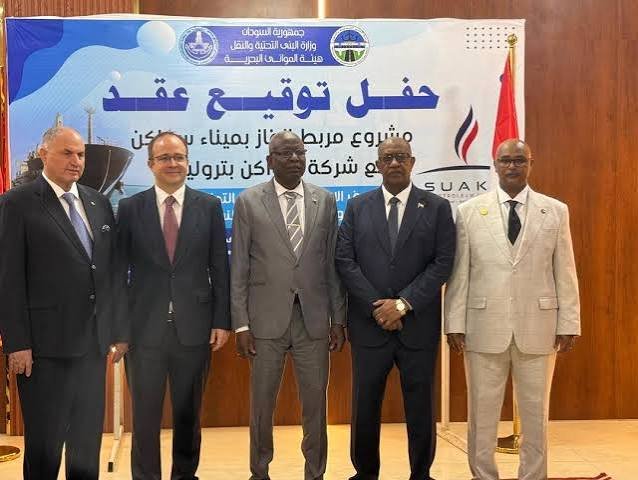
The agreement was signed on Sunday, November 8, 2026, between Sudan’s Sea Ports Corporation and Suakin Petroleum. The project will be implemented under a build-operate-transfer (BOT) arrangement, allowing the company to finance and operate the facility before transferring it in line with the agreed framework.
The proposed development forms part of Sudan’s wider efforts to rebuild critical infrastructure and improve its ability to receive, store and handle energy supplies through its Red Sea ports.
The signing ceremony in Suakin brought together senior Sudanese government officials, representatives of the port authority and Turkish diplomatic and business representatives.
Infrastructure and Transport Minister Saif Al-Nasr Al-Tijani Haroun and Red Sea State Governor Mustafa Mohammed Nour attended the event. Turkish Ambassador to Sudan Fakhri Oba, Sea Ports Corporation Director General Jelani Mohammed Jelani and Suakin Petroleum Chairman Mohammed Darwish Dabbagh were also present.
The project comes as Sudan continues to face major economic and infrastructure challenges amid the ongoing conflict, making energy supply and the rehabilitation of essential facilities important priorities.
Details of the planned LNG facility
According to the Sea Ports Corporation, the marine berth will be designed to accommodate LNG carriers with a capacity of up to 5,000 tonnes.
The facility will have a water depth of 12 metres, allowing specialised vessels to access the berth and discharge their cargo.
A separate storage installation with a capacity of 28,000 tonnes is also planned approximately 150 metres from the marine berth.
The port authority said the project would take 24 months to complete. The agreement followed nearly a year of negotiations between the parties involved.
The infrastructure is expected to strengthen Sudan’s ability to receive LNG shipments and improve the logistics involved in handling and storing the fuel.
However, the authorities have not publicly provided a detailed construction budget, the expected annual LNG import volume or a specific date for the beginning of construction.
Those details will be important in assessing the project’s eventual contribution to Sudan’s domestic energy supply.
Turkish-Sudanese partnership behind the project
Suakin Petroleum is a joint venture involving Turkish company Argaz and Sudanese firm Petrodar.
The agreement represents another example of economic cooperation between Sudan and Turkish business interests, particularly in infrastructure and energy development.
Turkish Ambassador Fakhri Oba said the project would strengthen economic relations between the two countries. He also indicated that Turkish businesspeople were interested in returning to Sudan and exploring investment opportunities.
Sudanese officials welcomed the partnership, presenting the project as part of the country’s efforts to attract investment and rebuild strategic infrastructure.
Minister Haroun described the agreement as an important step in Sudan’s economic recovery and reconstruction process. He said modernising the country’s seaports was essential to strengthening the national economy and making better use of Sudan’s geographical position along the Red Sea.
Red Sea State Governor Mustafa Mohammed Nour also highlighted the potential benefits for the region, including employment opportunities, increased commercial activity and improvements to local infrastructure.
He pledged that the state administration would support the project within the framework of existing investment regulations.
Sudan seeks to improve energy security
The planned LNG berth is intended to improve Sudan’s capacity to secure supplies of liquefied natural gas and strengthen its strategic energy reserves.
LNG is natural gas that has been cooled into liquid form to make it easier to transport and store. It is commonly shipped in specialised vessels and converted back into gas before distribution and consumption.
A dedicated marine berth and storage facility could give Sudan greater flexibility in receiving energy cargoes and managing supplies through its eastern coastline.
The development may also help reduce logistical constraints associated with handling specialised gas shipments, although its wider impact will depend on the availability of supply contracts, distribution infrastructure and adequate financing.
For a country facing serious economic pressures and damage to critical infrastructure, improving access to reliable energy supplies is an important part of longer-term recovery planning.
The government has not yet published a complete plan explaining how the proposed LNG facility will connect with domestic distribution networks or which consumers and industries will receive supplies.
Port infrastructure could serve regional markets
Beyond domestic energy needs, the Sea Ports Corporation believes the new facility could strengthen Sudan’s role in maritime and logistical services across the Red Sea region.
Director General Jelani Mohammed Jelani said modern port infrastructure would improve Sudan’s ability to serve landlocked African countries and other markets around the Red Sea basin.
Landlocked countries depend on neighbouring coastal states for access to international shipping routes. Improved port facilities can therefore create opportunities for transit trade, cargo handling and related commercial services.
The LNG berth could contribute to a wider expansion of port-related activities in eastern Sudan if supported by the necessary transport, storage and distribution connections.
The project also comes amid broader efforts to attract foreign investment into Sudan’s infrastructure sector, despite the uncertainty created by the country’s continuing conflict.
A 24-month construction timeline
The Sea Ports Corporation has indicated that construction is expected to take two years after the project moves into its implementation phase.
The Justice Ministry reviewed and authenticated the contract, according to the port authority, providing a formal legal basis for the agreement.
Nevertheless, the project’s success will depend on more than the signing of the contract. Financing arrangements, construction logistics, security conditions, equipment availability and the completion of supporting infrastructure will all influence the delivery timetable.
Sudan’s government is presenting the Suakin LNG berth as part of a broader effort to restore economic activity and strengthen the country’s strategic infrastructure.
If completed as planned, the facility could improve the country’s ability to handle LNG imports, support energy security and expand the commercial role of its Red Sea ports.
For now, the agreement marks the beginning of a major infrastructure project whose long-term benefits will depend on effective implementation and the country’s wider economic recovery.