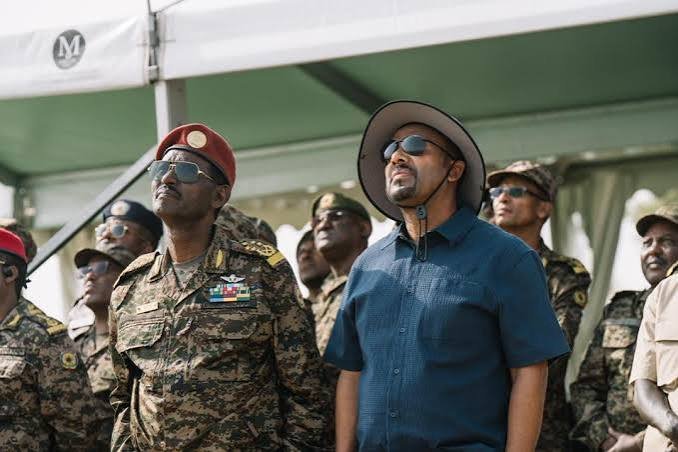
Ethiopian Prime Minister Abiy Ahmed has renewed his government’s determination to secure access to the Red Sea, despite growing tensions with neighbouring countries and renewed fighting in northern Ethiopia.
Abiy made the remarks on Monday, October 5, shortly after taking the oath for another five-year term. He said Ethiopia would continue working to obtain a port through negotiations and arrangements based on mutual benefit.
The issue has become increasingly sensitive as relations between Ethiopia and Eritrea deteriorate and fighting has returned to the Tigray region.
Abiy Says Sea Access Is Essential
Addressing parliament, Abiy argued that Ethiopia’s long-term development and modernisation depend on reliable access to the sea.
The prime minister said his administration would pursue the objective through what he described as a principle of give and take, rather than through territorial expansion.
Ethiopia has been landlocked since 1993, when Eritrea became independent. The loss of its coastline has left Addis Ababa heavily dependent on neighbouring countries, particularly Djibouti, for access to international shipping routes.
Abiy has repeatedly described maritime access as an important economic and strategic priority for Ethiopia, which has one of Africa’s largest populations and a rapidly expanding economy.
Neighbours Reject Any Threat to Coastal Sovereignty
The renewed Ethiopian demand came shortly after Egypt, Eritrea, Somalia and Sudan held a summit in Egypt.
The four countries, all of which have Red Sea coastlines, stressed that responsibility for the Red Sea coastline belongs to the states bordering it. Their position comes amid concerns that Ethiopia’s campaign for maritime access could contribute to greater instability in the Horn of Africa.
The countries also called for political and peaceful approaches to regional disputes, highlighting the need to prevent existing conflicts from developing into a broader confrontation.
Ethiopia, however, maintains that its geographic proximity and historical relationship with the Red Sea give it legitimate interests in discussions concerning the region.
In a statement released Monday, Ethiopia’s Foreign Ministry said the country’s nearest border is only about 30 miles from the Red Sea coast and argued that its interests should be considered in regional maritime discussions. The ministry also reaffirmed Addis Ababa’s preference for dialogue and regional cooperation.
Tensions With Eritrea Have Sharpened
The debate over sea access is taking place against the backdrop of a serious deterioration in Ethiopia-Eritrea relations.
The two neighbours severed diplomatic ties last week after Ethiopia announced the closure of its embassy in Asmara and ordered 10 Eritrean diplomats to leave the country. Eritrea subsequently cut diplomatic relations with Ethiopia.
Their relationship has become increasingly strained over Ethiopia’s maritime ambitions and allegations surrounding the renewed fighting in Tigray. Both countries have accused the other of supporting hostile armed groups.
Eritrea has also expressed concern that Ethiopia could eventually attempt to obtain access to the port of Assab by force, although Abiy has maintained that Ethiopia wants to achieve its maritime objective through peaceful negotiations.
Fighting Returns to Tigray
The Red Sea dispute is unfolding as fighting intensifies in northern Ethiopia.
Federal forces have clashed with fighters linked to the Tigray People’s Liberation Front, with the latest violence representing the most serious escalation since the 2020-2022 war.
Reuters reported that airstrikes and artillery fire were reported in parts of Tigray on Monday, with humanitarian sources reporting deaths in areas around Adwa and Sheraro. Reuters said it could not independently verify responsibility for the reported airstrikes.
Ethiopia has accused Eritrea, Egypt and Sudan of supporting opposition forces, allegations the countries have denied.
The renewed fighting has raised fears that the conflict could spread beyond Ethiopia’s borders, particularly given the country’s deteriorating relationship with Eritrea and the ongoing war in neighbouring Sudan.
Somalia Offers a Possible Alternative
Ethiopia’s search for maritime access is not limited to Eritrea.
Somali President Hassan Sheikh Mohamud has indicated that Somalia would not oppose Ethiopia obtaining access to the Red Sea through Somali territory, but he stressed that any such arrangement would require formal negotiations between the two countries.
Such an agreement could provide Ethiopia with another avenue for expanding its maritime trade without directly challenging Eritrean sovereignty.
However, any future arrangement would have to navigate the complicated political and security relationships linking Ethiopia, Somalia, Eritrea, Egypt and Sudan.
Risk of a Wider Regional Crisis
The combination of Ethiopia’s maritime ambitions, the breakdown in relations with Eritrea and the return of fighting in Tigray has increased concerns about a wider Horn of Africa crisis.
Analysts have warned that renewed conflict could draw neighbouring countries into the confrontation or worsen instability in Sudan, which is already experiencing a devastating civil war.
The strategic importance of the Red Sea adds another layer to the dispute. The waterway is a major international trade route connecting the Indian Ocean with the Suez Canal and Mediterranean markets.
For Ethiopia, gaining a dependable maritime outlet could reduce its reliance on foreign ports and strengthen its economic and strategic position. For coastal states, however, any arrangement must respect their territorial sovereignty and security interests.
Ethiopia Insists on Negotiation
Despite the rising tensions, Abiy’s latest remarks indicate that Ethiopia intends to keep its sea-access campaign at the centre of its national strategy.
The government says it is seeking a mutually beneficial arrangement rather than territory and has repeatedly argued that negotiations should provide Ethiopia with reliable access while respecting the sovereignty of neighbouring states.
The challenge for Addis Ababa will be pursuing that objective while avoiding further escalation at a time when northern Ethiopia is already experiencing renewed conflict.
With relations between Ethiopia and Eritrea at their lowest point in years, the question of Red Sea access is likely to remain one of the most sensitive political and security issues in the Horn of Africa.