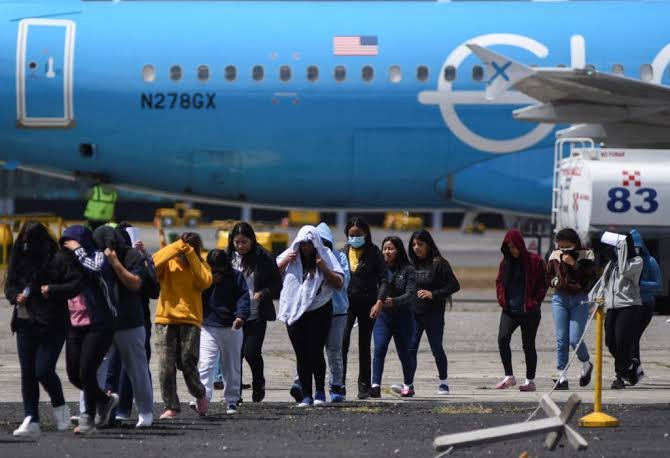
The United States has expanded its controversial immigration deportation programme through agreements involving 14 African countries, raising concerns about the treatment of migrants, the transparency of government deals and the potential consequences for vulnerable families.
Under President Donald Trump’s administration, Washington has increasingly relied on arrangements with countries outside migrants’ places of origin to facilitate the removal of people who cannot easily be deported directly to their home countries.
A report published by Business Insider Africa on October 8, citing monitoring data and other investigations, said the broader network had resulted in more than 25,000 people being transferred to 29 foreign countries, with over $49 million in direct US government funding reportedly linked to the arrangements. The figures highlight the growing international dimension of the administration’s immigration crackdown.
14 African Countries Linked to the Deportation Network
The countries identified in the report are Eswatini, Burundi, Cameroon, Cabo Verde, the Central African Republic, the Democratic Republic of the Congo, Equatorial Guinea, Ghana, Liberia, Libya, Rwanda, Sierra Leone, South Sudan and Uganda.
Under the arrangements, some migrants are transferred to countries with which they have little or no personal connection. Many of those affected are not citizens of the African countries receiving them, making the agreements different from conventional deportations that return people to their countries of nationality.
The arrangements vary from country to country. Some involve formal agreements, while others have been conducted through less transparent diplomatic understandings. The terms governing accommodation, legal status, detention and the possibility of onward removal have also attracted scrutiny.
Human Rights Watch said in a report released on October 8 that the United States had transferred more than 500 people to African countries that were not their countries of origin between January 2025 and August 5, 2026, based on immigration enforcement data.
Although that figure covers a narrower category and period than the broader international deportation total, the report documents cases in which people transferred to African countries faced detention, mistreatment or the risk of being returned to places where they could suffer persecution.
Human Rights Groups Raise Concerns Over Migrant Treatment
The expansion of the programme has drawn criticism from human rights organisations, which argue that migrants should not be transferred to unfamiliar countries without meaningful safeguards.
In its latest investigation, Human Rights Watch interviewed 24 people transferred from the United States to six African countries: Cameroon, the Central African Republic, the Democratic Republic of the Congo, Equatorial Guinea, Eswatini and South Sudan.
Interviewees described being restrained during flights, receiving limited information about their destinations and facing difficulties accessing essential medication, food and water. Some also reported arbitrary detention after arriving in receiving countries. These accounts form part of the organisation’s findings and should be understood as reported experiences rather than a claim that every deportee has faced identical treatment.
The organisation also questioned whether the arrangements provide adequate legal protection for people who fear persecution or torture if they are returned to their countries of origin.
Under the principle of non-refoulement, governments must not send people to places where they face a serious risk of persecution, torture or other prohibited harm. Human Rights Watch argued that some transfers and subsequent removals documented in its investigation raised serious concerns under international human rights law.
The controversy has placed receiving governments under pressure to explain the agreements they have signed, the protections available to transferred migrants and the procedures used to determine whether someone can safely be sent elsewhere.
More Than 25,000 Migrants Transferred to Third Countries
The African arrangements form part of a much broader international programme.
An investigation published in September by Forbidden Stories and a consortium of media organisations found that at least 25,447 people had been transferred from the United States to third countries by August 31, 2026.
The investigation reported that the transfers involved 35 countries, with Mexico receiving the largest share. Other migrants were sent to countries across Africa, Latin America and the Pacific.
The report also estimated that Washington had earmarked approximately $410 million for payments to receiving governments or international organisations involved in facilitating the transfers. That wider funding estimate differs from the more than $49 million in direct funding cited in the Business Insider Africa report, reflecting different categories of expenditure.
The deals differ in their conditions, including which nationalities receiving countries will accept and whether people with criminal convictions can be transferred.
The expansion has prompted questions about how financial assistance, diplomatic negotiations and other incentives may influence governments’ decisions to cooperate with US immigration enforcement.
For African countries, participation can bring diplomatic and financial considerations, but it can also create domestic political pressure over the costs and responsibilities associated with receiving people who have no established ties to the country.
Family Separation Adds to the Immigration Debate
The international deportation arrangements have unfolded alongside a separate controversy over the effects of US immigration enforcement on families living in the country.
Business Insider Africa cited estimates indicating that more than 35,000 children had experienced the deportation of both parents during the second Trump administration. The report said some affected children are US citizens whose parents lack legal immigration status.
Such cases can create difficult situations when parents are removed while their children remain in the United States. Families may have to make urgent decisions about whether children stay with relatives or other caregivers or accompany their parents abroad.
The consequences can include disruption to education, housing instability and financial hardship, particularly when families have limited support networks.
The debate has intensified over whether immigration enforcement is adequately accounting for children’s welfare and whether sufficient arrangements are being made for guardianship and family reunification before parents are deported.
The broader question is how authorities can enforce immigration laws while addressing the needs of children and other vulnerable people affected by those decisions.
African Governments Face Pressure to Explain Their Agreements
The growing number of countries involved has increased scrutiny of African governments that have agreed to receive migrants from the United States.
Critics argue that arrangements should be made public and should clearly establish the legal rights of transferred people, including access to lawyers, asylum procedures and independent monitoring of detention facilities.
Human Rights Watch has called on governments to suspend or end arrangements that expose people to serious human rights violations. It has also urged authorities to ensure that transferred migrants are not detained without a clear legal basis or sent onward to places where they could face persecution or torture.
However, the precise terms and implementation of the arrangements differ among participating countries. Some governments have publicly acknowledged cooperation with Washington, while information about other agreements remains limited.
That lack of transparency makes it difficult for citizens and independent observers to assess the financial terms, the responsibilities assumed by receiving countries and the protections offered to migrants.
A Growing Test for US-Africa Relations
The deportation programme is becoming an increasingly important issue in relations between Washington and African capitals.
For the Trump administration, third-country transfers provide another mechanism for carrying out its immigration enforcement agenda when direct removal to a migrant’s country of origin is difficult.
For receiving countries, the agreements raise questions about national sovereignty, diplomatic priorities, public resources and responsibility for people who arrive without established connections to local communities.
Human rights organisations say the central issue is whether immigration cooperation can operate without exposing migrants to arbitrary detention, mistreatment or the danger of being returned to places where they face serious harm.
As more information emerges about the agreements, African governments are likely to face continued calls to explain their participation and demonstrate that appropriate safeguards are in place.
The controversy also highlights a wider challenge for international migration policy: governments may cooperate on deportations, but their agreements do not remove their legal and humanitarian responsibilities toward the people affected.