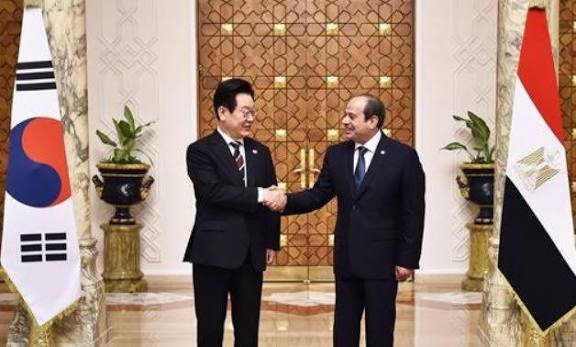
Egypt and South Korea have agreed to upgrade their bilateral relations to a strategic partnership, opening a new chapter of cooperation in trade, investment, defence, technology, energy and infrastructure.
The agreement was announced during Egyptian President Abdel Fattah El-Sisi’s state visit to Seoul, where he held talks with South Korean President Lee Jae Myung on Thursday, October 8.
The two leaders also witnessed the signing of several agreements and memoranda of understanding designed to expand cooperation between the two countries across a range of sectors.
The new partnership represents a significant development in relations between Cairo and Seoul, which formally established diplomatic ties in 1995. The latest summit followed President Lee’s visit to Egypt in November 2025 and El-Sisi’s first trip to South Korea since 2016.
Trade and Investment at the Centre of New Partnership
Economic cooperation featured prominently during the discussions, with both governments seeking to increase trade and attract greater investment.
Egypt and South Korea officially agreed to begin negotiations on a Comprehensive Economic Partnership Agreement (CEPA). Such an agreement is expected to provide a broader framework for trade, investment and economic cooperation between the two economies.
El-Sisi also called for stronger South Korean investment in Egypt, particularly in industries that Cairo considers important to its plans for economic development and industrial localisation.
Among the sectors highlighted were automotive manufacturing, electronics, petrochemicals, renewable energy and other advanced industries.
The Egyptian president also expressed interest in increasing access for Egyptian products to the South Korean market.
Egypt Promotes Suez Canal Economic Zone
Egypt’s geographical position was another important element of the partnership.
Cairo views itself as a strategic gateway linking Africa, the Middle East, Europe and international shipping routes. The Egyptian government wants to use this position to attract more Asian investment and establish production facilities that can serve regional and global markets.
Under the new partnership, Egypt and South Korea agreed to explore greater cooperation involving the Suez Canal Economic Zone, including industrial development and the localisation of manufacturing.
South Korean companies are already active in Egypt, and Cairo is seeking to expand that presence as part of its broader strategy to turn the country into a manufacturing and logistics hub.
El-Sisi had also met representatives of major South Korean companies during his visit and renewed Egypt’s invitation for Korean businesses to establish an integrated industrial zone in the Suez Canal Economic Zone.
Technology and Energy Cooperation
Technology is another major component of the upgraded relationship.
The two countries agreed to deepen cooperation in advanced technology, artificial intelligence and other emerging sectors.
They also identified clean energy and power infrastructure as areas where South Korean expertise could contribute to Egypt’s development plans.
The focus on technology and energy reflects Cairo’s efforts to diversify its economy while increasing investment in sectors capable of creating jobs, boosting exports and strengthening domestic production.
For Seoul, Egypt offers access to one of Africa and the Middle East’s most strategically important markets.
Defence Cooperation to Expand
Defence cooperation is also expected to form part of the new strategic relationship.
The two governments welcomed existing collaboration in the defence industry and agreed to pursue additional opportunities.
South Korean and Egyptian officials pointed to their cooperation on the K9 self-propelled howitzer as an example of defence-industrial collaboration that could provide a foundation for future projects.
The agreement comes as both countries seek to strengthen their broader strategic ties, moving beyond traditional diplomatic relations toward closer cooperation in industries considered important to national security and economic development.
Education and Cultural Exchange
The strategic partnership is not limited to government and business.
Egypt and South Korea also agreed to strengthen cultural and educational exchanges, including scholarships, Korean-language programmes and youth training.
Both sides also intend to expand technical and vocational education in Egypt, with programmes designed to respond more closely to labour-market requirements.
The countries have designated 2027 as the Year of Cultural Exchanges, a move expected to encourage greater interaction between their populations and institutions.
Cooperation on Regional Issues
The Seoul discussions also covered major international and regional issues.
Egypt and South Korea agreed to maintain dialogue on developments in the Middle East and Korean Peninsula, while also discussing issues involving Palestine, the Horn of Africa, Yemen, Libya, water security and freedom of navigation.
El-Sisi reiterated Egypt’s support for a two-state solution to the Israeli-Palestinian conflict and called for the establishment of an independent Palestinian state with East Jerusalem as its capital.
He also expressed Egypt’s opposition to the displacement of Palestinians and welcomed South Korea’s future participation in the reconstruction of Gaza.
The Egyptian president additionally highlighted the importance of Red Sea security and maintained that responsibility for the security and governance of the waterway should remain with its coastal states.
Nile Water Issue Also Raised
El-Sisi used the Seoul meeting to reiterate Egypt’s position on Nile water security.
He described the Nile as fundamental to Egypt’s population and said Cairo would continue to oppose unilateral actions that it believes could affect its water interests.
The issue remains a major component of Egypt’s regional diplomacy, particularly amid longstanding disagreements over water management in the Nile Basin.
A New Phase in Egypt-South Korea Relations
The strategic partnership marks an important expansion of ties between Egypt and South Korea.
For Cairo, the agreement fits into President El-Sisi’s broader policy of maintaining diversified international relationships while attracting investment, technology and industrial expertise from major economies.
For Seoul, Egypt’s position as a major African and Middle Eastern economy, as well as its role in global logistics and the Suez Canal, makes it an important partner.
South Korean officials have described Egypt as a key logistical hub connecting Europe, Africa and the Middle East, while Seoul has also highlighted Cairo’s importance to its engagement with both Africa and the Middle East.
The two governments are now expected to translate the new political commitment into practical projects covering trade, manufacturing, infrastructure, defence, energy and technology.
If implemented successfully, the strategic partnership could significantly deepen economic ties between the two countries and give Egyptian-South Korean relations a much broader regional and commercial dimension.