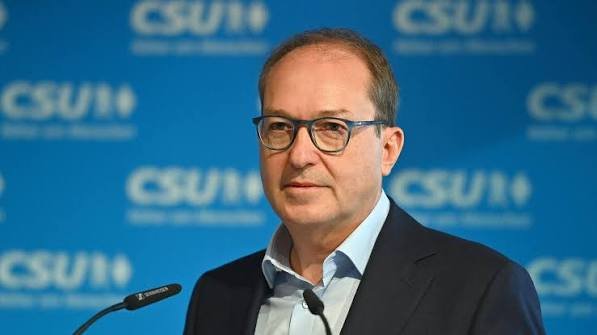
Germany’s Interior Minister Alexander Dobrindt has called for a faster European process for deporting people following large-scale irregular border crossings, citing the recent influx of migrants into Spain’s North African territory of Ceuta as an example.
Dobrindt made the proposal on Saturday, September 26, during a meeting with European Union counterparts in Munich, where migration management and border protection were among the issues under discussion.
The German minister argued that Europe needs a new mechanism capable of responding more quickly when unusually large numbers of people cross external EU borders.
Germany wants new EU migration mechanism
Dobrindt said exceptional migration situations had occurred repeatedly along the European Union’s external borders and called for a coordinated response from member states.
His proposal comes as European governments continue to debate how to manage irregular migration, asylum applications and the return of people who do not have permission to remain in EU countries.
The German government has increasingly advocated stronger cooperation between European countries on border controls and deportations.
According to Germany’s parliament, the government is also working with other EU countries on plans for so-called return hubs in third countries, although discussions with potential partner countries are still ongoing.
More than 72,000 people entered Ceuta
The immediate example cited by Dobrindt was the situation in Ceuta, a small Spanish territory on the North African coast bordering Morocco.
More than 72,000 people entered Ceuta from Morocco at the end of July, according to the Reuters report. Most of those who crossed subsequently left the territory, while Spanish authorities estimated that around 12,000 migrants remained, including minors.
The scale of the movement placed significant pressure on local authorities and renewed discussion about how European countries should respond to sudden increases in migration.
Ceuta and Spain’s other North African territory, Melilla, have long been focal points in Europe’s migration debate because of their land borders with Morocco.
Germany seeks quicker deportation procedures
Dobrindt’s proposal centres on establishing procedures that would allow authorities to deal with mass border crossings more rapidly.
The German minister has previously supported stronger European cooperation on returns and external border management.
Earlier this month, Germany and several other EU countries agreed to work towards arrangements for return centres outside Europe. Germany, Denmark, Austria, the Netherlands and Greece were among the countries involved in those discussions.
The German parliament has said the government is currently holding preliminary discussions with possible partner countries regarding the establishment of such centres.
Return hubs remain under discussion
The proposed return hubs are intended to provide locations outside the EU where people who are required to leave Europe could be processed before being returned to their countries of origin.
Germany’s government has said the legal basis for such centres is expected to emerge from the implementation of the EU’s new return regulations.
However, practical details—including which countries could host the centres and how they would operate—remain under discussion.
The issue is politically sensitive because deportation procedures involve questions about asylum rights, legal appeals and protections for vulnerable people.
Wider European migration debate
The Munich meeting reflects a broader effort by European governments to coordinate migration policies.
Germany has maintained temporary controls at its land borders and has also supported measures aimed at increasing the number of people returned after unsuccessful asylum applications.
The German government has said that people with serious criminal convictions should be subject to rapid returns, while recognising that vulnerable groups require particular consideration.
The EU’s migration policy remains a major issue for member states as they balance border management with asylum obligations and humanitarian considerations.
What happens next?
Dobrindt’s proposal will require cooperation from other EU governments if it is to become a broader European mechanism.
The discussion in Munich is expected to focus on how countries can coordinate border controls, asylum procedures and returns while operating within European and international law.
For African countries, developments in Europe’s migration policy are particularly significant because many African nationals travel to Europe through routes across North Africa and the Mediterranean.
Any changes to EU deportation procedures, border controls or return arrangements could therefore affect migrants, asylum seekers and governments on both sides of the Mediterranean.
For now, Germany is calling for a faster and more coordinated European response to large-scale border movements, with the Ceuta migration influx serving as a recent example of the challenges facing the EU.