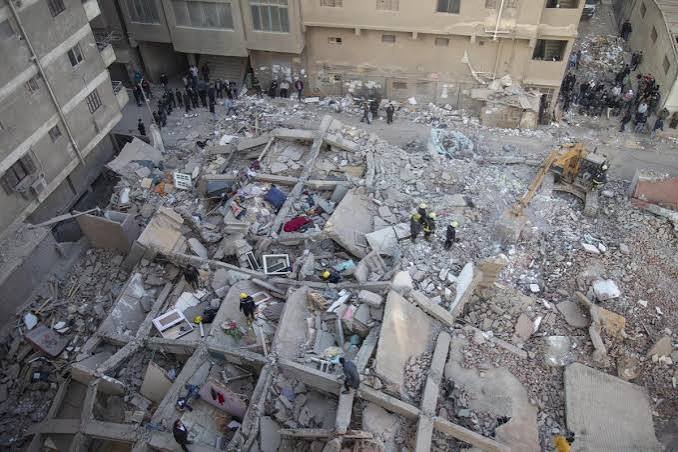
At least six people, including three children, have died after a five-storey residential building collapsed in Cairo, Egypt, prompting an emergency response and renewed concerns about the safety of ageing residential structures.
The building came down in the Hadayek El-Qobba district of the Egyptian capital on Tuesday, October 13, 2026. Emergency workers spent hours clearing debris and searching for people who might have been trapped beneath the remains of the structure.
Authorities confirmed that six people had died and several others had been taken to hospital with injuries. Reports from Egyptian media said seven injured people were transported to Al-Zaitoun Hospital, while other reports initially gave a slightly different number. Rescue operations continued as officials worked to establish the full circumstances surrounding the disaster.
The incident has drawn attention to the risks associated with older residential buildings in Egypt, where structural deterioration, unauthorised construction and inadequate maintenance have raised safety concerns in some communities.
Rescue Workers Recover Victims From the Debris
Civil defence personnel, ambulance crews, police officers and local government officials were dispatched to the scene after authorities received reports of the collapse.
Rescuers worked through the rubble to locate victims and determine whether anyone else remained trapped. The operation required careful coordination because damaged sections of the building and debris could pose additional risks to emergency personnel.
Among those who died were three children, according to Egyptian media reports. The loss of young lives has added to the tragedy for families affected by the collapse.
Cairo Governor Ibrahim Saber and senior security officials monitored the emergency response, while local authorities coordinated rescue efforts and measures to protect nearby residents.
Officials said the search would continue until they could establish whether anyone remained beneath the wreckage.
The incident has also highlighted the difficult work faced by emergency teams responding to building collapses in densely populated urban areas, where nearby structures and narrow streets can complicate access to disaster sites.
Authorities Identify Building as an Old Structure
According to Cairo Governorate, the collapsed property was an ageing building constructed in the 1950s. It consisted of a ground floor and four upper floors, with load-bearing walls supporting the structure.
The building’s age has raised questions about its structural condition, but authorities have not established the definitive cause of the collapse.
Investigators will need to examine the building’s condition, construction history and any available records to determine what led to the disaster. Until that investigation is completed, it would be premature to attribute the collapse to a particular structural defect or regulatory failure.
Building safety remains an important issue in Cairo, a densely populated city where many residents live in older residential properties. Regular structural inspections and timely repairs are essential to identifying potential hazards before they lead to a disaster.
The investigation into this incident could provide further information about whether the building had previously been identified as unsafe and whether any remedial measures had been recommended.
Neighbouring Buildings Evacuated as Precaution
Following the collapse, authorities ordered the evacuation of nearby buildings as a safety measure.
Officials also began installing temporary steel supports to help stabilise neighbouring structures while specialists assessed the surrounding area. The measures were intended to reduce risks to residents, pedestrians and property during the emergency response.
The precautionary evacuations may cause additional disruption for families living near the collapsed property, some of whom could face uncertainty over when they will be allowed to return home.
Engineering assessments will be important in determining whether adjacent buildings have sustained damage or present further safety risks.
Authorities must balance the need to remove debris and restore normal activity with the importance of ensuring that the surrounding structures are safe.
The Egyptian Red Crescent also sent emergency response teams to assist at the scene. Its personnel supported the wider response and provided psychological first aid to people affected by the incident.
Investigation Launched Into the Cause of the Collapse
Egyptian authorities have initiated legal proceedings and are investigating the circumstances that led to the building’s collapse.
The investigation is expected to help establish what happened and whether any individuals or organisations may bear responsibility. Officials have also indicated that further examinations of the site will be needed before the remaining debris can be cleared.
A thorough investigation will be important not only for determining accountability but also for identifying any safety concerns that could affect other buildings in the neighbourhood.
Authorities have not yet confirmed the final cause of the collapse, and the investigation remains a key part of the response.
Building Safety Remains a Concern in Egypt
The Cairo disaster has renewed attention to the dangers posed by unsafe residential buildings.
Building collapses have occurred in Egypt over the years, with concerns often focusing on deteriorating structures, unauthorised construction, poor maintenance and weaknesses in the enforcement of building regulations.
Older properties may become increasingly vulnerable when structural problems are not identified and repaired. Unapproved alterations or additional floors can also create risks if a building is not designed to support the extra weight.
However, the specific circumstances of the Hadayek El-Qobba collapse must be established through the ongoing investigation rather than assumed from previous incidents.
Effective enforcement of construction standards, regular engineering assessments and action against buildings found to be dangerous can help reduce the risk of similar tragedies.
The challenge for authorities is to identify unsafe properties before lives are lost while ensuring that residents have access to secure housing.
Conclusion
The collapse of the five-storey building in Cairo has left at least six people dead, including three children, while several others were injured.
Emergency crews worked to recover victims and search the debris, while authorities evacuated neighbouring buildings and installed temporary supports as a precaution.
Investigators are now working to establish what caused the structure to collapse and whether any safety failures contributed to the disaster.
The tragedy has once again highlighted the importance of maintaining ageing residential buildings and enforcing safety regulations in densely populated urban areas.
As the investigation continues, the priority remains supporting affected families, ensuring nearby properties are safe and establishing the circumstances behind the deadly collapse.