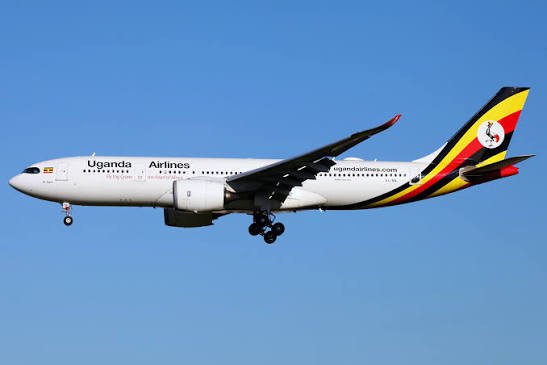
Uganda Airlines is facing growing regulatory challenges as it seeks to expand its operations across Africa, with restrictions on international traffic rights limiting its ability to tap into lucrative regional passenger markets.
The national carrier’s expansion ambitions have encountered difficulties in Nigeria and South Africa, where aviation authorities have reportedly declined requests for permission to transport passengers between foreign destinations as part of flights connecting through Uganda.
The dispute centres on Uganda’s position outside the Single African Air Transport Market (SAATM), an African Union-backed initiative designed to liberalise air travel across the continent and make it easier for airlines to operate between participating countries.
For Uganda Airlines, the restrictions represent a commercial setback at a time when management is seeking to strengthen its regional network, increase passenger numbers and establish Entebbe as a major connecting hub.
Nigeria blocks proposed Accra-Lagos passenger service
One of the most immediate challenges concerns Uganda Airlines’ planned operations between Accra in Ghana and Lagos in Nigeria.
The airline had secured approval from Ghanaian aviation authorities to carry passengers and cargo between the two West African cities. However, Nigeria has yet to grant the corresponding authorisation needed to operate the service.
Uganda Airlines Chief Executive Officer Girma Wake confirmed that the carrier was negotiating with Nigerian authorities to resolve the disagreement.
According to Wake, Nigeria’s position is linked to Uganda’s failure to participate in SAATM. Without the necessary approval from both countries, Uganda Airlines cannot exercise the fifth-freedom rights granted by Ghana.
These rights allow an airline to transport passengers or cargo between two foreign countries as part of a journey that begins or ends in its home country.
For example, Uganda Airlines could carry passengers from Entebbe to Lagos and then onward to Accra, while also selling tickets to travellers whose journeys begin in Lagos and end in Accra.
The arrangement would provide an additional source of revenue beyond passengers travelling directly to or from Uganda.
The airline launched its Entebbe-Lagos-Accra service on October 27, 2026, operating four times weekly. The combined route is intended to build passenger demand before the carrier considers operating the two destinations independently.
South Africa presents another regulatory challenge
Uganda Airlines is encountering a similar problem in Southern Africa.
The carrier reportedly received approval from Zimbabwe to transport passengers between Harare and Johannesburg. However, South African authorities have not granted the necessary permission.
The situation highlights the difficulties airlines from countries outside SAATM can encounter when attempting to access commercial opportunities in markets where participating states support a more liberalised aviation framework.
Nigeria and South Africa are important aviation markets, making access to their domestic and regional passenger traffic commercially significant for airlines seeking to expand across the continent.
For Uganda Airlines, the restrictions could limit its ability to build connecting routes, improve aircraft utilisation and compete for passengers travelling between major African cities.
What SAATM means for African aviation
The Single African Air Transport Market was established under the African Union’s Agenda 2063 development framework.
Its broader objective is to remove unnecessary restrictions on air transport, encourage competition, improve connectivity and strengthen trade and tourism between African countries.
The initiative builds on the principles of the 1999 Yamoussoukro Decision, which sought to liberalise air services across the continent.
Greater participation is expected to give African airlines more opportunities to operate regional routes without facing the same level of restrictions associated with traditional bilateral air service agreements.
However, countries that have not joined or fully implemented the framework may continue to depend on existing bilateral arrangements when negotiating access to other markets.
Uganda’s position has therefore become a concern for its national airline. Although the country previously maintained that staying outside the arrangement would help protect its domestic aviation industry, the strategy is now creating difficulties for the carrier as it attempts to expand internationally.
Wake has indicated that Uganda is working with relevant government institutions to address the issue and move towards participation in the continental aviation framework.
Revenue ambitions remain ambitious
The regulatory difficulties come as Uganda Airlines pursues significant financial and operational targets.
The carrier is targeting annual revenue of between $400 million and $500 million by 2030. Management also aims to reach break-even by 2031 before moving towards sustained profitability.
Achieving those objectives will require higher passenger numbers, stronger cargo operations and a wider network of regional and international destinations.
The airline is pursuing annual passenger growth of between 12 and 15 per cent, while also looking to increase revenue from cargo and other aviation-related services.
However, the inability to secure fifth-freedom traffic rights in important markets could make some planned routes less commercially attractive.
Access to passengers travelling between foreign destinations would allow the airline to fill more seats and generate additional income from aircraft already operating through Entebbe.
Building regional routes before expanding internationally
Uganda Airlines is also adopting a gradual approach to network expansion.
Management wants to establish more African destinations that can feed passengers into its longer international services.
Kigali is among the destinations identified for expansion, while additional connections across East and Southern Africa are expected to strengthen Entebbe’s position as a regional hub.
The airline believes that a broader African network would help attract passengers travelling to destinations outside the continent.
A potential China service, for instance, would require substantial passenger demand and at least three wide-body aircraft to support the operation.
Rather than introduce expensive long-haul routes without sufficient traffic, the carrier intends to develop its regional network first.
But that strategy depends partly on securing the regulatory approvals needed to transport passengers across key African markets.
Aircraft availability adds to expansion pressure
Beyond the regulatory difficulties, Uganda Airlines must also address limitations involving its fleet.
The airline has six aircraft in its existing fleet, but two have been grounded, leaving only four available for operations, according to Wake’s account reported by Uganda’s Daily Monitor.
The shortage has forced the carrier to rely on leased aircraft to maintain services and support its expansion plans.
Management has been working to extend the lease of a Boeing 737-800 until March 2027 while awaiting the return of grounded aircraft to service.
The airline is also dealing with outstanding supplier obligations, including payments for fuel, spare parts and aircraft engine maintenance. Government assistance has helped reduce some of those liabilities.
These operational and financial pressures underline the challenge facing the carrier: expanding its network while ensuring it has enough aircraft, reliable services and the financial resources to sustain growth.
A crucial period for Uganda Airlines
Uganda Airlines’ ability to resolve the SAATM question could influence how quickly it expands across Africa.
Securing additional traffic rights would give the carrier greater flexibility to develop connecting routes, attract new customers and improve the commercial performance of its existing services.
However, regulatory access alone will not guarantee success. The airline must also restore grounded aircraft, manage supplier payments, improve operational reliability and build consistent passenger demand.
For Uganda, the future of its national carrier is closely connected to broader ambitions around tourism, trade and regional transport links.
Whether Uganda Airlines can achieve its revenue targets by 2030 will depend not only on its expansion plans but also on how effectively it addresses the regulatory and operational obstacles currently limiting its growth.