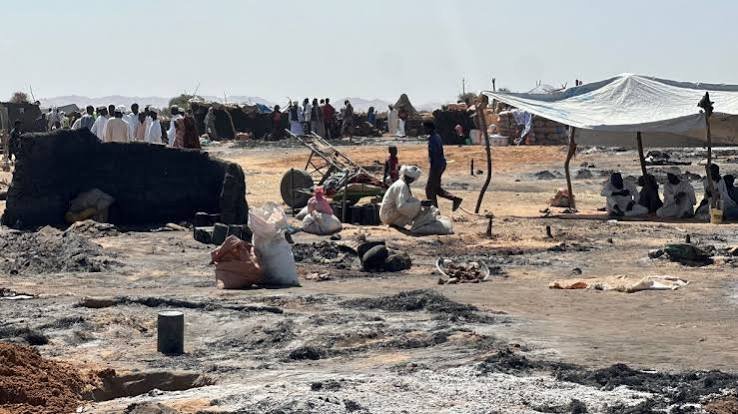
The United Nations has condemned a deadly drone attack near a displacement camp in Sudan’s Blue Nile state, where at least 31 civilians, including women and children, were reportedly killed amid escalating violence in the country’s ongoing conflict.
The attack, which was blamed on the paramilitary Rapid Support Forces (RSF), struck near the Abu Shindi shelter site in Wad al-Mahi on Friday, October 9, 2026. The area is controlled by the Sudanese Armed Forces (SAF) and has experienced repeated attacks in recent days.
The incident has intensified concerns about the safety of civilians who have fled their homes to escape fighting, only to find themselves exposed to further violence in places where they had hoped to find protection.
In a statement released on Saturday, October 10, Denise Brown, the United Nations Resident and Humanitarian Coordinator in Sudan, expressed alarm over reports of the attack and called for those responsible to be held accountable.
She warned that the death toll could rise because several injured people remained in hospital, some with serious wounds.
The United Nations also stressed that civilians and humanitarian workers must be protected in accordance with international humanitarian law, regardless of where fighting takes place.
The RSF had not immediately responded to a request for comment on the allegations, while the reported casualty figures and responsibility for the strike had not been independently verified by Reuters.
Displaced Families Hit by Fresh Violence in Blue Nile State
The drone strike has highlighted the growing dangers faced by thousands of Sudanese civilians who have been forced to abandon their homes because of the war.
According to the United Nations, many of the people sheltering at the Abu Shindi site had previously escaped fighting in the neighbouring Geissan and Kurmuk localities. Their relocation was intended to provide some measure of safety, but the latest attack has raised fresh questions about the protection available to displaced communities.
Families living in temporary shelters often have limited access to essential services, including healthcare, clean water, food and adequate accommodation. When violence reaches these locations, civilians may have few options for escaping further attacks.
The reported deaths of dozens of people have renewed calls for all parties involved in Sudan’s conflict to respect civilian protection obligations and prevent humanitarian sites from becoming targets.
Denise Brown warned that expressions of condemnation alone would not be enough to address the crisis, emphasising the need for accountability over attacks that cause civilian casualties.
The incident adds to the difficulties confronting humanitarian organisations attempting to assist people affected by Sudan’s prolonged war. Continued insecurity can disrupt aid delivery, limit access to vulnerable populations and make it harder for medical teams to treat those injured in attacks.
UNICEF Reports Deaths of Five Children
The United Nations Children’s Fund (UNICEF) said at least five children younger than 10 were among those killed in the drone strike.
The deaths have intensified concerns about the impact of Sudan’s conflict on children, many of whom have already endured displacement, family separation and interruptions to their education.
Children living in displacement camps are particularly vulnerable because they depend heavily on adults and humanitarian organisations for shelter, food, medical care and protection.
An attack near a site accommodating displaced families can also leave survivors traumatised and force them to flee again, further disrupting their lives.
UNICEF has warned that displacement centres across Sudan’s conflict zones are increasingly exposed to attacks. The situation underscores the importance of ensuring that children and other vulnerable civilians receive the protection required under international humanitarian law.
The latest incident also illustrates how the consequences of the conflict extend beyond the battlefield, affecting families who may have no direct involvement in the fighting.
For humanitarian organisations, protecting children requires both emergency assistance and sustained efforts to ensure that civilians can access essential services without fear of further violence.
Fighting Intensifies Around Ed Damazin
The attack occurred amid mounting military pressure around Ed Damazin, the regional capital of Blue Nile state.
Sudanese government forces have been fighting an alliance involving the RSF and the Sudan People’s Liberation Movement-North (SPLM-N), which has been advancing towards government-held positions in southeastern Sudan.
The military developments have raised concerns about the potential expansion of fighting into additional communities and the resulting impact on civilian populations.
Blue Nile is strategically important because of its location in southeastern Sudan, close to the Ethiopian and South Sudanese borders. Further deterioration in the security situation could complicate humanitarian operations and increase the number of people forced to leave their homes.
Repeated attacks in the surrounding areas have already placed civilians under pressure, with some families moving from one locality to another in search of safety.
The latest drone strike represents another serious development in a conflict that has repeatedly exposed civilians to violence.
Although the circumstances surrounding the attack require further independent verification, the reported deaths underline the urgent need to reduce hostilities and protect communities caught between opposing forces.
UN Demands Accountability for Civilian Deaths
The United Nations has called for accountability over the attack, stressing that parties involved in the conflict must comply with their obligations under international humanitarian law.
These rules establish protections for civilians and civilian objects during armed conflict. They also require parties to distinguish between military targets and civilians and to take necessary precautions to reduce harm to non-combatants.
Displacement sites are not automatically immune from attack in every circumstance, but civilians and civilian facilities remain protected under international humanitarian law unless specific legal conditions alter that protection. Any attack must comply with the applicable rules governing distinction, proportionality and precautions.
The UN’s response reflects growing concern about the risks faced by civilians as fighting continues across Sudan.
Humanitarian officials have repeatedly warned that the country’s population is bearing a devastating burden from the war, with millions of people displaced and many communities struggling to obtain basic necessities.
The latest attack has added to those concerns, particularly because it reportedly struck an area where families had gathered after escaping violence elsewhere.
The United Nations is urging the parties to the conflict to respect their legal obligations and take concrete measures to prevent further civilian deaths.
Sudan’s Humanitarian Crisis Deepens
Sudan has been engulfed in conflict since April 2023, when fighting erupted between the Sudanese Armed Forces and the RSF.
The war has devastated communities, damaged essential infrastructure and forced millions of people from their homes. It has also disrupted healthcare, education, agriculture and other services necessary for daily life.
For displaced families, repeated attacks create additional uncertainty. People who have already lost their homes and livelihoods may be forced to relocate again, often without sufficient resources to meet their immediate needs.
Humanitarian agencies face significant challenges in delivering assistance to affected populations, particularly in areas where fighting restricts access or threatens the safety of aid workers.
The situation in Blue Nile state demonstrates how insecurity can undermine efforts to provide shelter and protection to civilians.
The deaths reported near the Abu Shindi site have therefore renewed attention on the need for stronger civilian protection, improved humanitarian access and sustained diplomatic efforts to reduce the fighting.
Ultimately, the protection of Sudan’s civilian population will depend on whether the parties to the conflict take meaningful steps to limit violence and allow humanitarian organisations to reach those in need.
For families who have already endured repeated displacement, the immediate priority remains safety, medical assistance and the opportunity to live without the constant threat of another attack.