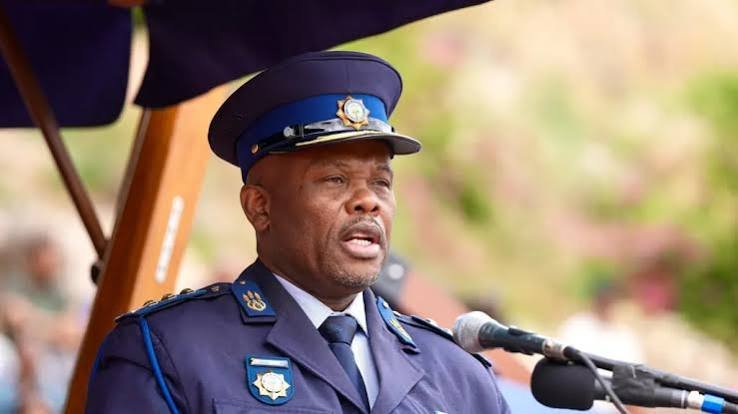
South Africa’s suspended deputy national police commissioner, Shadrack Sibiya, has resigned from the police service while facing allegations of corruption, misconduct and sexual offences, bringing his controversial tenure in the country’s law enforcement leadership to an end.
Sibiya submitted his resignation on Monday, October 12, 2026, shortly after disciplinary proceedings against him began. Police authorities confirmed that his departure would be treated as a dishonourable discharge because the internal case against him was still active when he left the service.
The resignation comes amid growing scrutiny of alleged corruption within the South African Police Service (SAPS) and concerns about possible links between law enforcement officials and criminal networks.
Sibiya, who had been suspended since September 2025, has also been arrested in a separate criminal case involving allegations of rape and the sexual grooming of a minor. He denies the allegations against him.
His departure is significant for South Africa’s ongoing efforts to address claims of misconduct within its policing institutions. However, his resignation does not resolve the criminal allegations or establish that the accusations made against him are true.
Resignation Comes as Disciplinary Hearing Begins
The resignation was handed in by Sibiya’s legal representative shortly after his internal disciplinary hearing commenced. Rather than continuing with the proceedings as a serving officer, he chose to leave the police service while facing the allegations.
Police spokesperson Athlenda Mathe confirmed that the resignation took immediate effect. She explained that because disciplinary proceedings were already underway, the police would classify his departure as a dishonourable discharge.
The development ends Sibiya’s employment with the police but does not bring the wider investigations involving him to a close.
His case has attracted considerable attention because of the senior position he previously held within SAPS. As deputy national commissioner responsible for crime detection, he occupied a role connected to the investigation of serious offences and the work of specialised police units.
His departure also comes at a sensitive time for South Africa’s police service, which is facing questions about accountability, internal discipline and allegations that criminal interests may have influenced law enforcement operations.
Sibiya Faces Separate Criminal Charges
Beyond the internal disciplinary case, Sibiya is facing criminal proceedings involving allegations of rape and sexual grooming.
He was arrested in September 2026 and remains in custody while the court considers his application for bail. His bail proceedings were scheduled to continue on October 13.
According to reports, the charges include allegations relating to an incident involving an 18-year-old woman and the alleged grooming of a 16-year-old girl. These are accusations that must be tested through the judicial process.
Sibiya has denied the allegations. His resignation from the police service should not be interpreted as an admission of guilt in the criminal case.
The legal proceedings are separate from the internal disciplinary action and the corruption allegations being examined by a judicial commission. Each matter will need to be addressed through the appropriate legal or investigative process.
The cases have nevertheless intensified public attention on the former senior officer and raised further questions about standards of conduct among officials entrusted with enforcing the law.
Madlanga Commission Examines Alleged Police Corruption
Sibiya has also been implicated in allegations investigated by the Madlanga Commission of Inquiry, which is examining claims of corruption and improper relationships between police officials and individuals suspected of involvement in organised crime.
Evidence presented to the commission has included allegations that Sibiya received money and gifts from people linked to criminal activity. Other accusations have concerned the handling of sensitive police information and possible interference in investigations.
Among the claims reported by South African media are allegations involving businessman Vusimuzi “Cat” Matlala, who has been linked to suspected criminal networks.
Sibiya has rejected the corruption allegations against him and denied wrongdoing during his testimony before the commission.
The inquiry forms part of broader efforts to establish whether criminal interests have penetrated parts of the country’s policing system and whether officials used their positions to influence investigations or protect particular individuals.
Its findings could have significant implications for police accountability and public confidence in law enforcement. However, allegations presented during an inquiry are not, by themselves, proof of criminal conduct.
The commission’s work is particularly important because the police are responsible for investigating and preventing crime. Any credible evidence of corruption within the institution risks undermining the public’s trust in its ability to carry out that responsibility fairly.
A Controversial Career in South African Policing
Sibiya’s career has included previous disputes and disciplinary controversy.
He returned to senior national police leadership in 2023, becoming deputy national commissioner for crime detection. He was later suspended in 2025 following allegations concerning his conduct and possible links to criminal networks.
His career had also been affected by an earlier dismissal in 2015 over his alleged involvement in the illegal rendition of Zimbabwean nationals. He challenged that decision, and the Labour Court subsequently ordered his reinstatement after finding procedural problems with the dismissal.
His latest resignation marks another major turning point in a career that has repeatedly drawn public scrutiny.
The circumstances surrounding his departure are likely to keep attention focused on how senior police officers are appointed, supervised and held accountable when serious allegations arise.
For SAPS, the challenge extends beyond the removal of one official. The service must also demonstrate that its disciplinary systems and investigations can operate effectively, including when allegations involve high-ranking members.
What Sibiya’s Departure Means for South Africa’s Police Service
The resignation adds to mounting pressure on South African authorities to confront allegations of corruption and criminal influence within law enforcement.
A police service depends on public cooperation and confidence. When senior officials face serious accusations, the institution must show that investigations are conducted impartially and that no individual is beyond scrutiny.
Sibiya’s departure removes him from his former leadership position, but it does not answer all the questions raised by the cases involving him.
The criminal proceedings will determine how the sexual offence allegations are handled, while the Madlanga Commission continues to examine wider claims concerning police corruption and links to criminal networks.
The government and police leadership will also face pressure to demonstrate that any institutional weaknesses identified through these investigations are addressed.
For South Africans concerned about crime and public safety, the central issue is whether the authorities can ensure that police officers are held to the same legal and ethical standards they are expected to enforce.
Sibiya’s resignation is therefore a significant development, but the wider test for South Africa will be whether the investigations lead to credible accountability and lasting improvements within the police service.