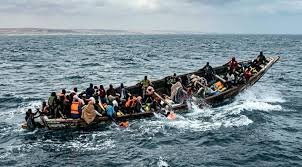
At least 34 people have died after a small boat carrying migrants sank off the northwestern coast of Senegal, highlighting the continuing dangers faced by people attempting to reach Europe through the Atlantic Ocean.
The vessel, described as a traditional flat-bottomed fishing boat known as a pirogue, capsized near the Loumpoul dunes in the Kebemer department, between the capital, Dakar, and the northern city of Saint-Louis.
Initial information released by Senegal’s Interior Ministry on November 8 reported that 21 bodies had been recovered and one person rescued alive. However, subsequent updates from the Senegalese Press Agency (APS) raised the death toll to at least 34.
The organisation Action for Human Rights and Friendship (ADHA) also confirmed the revised figure, according to reports from international news agencies.
Authorities said search operations were continuing, while the total number of people who had been aboard the vessel and the number still missing had not been established.
The tragedy has renewed attention on the dangerous migration route connecting West Africa to Spain’s Canary Islands, where overcrowded boats, long distances and unpredictable Atlantic conditions have contributed to repeated loss of life.
What happened off Senegal’s coast?
The boat reportedly sank near the Loumpoul dunes in the Kebemer department, an area along Senegal’s northwestern coastline.
Although the Senegalese Interior Ministry confirmed the deaths and the rescue of one survivor, early official information did not provide a complete account of how the vessel got into difficulty.
Media reports placed the accident on Saturday, November 7, although some local accounts gave a different timeline. The exact circumstances surrounding the sinking remained under investigation.
The boat was carrying people attempting to migrate irregularly, but authorities had not confirmed its total passenger capacity or how many people were on board when it capsized.
Local newspaper Le Soleil reported that many of the victims came from the Leona and Thieppe districts within the same department.
The nationalities of all those involved had not been confirmed in the initial reports.
Senegal launches search and rescue operations
Following the disaster, Senegalese authorities mobilised emergency resources to search for possible survivors and recover victims.
The Interior Ministry said the operation would continue as officials worked to establish the full circumstances of the incident.
President Bassirou Diomaye Faye expressed condolences to the victims’ families and those affected by the tragedy.
In a statement shared on social media, the president said government agencies and available resources had been mobilised to locate missing people, assist survivors and support bereaved families.
He also renewed his government’s commitment to tackling the networks responsible for organising dangerous irregular migration journeys.
Senegal’s Interior Minister was expected to visit the affected area to meet families and convey the government’s condolences.
The authorities also stressed the importance of working with neighbouring countries to combat people-smuggling networks operating along West Africa’s Atlantic coastline.
Atlantic migration route remains deadly
The latest sinking is part of a wider pattern of maritime tragedies involving migrants attempting to reach Europe from West Africa.
The Atlantic route to Spain’s Canary Islands is considered one of the world’s most dangerous migration corridors. People frequently travel in small, overcrowded boats that may remain at sea for several days.
Some vessels are poorly equipped for long journeys and lack sufficient food, drinking water, navigation equipment and emergency supplies.
The Atlantic Ocean can also be unpredictable, with strong currents and changing weather conditions creating serious risks for boats that are not designed for extended voyages.
According to the migrant-rights organisation Walking Borders, at least 635 people died while attempting to reach the Canary Islands during the first five months of 2026.
The organisation’s figures underline the scale of the humanitarian challenge, although the actual number of deaths may be higher because some vessels disappear without survivors or confirmed passenger lists.
Stricter patrols are changing migration routes
West African governments have increased maritime patrols and border enforcement in an effort to prevent dangerous departures.
Senegal, Mauritania and Morocco have strengthened monitoring around traditional departure points, while authorities have also stepped up cooperation against trafficking and smuggling networks.
However, tighter controls have contributed to changes in the routes used by some migrants.
The International Organization for Migration (IOM) has warned that restrictions around established departure locations can push boats towards more distant coastal areas, including parts of The Gambia, Guinea-Bissau and Guinea.
These alternative departure points can make journeys longer and expose passengers to additional risks.
The IOM has previously noted that some rerouted journeys can add hundreds of kilometres to an already dangerous crossing, increasing the time people spend at sea and the likelihood of dehydration, shipwreck or disappearance.
The shift also makes rescue operations more difficult when boats depart from remote locations or travel through areas with limited maritime surveillance.
More than 3,300 migrants reach Spain’s Canary Islands
The tragedy occurred amid a period of increased migrant arrivals in Spain’s Canary Islands.
Authorities on El Hierro, one of the islands in the archipelago, declared an emergency on Saturday after a surge in arrivals by sea.
Officials said more than 3,300 people had reached the island aboard approximately 30 boats since the beginning of November.
The figures illustrate the continuing pressure on the Atlantic migration corridor despite efforts by European and West African governments to discourage irregular crossings.
The Canary Islands remain an important entry point for migrants seeking to reach mainland Spain and other parts of Europe.
For many people making the journey, the decision to leave is driven by a combination of economic hardship, unemployment, insecurity and the hope of finding better opportunities abroad.
However, the dangers are substantial, particularly for those relying on informal operators and overcrowded fishing vessels.
Senegal intercepts another migrant boat
Senegalese authorities also reported intercepting another boat carrying migrants on Friday, November 6.
According to the Interior Ministry, 142 people were intercepted while attempting to travel towards Spain.
The group reportedly included 23 women, two babies and two other children. Passengers came from several West African countries, including Senegal, The Gambia, Guinea-Bissau, Guinea and Nigeria.
The interception demonstrated the continued use of Senegal’s coastline as a departure point for people attempting to reach Europe.
Authorities have said they intend to intensify efforts against smuggling networks while strengthening cooperation with neighbouring countries.
Government faces pressure to address migration causes
The latest disaster has renewed questions about the effectiveness of policies designed to prevent dangerous migration journeys.
Although maritime patrols and anti-smuggling operations can disrupt illegal departures, the continuing movement of people towards Europe points to deeper economic and social challenges.
Youth unemployment, limited access to stable jobs, poverty and unequal economic opportunities remain important factors influencing migration decisions in parts of West Africa.
President Faye has indicated that his administration intends to combine action against trafficking networks with efforts to create opportunities for young people within Senegal.
Such measures are important because preventing dangerous journeys requires more than stopping boats at sea. Sustainable employment, education, vocational training and access to economic opportunities can help address some of the pressures encouraging irregular migration.
For the families affected by the latest sinking, however, the immediate concern remains the recovery of victims and support for those who have lost relatives.
With at least 34 deaths reported and the possibility of additional missing passengers, the tragedy serves as another reminder of the human cost of the dangerous Atlantic journey from West Africa to Europe.