Morocco and Sierra Leone are exploring new opportunities to expand their economic relationship, with both countries looking to increase trade, attract industrial investment and strengthen the exchange of technical expertise.
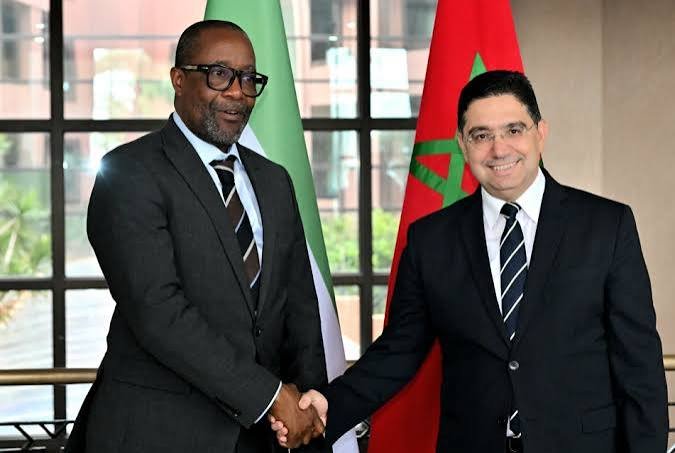
The discussions took place in Rabat on November 10, 2026, during a meeting between Morocco’s Minister of Industry, Trade, Investment and Economic Inclusion, Ryad Mezzour, and Sierra Leone’s Minister of Foreign Affairs and International Cooperation, Mohamed Rahman Swaray.
The two officials examined ways to translate their growing diplomatic relationship into practical economic projects that could benefit businesses and communities in both countries.
Their discussions focused on investment opportunities, strengthening domestic production, expanding bilateral trade and transferring industrial knowledge. They also considered how the two economies could take advantage of areas where their economic interests and capabilities complement each other.
The meeting reflects Morocco’s wider effort to strengthen economic partnerships across Africa through South-South cooperation, industrial development and the sharing of expertise.
For Sierra Leone, closer engagement with Morocco could create opportunities to benefit from the North African country’s experience in developing industrial sectors, attracting investment and building connections with regional and international markets.
Morocco seeks to expand trade with Sierra Leone
One of the main priorities discussed by the two ministers was the expansion and diversification of trade between Morocco and Sierra Leone.
Although both countries maintain diplomatic relations, their governments want to develop stronger commercial links and identify additional areas where businesses can work together.
Morocco has been seeking to broaden its economic engagement across African markets, while Sierra Leone is pursuing opportunities to attract investment and strengthen productive sectors of its economy.
The two countries believe that closer commercial cooperation could help businesses access new markets, establish partnerships and increase the movement of goods and services.
The discussions also highlighted the importance of identifying practical investment opportunities rather than limiting bilateral relations to diplomatic exchanges.
By encouraging companies to explore opportunities in each other’s markets, the governments hope to create a stronger foundation for long-term economic cooperation.
Industrial investment and local production take centre stage
Industrial development was another important subject during the meeting.
The two officials discussed ways to encourage investment in productive activities and strengthen local manufacturing capabilities.
For Sierra Leone, developing domestic production remains important for creating employment, improving economic resilience and reducing excessive dependence on imported finished goods.
Morocco, meanwhile, has expanded its industrial base over recent years, with activities spanning automotive manufacturing, aerospace, chemicals, textiles and other sectors.
The country’s industrial development experience could provide opportunities for cooperation through technical partnerships, investment projects and the exchange of knowledge.
The ministers also discussed the importance of transferring technical expertise to support local industries.
Such cooperation could involve sharing production methods, developing professional skills and helping businesses improve their capacity to manufacture goods locally.
However, the November 10 meeting did not announce specific investment amounts, company agreements or a list of confirmed industrial projects. Further discussions will be needed to turn the proposals into concrete business activities.
South-South cooperation remains central to Morocco’s African strategy
The meeting also reflected Morocco’s commitment to South-South cooperation, a diplomatic and economic approach that encourages developing countries to work together through investment, knowledge sharing and technical assistance.
Morocco has increasingly positioned African partnerships as an important part of its international economic strategy.
Through cooperation with other African countries, Rabat has sought to support industrial development, improve trade connections and create opportunities for businesses operating across the continent.
The government has also promoted the sharing of expertise in areas such as agriculture, infrastructure, manufacturing and financial services.
For Sierra Leone, stronger relations with Morocco could provide access to technical experience and new commercial connections that support its development priorities.
The two countries are also interested in making better use of their economic complementarities, allowing each side to contribute capabilities and resources that could support shared projects.
Talks build on wider diplomatic engagement
The meeting between Mezzour and Swaray formed part of a broader programme of engagement during the Sierra Leonean foreign minister’s working visit to Morocco.
On November 9, Swaray held separate discussions with Ahmed Touizi, President of Morocco’s House of Representatives.
Their meeting focused on strengthening economic cooperation, African integration and relations between the two countries’ parliamentary institutions.
Touizi highlighted initiatives associated with King Mohammed VI that seek to improve economic connectivity across Africa.
These included the Atlantic African States Process, the initiative aimed at facilitating access to the Atlantic Ocean for landlocked Sahel countries, and the Nigeria-Morocco Atlantic African Gas Pipeline project.
The Sierra Leonean minister welcomed progress on the proposed gas pipeline, describing it as an example of South-South cooperation that could support regional integration and increase commercial exchanges.
He also emphasised the potential importance of stronger African economic connections in helping countries respond to changes and disruptions in international markets.
Swaray reiterated Sierra Leone’s support for Morocco’s sovereignty over its entire territory and the Autonomy Plan proposed by Rabat.
New cooperation roadmap adds momentum to relations
Further developments during the same diplomatic visit provided a broader framework for the partnership.
On November 10, Sierra Leone’s Foreign Minister Mohamed Rahman Swaray met Morocco’s Foreign Minister Nasser Bourita in Rabat. The two ministers signed a joint communiqué and a cooperation roadmap covering the 2027–2029 period.
The roadmap is intended to strengthen collaboration in several areas, including trade, agriculture, investment, mining, water management, fisheries, the blue economy, technical training and cultural exchanges.
The ministers also agreed to accelerate the implementation of existing cooperation agreements and organise the fourth session of the Morocco-Sierra Leone Joint Commission for Cooperation in 2027.
The agreement provides an institutional framework for advancing the wider economic and diplomatic ambitions discussed during Swaray’s visit.
It also demonstrates the two governments’ intention to move beyond general expressions of friendship and establish more structured programmes for cooperation.
Opportunities for businesses and investors
Closer economic relations could create opportunities for private-sector organisations in both countries.
Moroccan companies may find opportunities to explore Sierra Leone’s investment environment, particularly in sectors where the country is seeking additional capital, technical expertise and industrial partnerships.
Sierra Leonean businesses could also benefit from stronger commercial connections with Morocco, including access to industrial knowledge and potential partnerships with established companies.
Agriculture, mining, manufacturing, trade and infrastructure are among the areas that could offer opportunities for further engagement.
Nevertheless, the extent of these opportunities will depend on the development of suitable projects, investment arrangements and practical cooperation between businesses and government institutions.
For both countries, improving the conditions for trade and investment will be important in ensuring that diplomatic agreements produce measurable economic benefits.
A broader push for African economic integration
The renewed engagement between Morocco and Sierra Leone comes amid wider efforts by African countries to strengthen trade, industrial capacity and economic integration.
Governments across the continent are seeking ways to increase trade within Africa, improve infrastructure connections and reduce dependence on external markets for certain goods and services.
Regional initiatives and bilateral partnerships are increasingly viewed as important tools for achieving these objectives.
Morocco and Sierra Leone’s discussions fit into this wider agenda by placing emphasis on investment, local production, technical cooperation and trade diversification.
The signing of the 2027–2029 roadmap gives the relationship a defined period for pursuing several of these priorities.
However, the success of the partnership will ultimately depend on implementation, including the identification of viable projects, participation by private businesses and continued cooperation between the two governments.
For now, the discussions in Rabat represent another step in efforts by Morocco and Sierra Leone to deepen their economic relationship and expand opportunities for cooperation across Africa.