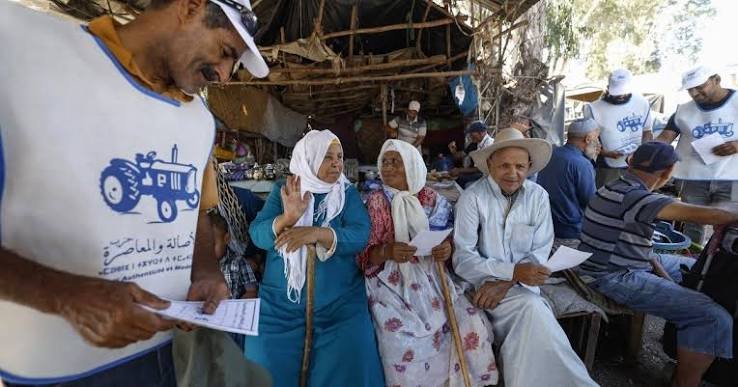
Moroccans went to the polls on Wednesday, September 23, to elect a new parliament in an election dominated by concerns over jobs, living costs, inequality and public services.
Nearly 16 million people were registered to vote for members of Morocco’s 395-seat House of Representatives. The election comes at a politically significant moment, with growing frustration among sections of the country’s younger population and renewed attention on migration following a large movement of Moroccan youths towards the Spanish enclave of Ceuta in July.
The election also follows youth-led protests in 2025 that focused on healthcare, education and economic opportunities, adding pressure on political parties to address issues affecting younger citizens.
Youth unemployment remains a major concern
Employment has emerged as one of the central issues in the campaign.
Morocco has experienced economic growth and attracted investment into sectors ranging from manufacturing to tourism. However, the benefits have not been distributed evenly, and finding stable employment remains difficult for many young people.
Youth unemployment reached about 37 per cent in 2025, according to government figures cited by the Associated Press. Millions of young Moroccans were also classified as being outside education, employment or training.
The situation has contributed to frustration among some young people who say economic opportunities have not kept pace with their expectations.
Ceuta migration highlights public frustration
The election follows a major migration episode involving Morocco’s northern border with Spain.
In July, large numbers of mostly young Moroccans attempted to reach Ceuta, a Spanish territory on Africa’s northern coast. The movement drew international attention and became another indication of the economic and social frustrations confronting parts of Morocco’s youth population.
The issue has added migration and employment to an election campaign already focused heavily on living standards.
Some young Moroccans who participated in the movement have expressed scepticism about traditional politics, while others have argued that greater youth participation could help bring about changes in education, employment and public services.
Nearly 16 million registered voters
Although Morocco has around 26.7 million citizens of voting age, only about 15.8 million were registered on the electoral lists.
Youth participation is expected to be an important indicator of public engagement. Only around four per cent of registered voters are between 18 and 24, according to the election data reported by France 24.
Low participation has been a recurring concern in Moroccan elections, with political observers watching closely to see whether voters’ dissatisfaction translates into abstention.
The previous parliamentary election in 2021 recorded a turnout of 50 per cent, while preliminary figures from the 2026 election showed significantly lower participation during the early stages of voting.
RNI and PAM among major contenders
The National Rally of Independents (RNI), which currently leads the governing coalition, is one of the major parties competing for seats.
Its principal rival includes the Authenticity and Modernity Party (PAM), another major party in the outgoing parliamentary majority.
Both parties have presented economic programmes centred on employment, wages and living standards.
The RNI has pledged to create about one million jobs during the next five-year term, while PAM has also made employment and social improvements major parts of its campaign.
Other parties contesting the election include the Istiqlal Party and the opposition Justice and Development Party (PJD), which suffered a major setback in the 2021 election but is seeking to rebuild its political influence.
World Cup preparations add another dimension
The next government will also oversee major infrastructure and investment projects linked to Morocco’s preparations to co-host the 2030 FIFA World Cup alongside Spain and Portugal.
The country is investing heavily in stadiums, transport infrastructure and other projects ahead of the tournament.
The International Monetary Fund has estimated the planned World Cup-related spending at roughly $20 billion, according to Reuters.
Political parties are therefore campaigning against the backdrop of both economic opportunity and public concern about how the benefits of major national investments will reach ordinary citizens.
King retains significant powers
Morocco’s parliamentary system gives the monarch an important role in determining the country’s political direction.
Under the constitution, the king appoints the prime minister from the party that secures the largest share of parliamentary seats. The appointed prime minister then works to form a coalition government.
The monarch, however, retains significant authority over areas including defence and foreign affairs.
This means the parliamentary election will determine the composition of the next government, while major areas of national policy will continue to operate within Morocco’s existing constitutional framework.
Focus turns to voter participation
As ballots are counted, attention is expected to focus not only on the distribution of seats but also on turnout and the extent to which younger Moroccans participate.
The election has placed economic pressures, youth unemployment, public services and migration firmly at the centre of the national conversation.
For political parties, the challenge after the vote will be translating campaign promises on jobs, wages, housing, healthcare and education into policies capable of addressing the concerns that have increasingly driven public debate.