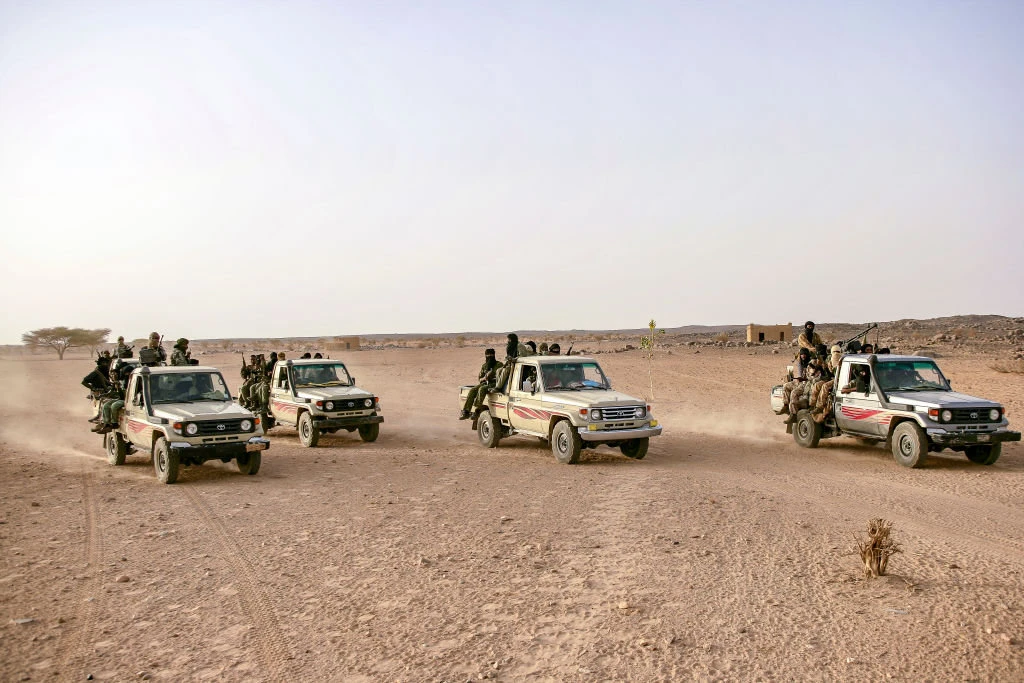
Tuareg separatists in northern Mali have announced a withdrawal from the strategic city of Kidal as the country’s military steps up a major offensive in the region.
The Azawad Liberation Front (FLA), which has been fighting for greater autonomy or independence for northern Mali, said on Tuesday that it had ordered a controlled withdrawal of its forces from Kidal. The group said the decision followed intensified air operations by the Malian military, supported by Russian personnel.
The development represents a potentially important shift in the battle for control of northern Mali, where Kidal has long carried both military and symbolic significance.
The Malian armed forces announced earlier on Tuesday that they had launched large-scale air and ground operations around the Kidal region. A source close to the FLA leadership told Reuters that the aerial campaign had begun about three days earlier.
It was initially unclear how close government troops were to Kidal or whether they had immediately entered and taken control of the city following the separatists’ withdrawal.
FLA Describes Withdrawal as Temporary
The separatist movement presented its decision as a tactical move rather than an abandonment of its wider struggle.
In its statement, the FLA described the withdrawal as a temporary operational measure intended to preserve its fighters and logistical resources. The group also cited concerns about the effect of continued air attacks on the civilian population.
The FLA has maintained that its broader campaign for a political settlement concerning the status of the northern region remains active. Its withdrawal from Kidal therefore does not necessarily signal an end to the conflict between the separatists and Bamako.
The group has also accused Malian forces and their Russian allies of conducting intensive aerial operations. Those claims about damage and civilian conditions have not been independently verified.
Kidal’s Strategic Importance
Kidal is located in northern Mali, a region that has been at the centre of repeated Tuareg rebellions and jihadist violence.
The city has particular importance for the separatist movement because it has historically been a stronghold for Tuareg groups seeking greater autonomy for the territory they refer to as Azawad.
Control of Kidal has changed hands during the country’s long-running insurgency.
Malian forces, supported by Wagner fighters, captured the city from insurgents in November 2023. At the time, the government presented the operation as a major military victory and an important step towards restoring state authority over the north.
The latest reversal illustrates how difficult it has been for Bamako to establish lasting control across the vast northern territories.
Separatists and Jihadists Joined Forces
The current crisis intensified after the FLA and the al-Qaeda-linked Jama’at Nusrat al-Islam wal-Muslimin (JNIM) became involved in coordinated attacks against government positions.
The two groups have different political objectives, but their activities have at times converged against Mali’s military government.
The FLA and JNIM captured Kidal again during a series of nationwide attacks in April. The offensive represented one of the most serious challenges to Mali’s military rulers and also resulted in the death of the country’s defence minister, according to reports.
The renewed contest for Kidal has consequently become part of a much broader struggle involving separatist forces, jihadist organisations and the military government in Bamako.
Russia’s Growing Role in Mali
The latest fighting also highlights Mali’s increasing reliance on Russian security assistance.
Mali’s military leaders seized power through coups in 2020 and 2021 and subsequently moved away from traditional Western security partnerships.
Russia has since become a key military partner for Bamako. The Russian-backed Africa Corps has taken over much of the role previously associated with the Wagner Group, with many former Wagner personnel incorporated into the newer force.
Russian support has featured prominently in Mali’s military campaigns against insurgent groups, particularly in the country’s north and central regions.
However, the government’s partnership with Russian forces has also attracted international scrutiny, including allegations concerning civilian casualties during counterinsurgency operations.
A New Test for Mali’s Junta
The withdrawal from Kidal comes at a critical moment for Mali’s military government.
The authorities have repeatedly pledged to restore state control over territory held by armed groups, making developments in the north politically significant.
If government forces succeed in re-establishing control over Kidal, it would provide Bamako with an important symbolic victory. But maintaining control of the city could prove considerably more difficult than capturing it, given the size of the surrounding territory and the continued presence of armed groups.
The situation also remains fluid, with uncertainty over the exact position of government troops and whether the FLA’s withdrawal will result in a permanent change of control.
For now, the separatists have characterised their move as a tactical retreat designed to preserve their forces rather than a surrender.
The struggle over Kidal therefore remains far from settled. The city continues to sit at the centre of Mali’s wider security crisis, where the military government is battling both separatist ambitions and jihadist insurgency while relying increasingly on Russian military support.
The coming days are likely to determine whether the Malian army can consolidate its position in Kidal or whether the separatist movement will regroup and attempt to challenge government control again.