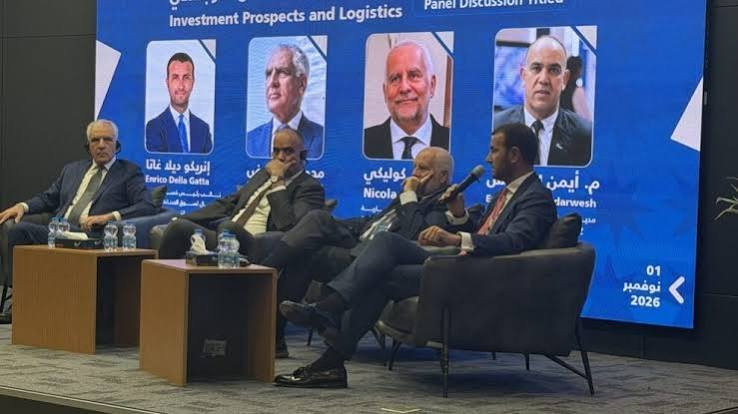
Libya and Italy are exploring new areas of cooperation in the maritime industry, with discussions in Misrata focusing on investment, port infrastructure and the expansion of specialised shipping services.
The talks took place during a session of the Libyan-Italian Business and Investment Forum at the Misrata Free Zone. Participants examined how Italian technical knowledge and investment could support Libya’s efforts to strengthen its maritime infrastructure and develop services that currently require specialised expertise.
A major issue discussed was the development of facilities at the Misrata Free Zone, particularly dock-lift and side-carrying platforms used in maritime operations. The project is approaching the final stages of preparation, maintenance and development, according to information provided by the free zone.
The proposed improvements are expected to support the zone’s longer-term ambition to establish more maritime maintenance and industrial services locally.
Key Libyan and Italian business representatives attend talks
The dialogue brought together officials and business representatives from both countries to examine possible areas of partnership.
Among those present were Ayman Al-Darwish, Director General of the Misrata Free Zone; Nicola Colicchi, President of the Libyan-Italian Chamber of Commerce; Mohamed Al-Raied, President of the General Union of Libyan Chambers of Commerce; and Enrico Della Gata, Vice President of Italian shipbuilding company Fincantieri.
Their discussions centred on the investment potential of the free zone and its importance to Libya’s commercial and logistics activities.
The participation of Fincantieri was particularly relevant to the maritime focus of the meeting, given the Italian company’s involvement in the shipbuilding and marine engineering industries. However, the session’s reported outcome was a discussion of potential cooperation rather than an announcement of a confirmed contract or investment agreement.
Misrata Free Zone targets expansion of maritime services
The Misrata Free Zone is seeking to strengthen its position as a centre for trade, logistics and industrial activity.
Its location and port facilities give it an important role in connecting Libyan businesses with international markets. Developing additional maritime services could also help the zone attract companies involved in shipping, vessel maintenance and related technical operations.
The dock-lift and side-carrying platform project featured prominently in the discussions because of its potential to expand the services available within the facility.
According to the free zone, the project forms part of a wider plan to bring more maritime industry and maintenance activities into Libya. This could reduce the need for some specialised services to be carried out outside the country, while creating opportunities for local businesses and technical workers.
Italian expertise was discussed as a possible means of supporting this development, particularly in areas where advanced equipment, engineering knowledge and operational experience are required.
Wider Libya-Italy business cooperation
The maritime discussions formed part of a broader effort to deepen commercial relations between Libya and Italy.
The Libyan-Italian Business and Investment Forum opened in Misrata on November 1, bringing together approximately 60 Italian companies and 250 Libyan businesses for meetings and investment discussions scheduled to run until November 3.
The programme covers several areas of economic activity, including industry, infrastructure, energy and services. Business-to-business meetings and institutional engagements are also intended to help companies identify potential partners and investment opportunities.
The forum was organised by the Italian-Libyan Chamber of Commerce in cooperation with the Italian Embassy in Tripoli and Unioncamere, with support from the Misrata Free Zone. It followed earlier efforts to promote Libyan investment opportunities to Italian businesses, including a presentation in Rome in July.
Italy’s diplomatic authorities described the gathering as a broad business mission to Misrata, bringing together companies and institutions from both countries. The participation of Libyan economic institutions and businesses reflects the range of sectors involved in the discussions.
What the maritime partnership could mean for Libya
For Libya, developing maritime infrastructure is closely connected to its ambitions to expand trade and diversify economic activity beyond its dependence on oil and gas.
Improved port facilities and specialised maintenance services could help strengthen the country’s logistics capacity and create additional opportunities for private-sector investment.
The Misrata Free Zone could also benefit from stronger links with Italian maritime companies, particularly if discussions eventually lead to technical partnerships, training programmes or investment in new facilities.
However, the potential benefits will depend on whether the discussions translate into concrete projects. Financing, technical implementation, operational capacity and sustained cooperation will all be important in determining how quickly the proposed developments can progress.
For now, the Misrata meeting represents another step in Libya and Italy’s efforts to identify commercial opportunities in the maritime sector. Both sides have highlighted the value of combining Libya’s port infrastructure and investment opportunities with Italian industrial and technical experience.
The next stage will be turning those discussions into practical arrangements capable of expanding maritime services and strengthening Libya’s position in regional and international trade.