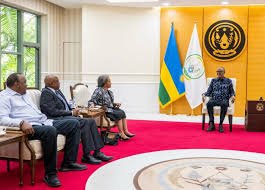
Rwandan President Paul Kagame has held discussions with a delegation from the African Union Panel of Facilitators as diplomatic efforts intensify to find a lasting solution to the conflict in eastern Democratic Republic of Congo.
The meeting took place at Village Urugwiro in Kigali on Wednesday, October 7, during a regional mission by the AU facilitators aimed at advancing dialogue and supporting ongoing peace initiatives surrounding the conflict.
The delegation included former Ethiopian President Sahle-Work Zewde, former Kenyan President Uhuru Kenyatta and former Botswana President Mokgweetsi Masisi. Yackoley Kokou Johnson, a Togolese official representing AU lead mediator and Togo’s President Faure Gnassingbé, also participated in the discussions.
According to Rwanda’s presidency, the talks centred on the AU-backed peace process, the next steps required to move negotiations forward and efforts to tackle the underlying causes of instability in eastern DR Congo.
The meeting comes as African mediators attempt to coordinate several diplomatic tracks seeking to end years of conflict in the mineral-rich region.
AU Steps Up Peace Diplomacy
The latest engagement is part of a wider effort by the African Union to bring the various parties closer to a political settlement.
The AU Panel of Facilitators has been conducting consultations with governments, armed groups, international organisations and other stakeholders involved in the crisis. Its membership also includes former Nigerian President Olusegun Obasanjo and former Central African Republic President Catherine Samba-Panza, although they were not part of the delegation that met Kagame.
Before meeting Kagame, the delegation had travelled to Goma in eastern DR Congo, where it held talks with representatives of the AFC/M23 movement as well as humanitarian and international organisations.
The AU said the Goma consultations were intended to gather views on the political process, security conditions and humanitarian needs, while identifying measures capable of rebuilding confidence between the parties.
The facilitators subsequently urged the parties to maintain political dialogue, honour ceasefire commitments and cooperate with mechanisms established to monitor violations.
Doha Process Remains Central
One of the major diplomatic channels involved in the search for peace is the Doha process, which brings together the Congolese government and the AFC/M23 movement.
The talks are aimed at addressing the causes of the conflict and finding a political settlement to the fighting in eastern DR Congo.
The AU has supported the process through mediation and ceasefire monitoring arrangements. During their Goma visit, the facilitators urged the parties to continue engaging through the Doha framework and avoid actions that could further undermine negotiations.
The AU delegation’s recent consultations also included representatives of MONUSCO, the UN humanitarian coordination office, the International Committee of the Red Cross and the Expanded Joint Verification Mechanism Plus.
These meetings allowed the facilitators to assess both the political situation and the humanitarian consequences of the continuing conflict.
Washington Peace Track Also in Focus
The AU’s work in eastern DR Congo is not limited to the Doha negotiations.
A separate diplomatic track involving Rwanda and the DR Congo addresses tensions between the two countries and is supported by the United States, Qatar and the African Union.
The Washington peace framework includes commitments relating to the FDLR armed group and Rwanda’s security concerns. Rwanda has repeatedly identified the FDLR as a threat and has linked its security position in eastern DR Congo to the presence of the group.
The two peace tracks are therefore closely connected, with progress on one potentially influencing the other.
Focus on Civilian Protection
Beyond political negotiations, the AU facilitators have highlighted the urgent need to protect civilians affected by the conflict.
Following their Goma consultations, the panel called for greater protection of women and girls, action against sexual and gender-based violence and accountability for violations.
The facilitators also stressed the importance of ensuring humanitarian organisations can reach vulnerable communities safely and without unnecessary restrictions.
Essential services, including schools and other civilian infrastructure, were also identified as areas requiring protection.
The emphasis reflects the wider humanitarian dimension of the eastern DR Congo crisis, where prolonged insecurity has displaced communities and disrupted access to basic services.
Kenyatta Holds Separate Kigali Talks
The Kagame meeting followed another engagement in Kigali involving former Kenyan President Uhuru Kenyatta and Rwanda’s Minister of Foreign Affairs and International Cooperation, Olivier Nduhungirehe.
Their discussions focused on the work of the AU Panel of Facilitators and broader efforts to move the regional peace process forward.
The consultations demonstrate the facilitators’ effort to speak with different stakeholders rather than relying solely on formal government-to-government negotiations.
Their regional tour is expected to continue as the panel seeks to build support for dialogue and encourage the parties to maintain commitments already made under the various peace initiatives.
AU Seeks Practical Progress
The latest diplomatic activity comes at a critical point for the eastern DR Congo peace process, where negotiations have continued alongside persistent security concerns.
The AU facilitators have stressed that lasting stability will require more than ceasefire arrangements. Their position is that political dialogue, confidence-building, civilian protection and attention to the underlying causes of the conflict must all form part of the solution.
Following the consultations, the panel is expected to communicate its findings to AU mediator Faure Gnassingbé and continue discussions with governments and other actors involved in the conflict.
For Rwanda, DR Congo and the wider Great Lakes region, the success of these diplomatic efforts could prove significant in determining whether the latest peace initiatives translate into a durable reduction in violence.