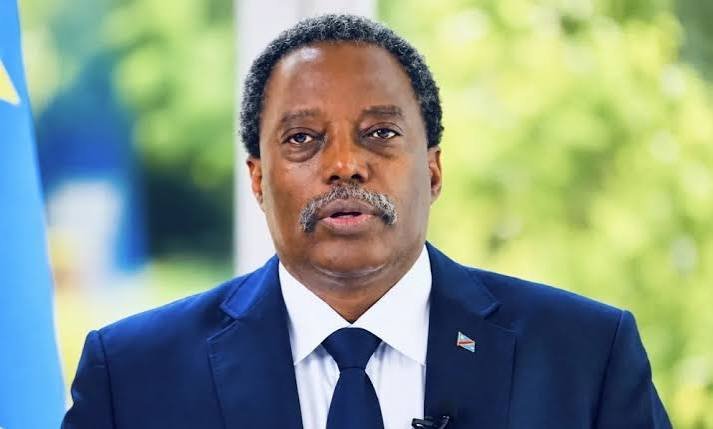
The Democratic Republic of Congo (DRC) has accused former President Joseph Kabila of preparing a large-scale offensive against the country following his decision to lead a new political and military alliance that includes the M23 rebel movement.
The accusation has intensified political tensions in the Central African nation, where years of armed conflict in the eastern region have displaced civilians, disrupted economic activities and complicated efforts to restore lasting peace.
Congolese government spokesman Patrick Muyaya told Agence France-Presse (AFP) that Kabila’s involvement in the new alliance represented a serious threat to the country’s stability. He argued that the former president was moving beyond political opposition by aligning himself with forces involved in the ongoing insurgency.
Muyaya also questioned whether the newly established organisation represented a genuine change in the rebel movement’s objectives, suggesting that its creation was an attempt to present existing forces under a different identity.
Joseph Kabila Takes Leadership of New Anti-Government Alliance
Kabila’s latest political move follows the establishment of the Front for the Refoundation of the Nation (FRN), a coalition formed by groups opposed to the administration of President Félix Tshisekedi.
The organisation was announced in Goma, a major city in eastern Congo that has been under M23 control since the rebel group’s offensive in early 2025. Its formation brings together figures associated with the M23 movement and the Alliance Fleuve Congo (AFC), its former political platform.
The coalition says it intends to unite opposition forces and challenge what it describes as authoritarian rule. Its stated objectives include the use of force if necessary, a declaration that has heightened concerns about the possibility of further violence.
Kabila has assumed leadership of the new organisation, while several figures associated with the existing insurgency occupy senior positions. Among them are Corneille Nangaa and Bertrand Bisimwa, who have been named vice-presidents, while veteran M23 commander Sultani Makenga retains a prominent military role.
The formation of the FRN marks a significant development in the conflict because Kabila is a former head of state with extensive experience in Congolese politics.
However, it remains uncertain whether his leadership will attract substantial support beyond territories already influenced by the armed opposition or change the military balance in the country’s east.
DRC Government Questions Kabila’s Intentions
The government in Kinshasa believes the creation of the FRN does not necessarily signal a change in the objectives of the forces opposing Tshisekedi.
Muyaya argued that the people behind the new organisation were closely connected to the existing insurgency, warning that the use of armed force to seize territory would come at the expense of Congolese lives.
The government has repeatedly accused Kabila of maintaining links with the M23 rebellion and playing a role in the wider network of opposition forces operating in eastern Congo.
Kabila, however, has rejected allegations linking him to the rebellion, describing the legal proceedings against him as politically motivated.
In September 2025, a Congolese military court sentenced him to death in absentia over charges that included complicity with the M23 movement. The former president has denied wrongdoing.
The latest developments have placed his return to active politics at the centre of the country’s worsening security and political crisis.
Conflict Continues in Eastern Democratic Republic of Congo
Eastern Congo has endured decades of instability involving armed groups, regional rivalries and disputes over political influence and natural resources.
The security situation deteriorated significantly in early 2025 when M23 fighters, reportedly supported by Rwanda, captured Goma in North Kivu province and Bukavu in neighbouring South Kivu.
The advances gave the rebels control over important population centres and expanded their influence across a region rich in minerals.
Although the main front lines have experienced periods of relative stability, fighting has continued in several areas. Clashes have included artillery exchanges and drone attacks, leaving communities exposed to renewed displacement and insecurity.
The conflict has also complicated humanitarian operations and efforts to restore normal economic activity in affected communities.
Kabila’s decision to lead the new coalition has raised further questions about whether the insurgency could expand its political reach and sustain its military campaign against the government.
The extent to which the former president can mobilise additional support remains unclear, particularly as some opposition groups have kept their distance from his alliance.
Political Tensions Rise Ahead of the 2028 Presidential Election
The confrontation between Kabila and Tshisekedi is unfolding against the backdrop of growing debate over the future of presidential power in the DRC.
Tshisekedi, who succeeded Kabila in 2019, is approaching the end of his second five-year term in 2028. Under the current constitution, the president is limited to two terms.
However, discussions surrounding a possible constitutional amendment have generated concern among opposition figures, who fear that proposed changes could create an opportunity for Tshisekedi to remain in office beyond the existing limit.
Opposition supporters organised demonstrations in June and September 2026 to protest against the possibility of constitutional changes.
Kabila has also criticised the current administration, accusing it of prioritising its continued hold on power rather than addressing the country’s problems.
Despite their opposition to Tshisekedi, the main opposition coalition has not fully aligned itself with Kabila’s new political-military movement. This distinction is significant because opposition to the government does not necessarily translate into support for armed rebellion.
Peace Efforts Face Fresh Uncertainty
The emergence of the FRN presents another challenge for diplomatic initiatives seeking to end the conflict in eastern Congo.
Negotiations involving the Congolese government and representatives of the M23 movement have been pursued through international mediation, including talks facilitated by Qatar.
However, continued fighting and deep disagreements between the opposing sides have made progress difficult.
Kinshasa maintains that armed groups must ultimately abandon their military campaigns, while the rebels have demanded political changes and criticised the government’s handling of the country.
Kabila’s entry into the insurgency could complicate these discussions by introducing a former president with an established political profile into an already complex conflict.
It also raises questions about whether the new alliance will prioritise negotiations or pursue its stated objectives through military pressure.
For civilians living in eastern Congo, the immediate concern remains the possibility of further fighting, displacement and disruption to essential services.
The central challenge for the DRC is now whether political disagreements can be addressed through negotiations before the growing confrontation between the government and the new Kabila-led alliance triggers another escalation in the country’s long-running conflict.
The situation remains fluid, and the government’s allegations about a planned large-scale offensive should be understood as its stated position rather than confirmation that such an attack has taken place.