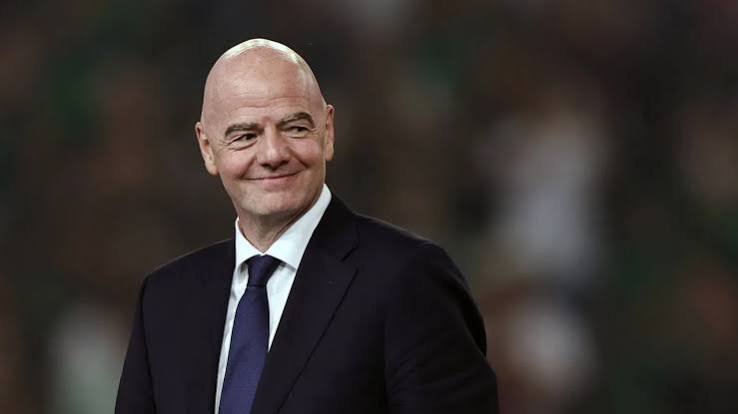
FIFA President Gianni Infantino has been invited to attend a major African football strategy meeting in Cape Verde next month as uncertainty continues to surround the upcoming election for the leadership of world football’s governing body.
The Confederation of African Football is expected to hold the two-day meeting on October 7 and 8, bringing together presidents of its 54 member associations. The gathering is expected to provide an opportunity for African football leaders to discuss key issues affecting the continent and the wider game.
According to a report seen by Reuters and published by several international outlets, CAF sent an invitation to its member associations during the week. The organisation is yet to release the full agenda for the meeting.
The summit comes at a significant period for Infantino, who has confirmed his intention to seek another term as FIFA president. The election is scheduled to take place in Rabat, Morocco, in March 2027.
Although no confirmed challenger has emerged, Infantino has faced increasing criticism from some parts of the international football community following the collapse of a controversial proposal linked to FIFA’s commercial rights.
The proposal, known as the FIFA Forward Enterprise plan, reportedly involved offering private investors a stake of up to 20 per cent in selected FIFA competitions, including the World Cup.
The idea attracted strong resistance from several powerful football confederations, including UEFA, the Asian Football Confederation and CONCACAF. The opposition eventually contributed to the abandonment of the plan.
Africa, however, has continued to maintain a different position. CAF’s executive committee expressed support for Infantino, while a number of African football associations have also publicly indicated their backing for his re-election.
CAF’s 54 member associations represent a substantial bloc within FIFA’s 211-member Congress. Their votes could therefore become an important factor if Infantino faces a challenger in the 2027 presidential contest.
In April 2026, CAF member associations unanimously agreed to support Infantino’s bid for another term, according to the African governing body’s official statement.
The relationship between Infantino and African football has developed considerably during his presidency. His administration has promoted expanded international competitions and increased financial support programmes for member associations, while African football leaders have generally maintained close relations with FIFA under his leadership.
The forthcoming Cape Verde meeting could therefore attract considerable attention as football authorities assess the direction of the sport ahead of the next FIFA election.
Infantino, who is 56, became FIFA president in 2016 after succeeding Sepp Blatter. He was re-elected in 2019 and again in 2023, having secured the support necessary to continue in office.
However, his current bid comes against a more complicated political backdrop within international football.
Reports have indicated that FIFA Secretary General Mattias Grafström has been approached by some African football officials about the possibility of challenging Infantino. Grafström has not publicly confirmed an intention to contest the presidency and has remained non-committal about such a move.
The potential for a contested election has also intensified debate about the balance of power between FIFA’s continental confederations. UEFA and CONCACAF have been among the strongest critics of Infantino’s recent commercial initiative, while CAF has continued to publicly support him.
The Cape Verde conference will be followed on October 9 by a review of the 2026 FIFA World Cup involving African national-team coaches. The session will be led by former Arsenal manager Arsène Wenger, who serves as FIFA’s Chief of Global Football Development.
The review is expected to examine areas including tactics, refereeing, logistics and other technical aspects of the tournament.
With the FIFA presidential election still months away, the African summit is likely to provide another important platform for discussions about the continent’s priorities and its relationship with FIFA.
For now, Infantino retains CAF’s declared backing, while the identity of any serious challenger remains unresolved. The political landscape within world football could nevertheless continue to shift as national associations and continental bodies consider their positions before the 2027 election.