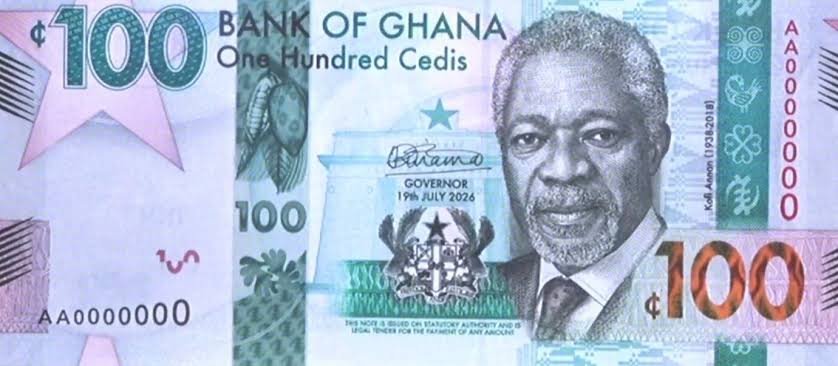
Ghana’s central bank has unveiled a redesigned series of banknotes that will begin entering circulation on December 1, 2026. Called the Ghana Cedi Heritage Series, the notes are intended to strengthen protection against counterfeiting, improve durability and make cash easier to handle. The Bank of Ghana says the existing notes will remain legal tender and circulate alongside the new series.
The central bank formally launched the series in Accra on November 12. Governor Johnson Pandit Asiama said the designs reflect Ghanaian history and culture, while updated security features and more portable sizes are intended to meet practical needs. The rollout will be phased, giving people, businesses and financial institutions time to become familiar with the new notes.
Eight denominations, with no new value levels
The Heritage Series retains the eight existing denominations: GH¢1, GH¢2, GH¢5, GH¢10, GH¢20, GH¢50, GH¢100 and GH¢200. The banknotes are upgraded versions of the existing denominations, not a new currency or a change in the value of the cedi. Earlier, the Bank of Ghana said the redesign would not introduce a GH¢500 note.
The notes feature Ghanaian historical figures, landmarks and Adinkra symbols. Africanews reports that the GH¢1 note honours market trader Agnes Oforiwa Tagoe-Quarcoopome and features Makola Market, while the GH¢2 note highlights Cardinal Peter Dery and Larabanga Mosque. Other denominations recognize educator James Emman Kwegyir Aggrey, judge Annie Ruth Jiagge, composer Ephraim Amu, flag designer Theodosia Okoh, former United Nations Secretary-General Kofi Annan and Ghana’s first president, Kwame Nkrumah.
By linking people and places to different denominations, the series gives the banknotes a cultural and educational dimension in addition to their everyday role in payments. The central bank says each denomination draws on Ghanaian heritage and identity. Its launch theme is “The Cedi, Our Future: Secure & Designed to Last.”
Security, durability and easier handling
The Bank of Ghana says the new notes include enhanced security features intended to make counterfeiting more difficult and help people identify genuine banknotes. It has also designed them to withstand frequent handling and Ghana’s climate, with the aim of extending their lifespan in circulation. The notes are smaller and more portable than the current series, according to the governor.
The Bank of Ghana has described the redesign as part of a wider effort to modernize currency management. Physical cash remains important for transactions, including when electronic payment systems are unavailable. At the same time, stronger security and more durable notes could help the bank manage the costs and logistics of replacing damaged or worn currency.
The announcement comes after more than two decades in which the core designs of Ghana’s banknotes remained in circulation, according to the central bank. The bank says that currency use, printing technology and security standards have changed over that period, prompting the update.Existing cedis will remain valid
The new notes will not make current cedis worthless. The Bank of Ghana says the Heritage Series will circulate alongside the existing banknotes, which remain legal tender. People do not need to rush to banks to exchange their money or withdraw cash simply to obtain the redesigned notes.
That assurance is important during a currency transition, when confusion or rumours can prompt unnecessary withdrawals or cause some people to wrongly reject valid notes. The central bank says it will run a nationwide public education campaign in major local languages to explain the designs and security features. It is also launching a Cedi App to help the public learn about the series, including people with visual impairments.
A gradual transition
The new banknotes are scheduled to enter circulation on December 1, 2026. Their arrival will be gradual: the old and new designs will both be used as the new series moves through the banking system and into daily transactions.
The Bank of Ghana has urged people to handle all notes carefully, avoiding practices such as writing on, stapling or deliberately damaging them.For the public, the practical change will be seeing updated designs and learning how to check their security features. The value of each denomination remains the same, and current notes remain accepted. For the central bank, the redesign is an opportunity to update the physical currency while reinforcing confidence in the cedi and making the transition without disrupting everyday payments.