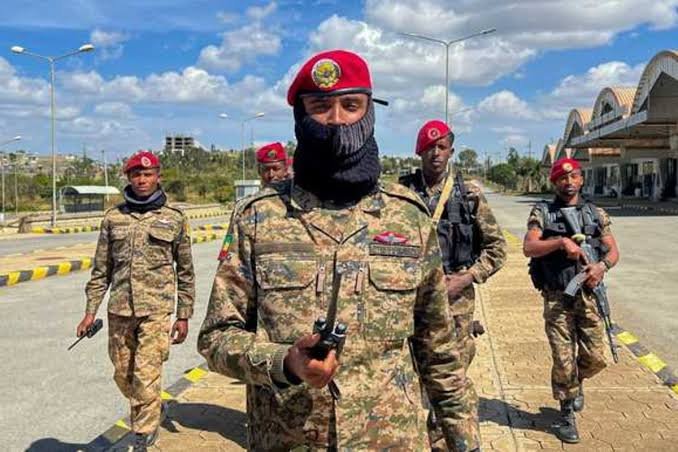
Residents in the northern Ethiopian city of Adigrat have reportedly taken to the streets to celebrate following reports that Eritrean troops accused of crossing into the country had withdrawn from the area.
The development comes amid rising tensions between Ethiopia and neighbouring Eritrea, with the two governments exchanging accusations as renewed fighting in Ethiopia’s Tigray region threatens to destabilise the wider Horn of Africa.
According to Al Jazeera, Ethiopian government forces and their allied fighters were seen in Adigrat following reports of the Eritrean withdrawal. Eritrea, however, has denied that its troops entered Tigray, and the reported incursion has not been independently verified.
The celebrations came at a sensitive moment for the border city, which lies close to Eritrea and has been caught up in the wider security crisis affecting northern Ethiopia.
The presence of Ethiopian government forces has also raised questions about whether authorities can restore stability in the area after days of uncertainty surrounding reports of foreign troops operating inside Ethiopian territory.
Ethiopian Forces Return to Adigrat Amid Border Tensions
Adigrat, a strategically important city in the Tigray region, has become a focal point in the latest deterioration of relations between Ethiopia and Eritrea.
Residents told Reuters that Ethiopian government forces and allied militia fighters entered the city on Saturday, October 10, following reports that Eritrean troops had previously moved into the area and were later pushed back. Witnesses said soldiers and military vehicles were visible on the streets. However, Reuters said it could not independently confirm whether Ethiopian forces had established full control of the city.
The reported movement of troops has heightened anxiety among residents who fear that the situation could develop into a broader confrontation between the two neighbouring countries.
Adigrat’s location near the Eritrean border gives it considerable strategic importance. Any military activity in or around the city could influence security along northern Ethiopia’s frontier and complicate efforts to contain the renewed conflict in Tigray.
Although the reported Eritrean withdrawal has prompted celebrations, it remains unclear whether the development will lead to a lasting improvement in security.
Ethiopia Accuses Eritrea of Crossing Its Border
The latest developments follow serious accusations from Ethiopia’s government that Eritrean forces entered northern Ethiopian territory.
Addis Ababa has described the alleged movement of Eritrean troops as an act of aggression and raised the matter with the United Nations Security Council. Ethiopian officials have also accused Eritrea of supporting armed groups fighting the federal government.
In a letter to the United Nations, Ethiopia’s Foreign Minister, Gedion Timothewos, described the alleged incursion as an invasion and invoked the country’s right to defend itself under international law. The government has argued that the presence of foreign troops on Ethiopian soil would constitute a violation of its sovereignty.
Eritrea has rejected Ethiopia’s accusations. The two countries have offered conflicting accounts of the situation, and independent verification of the alleged troop movements remains limited.
The dispute has become particularly serious because relations between the former allies have deteriorated sharply in recent weeks. Their diplomatic confrontation has raised concerns that accusations and military movements could lead to a direct conflict.
For residents of border communities such as Adigrat, the uncertainty creates immediate concerns about personal safety, access to essential services and the possibility of further displacement.
Renewed Fighting in Tigray Adds to Regional Uncertainty
The reported Eritrean incursion comes as fighting has intensified in Ethiopia’s northern Tigray region.
Clashes involving Ethiopian federal forces and armed opposition groups have undermined the fragile peace that followed the devastating 2020–2022 Tigray war. The renewed violence has raised fears that the region could face another prolonged period of conflict.
Earlier in October, Ethiopian federal forces entered Mekelle, the regional capital, after opposition fighters withdrew. The latest fighting has involved the Tigray People’s Liberation Front (TPLF) and other armed groups opposed to Prime Minister Abiy Ahmed’s government.
The conflict has also created uncertainty over who will administer areas affected by the fighting and how essential services can be restored.
Reports of Eritrean troops operating in Tigray have added another dimension to the crisis. A confrontation involving the two national militaries could expand the conflict beyond Ethiopia’s internal political and military disputes.
The possibility of a wider confrontation is particularly concerning because Ethiopia and Eritrea fought a devastating border war from 1998 to 2000. Although relations improved in 2018, tensions have returned as disagreements over regional security and access to the Red Sea have intensified.
Ethiopia and Eritrea’s Relationship Continues to Deteriorate
Ethiopia and Eritrea have a complicated history shaped by war, political rivalry and periods of cooperation.
Eritrea became independent from Ethiopia in 1993 following a lengthy struggle. The countries subsequently fought a border war that resulted in significant casualties and lasting hostility.
In 2018, the relationship improved after Ethiopian Prime Minister Abiy Ahmed and Eritrean President Isaias Afwerki agreed to restore diplomatic relations. The rapprochement earned Abiy the Nobel Peace Prize that year.
However, the partnership has since weakened. Eritrea supported Ethiopian federal forces during the 2020–2022 Tigray war, but it was not a party to the peace agreement signed in Pretoria in November 2022.
Relations have deteriorated further over Ethiopia’s efforts to secure reliable access to the Red Sea. Ethiopia has been landlocked since Eritrea’s independence and relies on neighbouring countries for access to international maritime trade.
Ethiopia has argued that access to the sea is an important economic and strategic priority. Eritrea, meanwhile, has expressed concern about Ethiopia’s ambitions, particularly in relation to its ports.
The disagreement has contributed to mistrust between the governments at a time when both countries are facing wider security challenges.
Concerns Grow Over the Humanitarian Impact
The developments around Adigrat have also raised concerns about the potential consequences for civilians if fighting intensifies.
Communities in northern Ethiopia are still dealing with the effects of previous conflict, including disrupted public services, economic hardship and difficulties accessing medical care.
Further fighting could make it harder for residents to obtain food, healthcare and other necessities. It could also force families to leave their homes in search of safer locations.
The risk extends beyond the immediate border area. A wider conflict between Ethiopia and Eritrea could place additional pressure on neighbouring countries and undermine regional efforts to maintain stability.
International observers have repeatedly called for restraint and diplomatic engagement as tensions rise. The African Union has urged countries involved in the regional dispute to avoid actions that could further undermine peace and security in the Horn of Africa.
For now, the reported withdrawal of Eritrean forces and the return of Ethiopian troops to Adigrat have provided a significant development in the unfolding crisis. However, the competing accounts from Addis Ababa and Asmara mean that the situation remains uncertain.
What Happens Next in Adigrat?
The celebrations reported in Adigrat may reflect residents’ relief at seeing Ethiopian government forces return to the city after fears of a foreign military presence.
However, the broader security situation remains unresolved. The reported Eritrean incursion has not been independently confirmed, Eritrea denies entering Tigray, and the precise circumstances surrounding the alleged withdrawal remain unclear.
The immediate priority will be to establish whether the city is secure and whether residents can return to normal daily activities without fear of renewed fighting.
Diplomatic efforts will also be important in preventing further escalation. Without communication and a clear effort to address the competing security concerns, the current tensions could deepen the already fragile relationship between Ethiopia and Eritrea.
The events in Adigrat are therefore more than a local security development. They are part of a wider regional crisis involving territorial sovereignty, the conflict in Tigray and the strategic competition shaping the Horn of Africa.