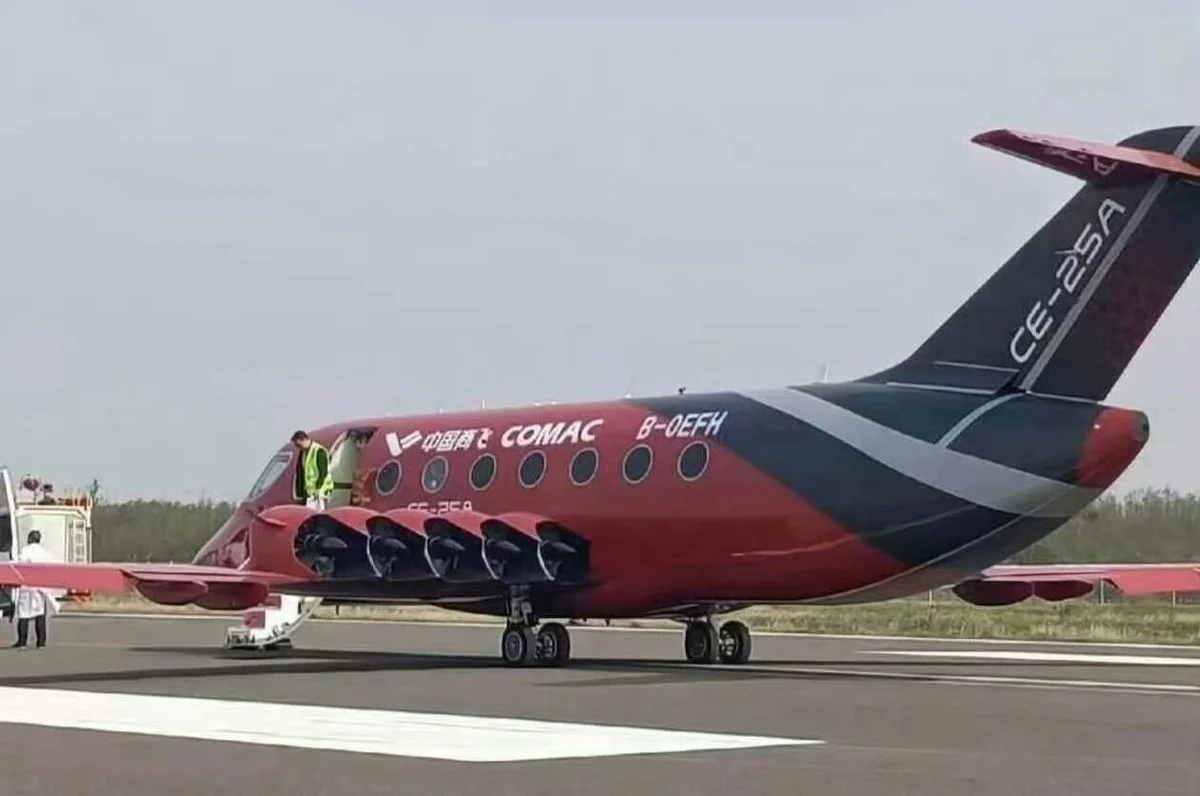
China’s CE-25A, a 19-seat electric commercial aircraft developed by the state-owned Commercial Aircraft Corporation of China (COMAC), completed its first flight with people aboard on November 14 in Binzhou, Shandong province. The milestone moves the aircraft’s development beyond its earlier autonomous flight trials, although it still needs to complete certification work before it can enter commercial service.
Two pilots and a flight-test engineer were on board for the maiden piloted flight. COMAC said the aircraft operated normally and that its performance indicators met expectations. The company’s report, carried by Xinhua, did not describe the flight’s duration or provide further operational details.
The CE-25A is designed mainly for commercial journeys between cities. It has a stated capacity of 19 passengers and a maximum take-off weight of 10 tonnes. According to COMAC, its planned cruising speed is 300 kilometres per hour, cruising altitude is 2,400 metres, and range is 400 kilometres. Those figures describe the aircraft’s design specifications; they do not establish how it will perform on regular passenger routes or under different operating conditions.
The aircraft first flew without a crew on February 2, 2026. Since then, it has completed 19 autonomous flight validation tests, according to COMAC. The piloted flight marks another stage in the programme, allowing the development team to assess the aircraft with pilots and a flight-test engineer on board. It is a test milestone rather than evidence that the aircraft is ready to carry paying passengers.
COMAC developed the CE-25A in partnership with battery maker CATL, Shanghai Jiao Tong University and other organisations. Its propulsion system uses distributed electric ducted fans mounted above the wings. The aircraft’s designation also reflects its intended regulatory path: Xinhua reported that “25” refers to China’s CCAR-25 airworthiness rules for transport-category aircraft. China’s civil aviation regulator has accepted COMAC’s application for a type certificate, but acceptance of an application is not the same as approval or certification.
The aircraft’s 400-kilometre stated range places its proposed role in short-distance regional travel. In principle, this could make it suitable for connecting nearby cities, subject to the aircraft meeting safety and performance requirements and airlines finding workable routes. The manufacturer has not announced a service launch date, airline customer or planned passenger route in the information released about the first crewed flight.
Electric propulsion is the programme’s defining feature, but the successful test alone does not answer the commercial questions that determine whether an aircraft can operate routinely. Certification, battery performance, charging arrangements, maintenance, operating costs and airport infrastructure all have to be addressed. The released flight information confirms the test took place and reports the manufacturer’s results; it does not provide independent performance data or a timeline for resolving those issues.
The CE-25A is part of China’s effort to develop aircraft for its domestic aviation market. Its 19-seat capacity is far below that of the large passenger jets also built by COMAC, so the project is aimed at a different category of service: smaller aircraft for shorter connections. Whether that category can support regular electric passenger flights will depend on the aircraft’s certified range and payload, as well as the economics of operating it.
For now, the clearest achievement is technical: the 10-tonne aircraft has moved from unmanned tests to a crewed flight, and its developer says the aircraft performed as expected. The next significant step is completing the certification process. Until regulators issue the required approval and the company establishes an operational plan, the CE-25A remains a developmental aircraft rather than a commercial passenger service.
The first crewed flight therefore signals progress without settling the questions ahead. COMAC has reported the aircraft’s specifications, development partners and testing history, while the regulator has received its type-certificate application. Further testing and regulatory review will determine whether the CE-25A can progress from a test programme to carrying passengers.