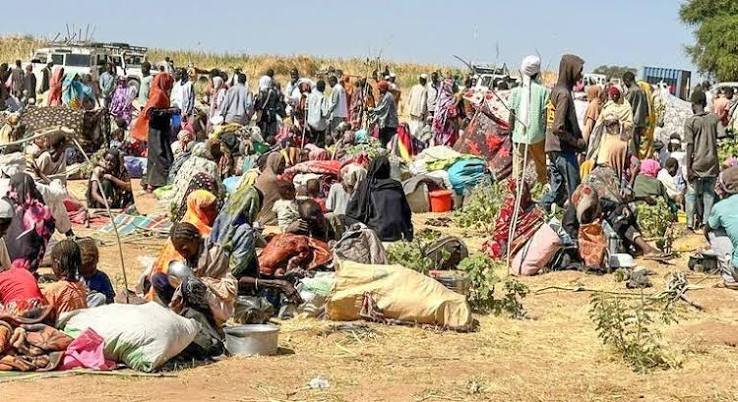
Hundreds of civilians have been forced to leave their homes in Sudan’s southeastern Blue Nile region following renewed fighting involving the paramilitary Rapid Support Forces (RSF), according to local authorities and humanitarian officials.
The latest displacement has been reported in the Jabal Al-Nimr and Minza areas, where residents fled after the communities came under attack. Many of those escaping the violence have reportedly moved towards Al-Azaza and Village 6 in search of safety.
The fresh fighting adds another layer to Sudan’s worsening humanitarian crisis, with civilians caught between rival armed groups as the country’s conflict continues to spread across different regions.
Sudan has been engulfed in war between the Sudanese Armed Forces (SAF) and the RSF since April 2023. The conflict has killed large numbers of people, displaced millions and created severe shortages of food, medicine and other basic necessities.
According to the regional Humanitarian Aid Commission, the latest violence in Blue Nile has triggered a new wave of civilian movement. The commission raised concerns about the ability of displaced families to access essential supplies as they arrive in areas already struggling to cope with the humanitarian burden.
The RSF had not immediately responded to the allegations concerning the attacks.
The reported displacement came shortly after the Sudanese military announced that it had repelled an assault involving RSF fighters and an allied faction of the Sudan People’s Liberation Movement-North (SPLM-N).
The military said the attack targeted Minza and nearby Bashkarkad, areas located close to Sudan’s border with Ethiopia.
Minza is situated in Wad Al-Mahi district, east of the Roseires Dam. Its location gives it strategic importance because of its position along supply and defensive routes in southeastern Sudan.
The Blue Nile region has increasingly become another important theatre in the country’s prolonged conflict. Government forces have claimed advances in several locations during recent months, while armed groups have continued to challenge military positions.
The Sudanese army previously said it had regained control of strategic areas, including Al-Karmak and Geissan, following intense fighting in July.
The latest exodus is not the first major displacement from the area in recent weeks.
The International Organization for Migration reported that about 7,000 people, representing approximately 1,400 families, fled Minza, Jabal Al-Nimr and Manshlong on September 26 as insecurity intensified.
The continuing movement of civilians highlights the growing pressure on communities that are receiving people displaced by the war. Families forced from their homes often arrive with limited food, shelter and medical supplies, increasing the demands on humanitarian organisations and local authorities.
Meanwhile, Sudanese military commanders have sought to reassure residents that government troops remain in control of the area.
Major General Ismail Al-Tayeb Hussein, commander of the army’s 4th Infantry Division, visited Bilgoh and Wad Al-Mahi on Monday to assess military deployments along the eastern front.
According to the army, Hussein rejected reports suggesting that the RSF was on the verge of making a major breakthrough in the area. He said government forces remained on heightened alert and maintained control of the sector.
Despite those assurances, the latest civilian displacement demonstrates the continuing insecurity faced by communities in Blue Nile.
The conflict between Sudan’s army and the RSF has produced one of the world’s largest displacement crises, with civilians repeatedly forced to abandon their homes as fighting moves from one region to another.
The situation in Blue Nile is particularly sensitive because of the region’s proximity to Ethiopia and its strategic position around key transport and military routes.
For civilians caught in the latest fighting, however, the immediate concern remains survival and finding secure places to stay.
Humanitarian agencies are expected to continue monitoring population movements and assessing the needs of newly displaced families as fighting persists.
With no lasting ceasefire in sight, renewed clashes in Blue Nile could create additional pressure on already stretched humanitarian operations and deepen the suffering of Sudanese civilians.
The latest developments also underline the difficulty of containing Sudan’s conflict, which continues to involve multiple armed factions and affect communities far beyond the country’s main urban centres.