Libyan teachers have extended their industrial action after rejecting calls from authorities to return to classrooms, keeping pressure on the government over demands for improved salaries, working conditions and better protection of their rights.
The dispute has intensified as the new academic year gets underway, with teachers maintaining that promises from government officials are not enough without concrete measures to address their concerns.
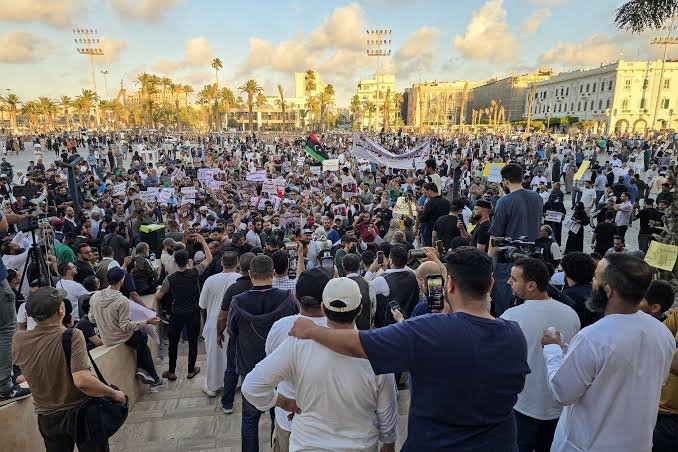
The General Teachers’ Union has said the protest will continue until authorities begin implementing the demands formally and on the ground. The union rejected a government request to suspend the action while officials worked on possible solutions.
Teachers Reject Government Appeal
The latest development followed a meeting between representatives of the teachers’ unions and the Government of National Unity.
According to the union, government representatives asked teachers to suspend their sit-in and allow time for the authorities to begin addressing the outstanding issues.
Teachers declined the proposal, arguing that they wanted official decisions and tangible steps before ending their action.
The union has also stressed that any decision to call off the protest must involve consultation with teachers’ branches across the country rather than being made solely by government officials.
Salary Improvements at Centre of Dispute
Pay remains one of the main issues driving the protest.
Teachers are seeking improvements to their salaries and a more unified wage structure, citing the rising cost of living and what they describe as inadequate financial conditions.
Their demands also include payment of outstanding financial differences owed under existing legislation, along with other allowances and benefits connected to their work.
The union has argued that resolving salary concerns is necessary to improve the wider conditions of teachers and restore stability to the education sector.
Health Insurance and Other Demands
The dispute extends beyond salaries.
Teachers are also demanding comprehensive health insurance covering themselves and their families. They want legislation protecting teachers’ professional rights to be implemented and outstanding financial obligations to be settled.
Other reported demands include compensation linked to teaching hours, payments for school administrators and measures to regularise the positions of teachers employed under contract arrangements.
The union says these issues have been raised repeatedly and that teachers are now seeking practical implementation rather than further assurances.
Government Orders Schools to Reopen
The Ministry of Education has meanwhile called for schools to resume normal activities.
Education Minister Mohammed Abdulsalam Al-Gryou instructed municipal education offices to reopen schools and receive students, saying the ministry was following the teachers’ concerns and that the government was working to address them.
The ministry has also stressed the importance of protecting students’ right to education and maintaining the academic year without prolonged disruption.
However, the teachers’ union has challenged the ministry’s position, arguing that local education offices should not be placed in the middle of the dispute.
The union maintains that teachers and their representative bodies should determine when the protest ends, particularly because the outstanding demands have not yet been backed by sufficient implementation measures.
Schools Face Disruption
The continuing dispute has created uncertainty for students and parents at the beginning of the academic year.
Some schools have reportedly been affected by the protest, while others have continued operating with administrative staff present despite the absence of teachers. The scale of disruption has varied between locations.
The teachers’ action began with an open-ended strike following earlier protest activity. Unions had already warned that they would escalate their campaign if their demands were not addressed.
Reports from September indicated that teachers in several parts of Libya were participating in the movement, with demands focused on salaries, insurance, financial arrears and professional rights.
Dispute Puts Education Sector Under Pressure
The confrontation highlights the difficulties facing Libya’s public education system as authorities attempt to keep schools functioning while dealing with teachers’ concerns over pay and employment conditions.
For the government, prolonged disruption could complicate efforts to maintain a regular academic calendar. For teachers, however, union representatives say returning to work without firm guarantees would leave long-standing grievances unresolved.
The two sides therefore remain divided over the conditions required to end the strike.
While the government has called for schools to reopen, teachers are insisting that formal measures must precede any decision to return to classrooms.
The outcome of the dispute is likely to depend on whether authorities can produce concrete steps addressing the teachers’ financial and professional demands while also ensuring that students can resume uninterrupted learning.
For now, the strike remains in place, with the teachers’ union saying the action will continue until there is visible progress on the issues at the centre of the dispute.