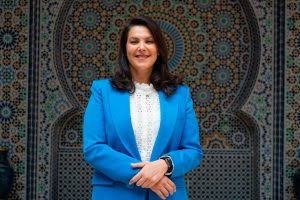
Morocco has made a historic political change after King Mohammed VI appointed Fatima Ezzahra El Mansouri as the country’s first woman to serve as prime minister.
The appointment was announced on Tuesday, September 29, 2026, shortly after El Mansouri’s Authenticity and Modernity Party (PAM) emerged as the largest party in Morocco’s parliamentary election.
The 50-year-old lawyer has now been given the responsibility of forming a new government, placing her at the centre of Morocco’s next political administration.
El Mansouri tasked with forming new government
Following a meeting with King Mohammed VI at the Royal Palace in Rabat, El Mansouri was formally asked to begin the process of establishing a new government.
Her appointment follows Morocco’s September 23 parliamentary election, in which PAM won 97 seats in the 395-member House of Representatives.
However, the party fell well short of the 198 seats required for an outright majority. This means El Mansouri will have to negotiate with other political parties before she can assemble a governing coalition.
The National Rally of Independents (RNI) finished second with 66 seats, while the Istiqlal Party secured 65. The Justice and Development Party (PJD) won 54 seats and has indicated that it will remain in opposition.
Historic moment for Moroccan women
El Mansouri described her appointment as a major moment in Morocco’s history, becoming the first woman to lead the country’s government.
She is also the second woman to serve as prime minister in the Arab world, following Tunisia’s Najla Bouden, who held the position from 2021 to 2023.
Her political career has already included several prominent positions.
El Mansouri first gained national attention after becoming mayor of Marrakesh in 2009, making her the first woman to lead the Moroccan city. She later returned to the position after the 2021 elections.
She has also served in parliament and held a ministerial position responsible for national territorial planning, urban development, housing and city policy.
PAM’s election victory
El Mansouri’s appointment followed PAM’s emergence as the leading party in the latest parliamentary election.
The party, which was established in 2008, moved ahead of the RNI and Istiqlal Party after securing 97 seats.
Morocco’s constitutional system requires the king to appoint the head of government from the party that wins the largest number of seats in the House of Representatives.
With PAM failing to secure a majority, coalition negotiations are expected to become one of El Mansouri’s immediate priorities.
Youth unemployment and cost of living among key issues
The new government faces several economic and social challenges.
Youth unemployment, living costs, inequality and access to public services are among the issues that have generated concern in Morocco.
El Mansouri placed young people at the centre of her campaign, arguing that the government must respond to their concerns with practical measures rather than promises alone.
The election itself recorded relatively low participation. Turnout was around 38%, down from roughly 50% in 2021 and the lowest level recorded since 2007.
The figures have placed additional attention on the relationship between citizens and political institutions, particularly as the new administration prepares to begin its work.
2030 World Cup preparations
Another major responsibility awaiting El Mansouri’s government will be Morocco’s preparations for the 2030 FIFA World Cup.
Morocco will co-host the tournament alongside Portugal and Spain, with billions of dollars in infrastructure and development spending tied to preparations for the global sporting event.
The incoming government will therefore be expected to oversee major investment programmes while simultaneously addressing domestic economic pressures.
A new chapter in Morocco’s political history
El Mansouri’s appointment represents a significant milestone in Morocco’s political history, but her immediate task will extend beyond the symbolism of becoming the country’s first female prime minister.
She must first build a coalition capable of supporting her government in parliament before turning to the broader economic and social priorities facing the country.
Her administration will also operate within Morocco’s constitutional monarchy, where King Mohammed VI retains important powers over areas including foreign policy, defence and other strategic matters.
As El Mansouri begins consultations with political parties, attention will now turn to the composition of her cabinet and the policies her government will introduce.
For Moroccan women, her appointment marks a historic breakthrough at the highest level of government. For the country as a whole, it begins a new political phase shaped by coalition negotiations, economic pressures and preparations for one of the world’s biggest sporting events.