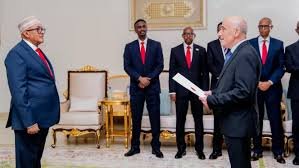
Israel has taken another major step in strengthening its diplomatic relationship with Somaliland after its first ambassador to the territory formally presented his credentials to President Abdirahman Mohamed Abdullahi in Hargeisa.
The ceremony marks a significant development in relations between the two sides, following Israel’s decision in December 2025 to recognise Somaliland as an independent state. Israel became the first United Nations member country to take that step since Somaliland declared independence from Somalia in 1991.
The Israeli Foreign Ministry announced on Sunday, November 1, that Ambassador Michael Lotem had presented his credentials to the Somaliland president during a ceremony held the previous week. The event was also accompanied by the laying of a cornerstone for a planned Israeli embassy in Hargeisa.
President Abdullahi, popularly known as Cirro, described the occasion as historic, noting that it was the first time a Somaliland president had formally received the credentials of an ambassador representing a UN member state that recognises the territory’s independence.
For Somaliland, which has operated with its own government and institutions for more than three decades without broad international recognition, the development represents a further attempt to establish its position in international diplomacy.
Israel and Somaliland Expand Diplomatic Relations
Ambassador Lotem said Israel’s recognition was an acknowledgement of the progress Somaliland had made over the past 35 years rather than simply a diplomatic gesture.
Israeli Foreign Minister Gideon Sa’ar also welcomed the exchange of ambassadors, saying it fulfilled commitments made when the two sides established diplomatic relations.
The appointment and accreditation of Lotem follow several diplomatic engagements between Israel and Somaliland since the recognition agreement.
Sa’ar travelled to Hargeisa in January 2026, while Somaliland later opened its embassy in West Jerusalem during President Cirro’s visit to Israel in June.
The latest ceremony therefore represents another stage in efforts to establish permanent diplomatic channels and expand cooperation.
Both sides have identified several areas where they hope to strengthen their relationship, including trade, investment, infrastructure, technology, healthcare, education and security.
However, neither government has announced detailed funding arrangements, specific commercial projects or an implementation timetable for the proposed cooperation.
Strategic Importance of Somaliland’s Location
Somaliland’s geographical position is an important factor in the growing relationship.
The territory lies along the Gulf of Aden, opposite Yemen, and close to the Bab al-Mandeb Strait, a major maritime passage connecting the Red Sea with the Gulf of Aden and the Indian Ocean.
The waterway is particularly important for international shipping because vessels travelling between Europe and Asia frequently use the route as part of their journeys through the Suez Canal.
Growing insecurity around the Red Sea and neighbouring parts of the Middle East has increased international attention on the region.
During his visit to Israel in June, Somaliland’s president emphasised the strategic value of the territory’s location, saying cooperation with Israel could have wider regional and international significance.
Israel has also previously indicated an interest in strengthening security cooperation with Somaliland. During an earlier visit, Israeli Defence Minister Israel Katz said the two sides had maintained security contacts before formal recognition and intended to expand their relationship.
The possibility of an Israeli military presence in Somaliland has also become a subject of regional debate. Somaliland officials have indicated openness to discussing such cooperation, but President Cirro recently said no talks on establishing a military base had taken place.
Somalia Rejects Israel’s Recognition
Israel’s growing relationship with Somaliland has attracted strong opposition from Somalia’s federal government, which continues to regard the territory as part of its sovereign territory.
Somaliland declared independence in 1991 following the collapse of Somalia’s central government and the civil war that followed. Although it has maintained its own administration, currency and security institutions, it has struggled for decades to secure formal recognition from the international community.
Somali President Hassan Sheikh Mohamud has questioned Israel’s intentions, arguing that its interest is connected to access to the Red Sea rather than simply supporting Somaliland’s independence.
In an interview with Sky News, Mohamud alleged that Israel was interested in establishing a naval base in the territory. His comments reflect Mogadishu’s wider concerns about the security and political implications of Israel’s growing presence in the Horn of Africa.
Somalia condemned Israel’s recognition decision in December 2025, describing it as a violation of the country’s sovereignty and territorial integrity.
The African Union, Arab League and Organisation of Islamic Cooperation have also criticised the recognition.
The disagreement highlights the diplomatic complications surrounding Somaliland’s status. While Israel treats the territory as an independent state and has established formal diplomatic relations, Somalia and several regional organisations continue to oppose that position.
What the Development Means for the Horn of Africa
The presentation of diplomatic credentials and the planned embassy in Hargeisa could strengthen Somaliland’s international engagement, particularly in areas such as investment, technology, healthcare and security.
For Israel, closer relations with Somaliland offer an opportunity to develop partnerships in a strategically important part of the Horn of Africa, near major international shipping routes.
Nevertheless, the move could also deepen tensions between Israel and Somalia while creating further diplomatic challenges for regional organisations seeking to maintain stability.
Whether other countries will follow Israel’s decision to recognise Somaliland remains uncertain. For now, Israel remains the only UN member state to have formally recognised the territory’s independence.
The latest diplomatic ceremony demonstrates that both sides intend to move beyond recognition towards a more structured relationship. However, the wider consequences will depend on how Somalia, neighbouring countries and international organisations respond to the expanding partnership.