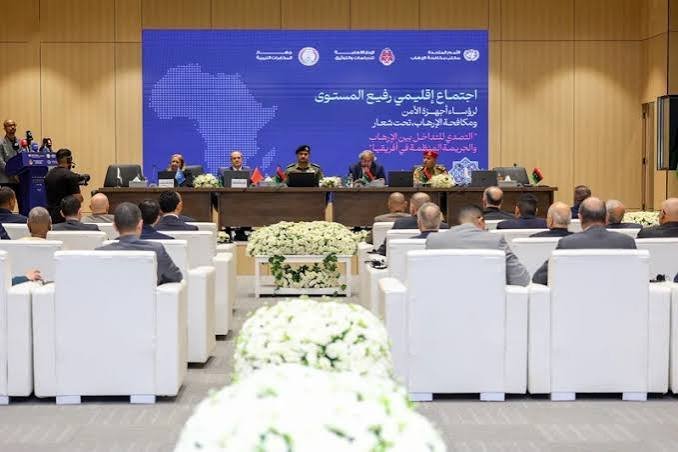
Benghazi meeting brings together 43 security delegations to strengthen intelligence-sharing and cooperation against cross-border threats.
Libya and Morocco have brought together senior security and intelligence officials in Benghazi for a regional meeting focused on the growing links between terrorism and organised crime across Africa.
The meeting, held on October 22, 2026, gathered 43 delegations, including more than 20 heads of intelligence services, alongside security officials and specialist experts. Participants examined ways to improve information-sharing, identify emerging threats earlier and coordinate responses to criminal networks operating across national borders.
The gathering was jointly organised by Libya’s intelligence service and Morocco’s General Directorate for Studies and Documentation (DGED), with support from the United Nations Office of Counter-Terrorism through its programme office in Rabat.
The initiative reflects growing concern among African security agencies that terrorism and organised crime can reinforce each other, creating challenges that individual countries may struggle to address without regional cooperation.
Senior Security Officials Lead Regional Discussions
The meeting was co-chaired by Hussein Al-Aaib, head of Libya’s intelligence service, and Mohamed Yassine Mansouri, director-general of Morocco’s DGED.
The opening ceremony was attended by Saddam Haftar, deputy commander-in-chief of the Libyan armed forces in the east, as well as the United Nations under-secretary-general responsible for counter-terrorism.
Their participation underlined the importance being placed on closer security coordination between Libya, Morocco and international partners. The gathering also offered officials a platform to exchange views on how intelligence services can respond more effectively to threats that cross borders and involve multiple criminal networks.
Rather than treating terrorism and organised crime as entirely separate problems, the discussions focused on understanding their points of connection and how security agencies can respond through better coordination.
Why Terrorism and Organised Crime Are Connected
Terrorist organisations and criminal groups may operate independently, but their activities can overlap. Illicit trafficking, arms smuggling, financial crime and other cross-border offences can create opportunities for violent extremist groups to obtain resources, move people or exploit weak security controls.
Such links can complicate investigations because the individuals and networks involved may operate across several countries, use different routes and rely on intermediaries to conceal their activities.
For African governments, this creates a need for security agencies to exchange relevant intelligence quickly, strengthen investigative capabilities and improve coordination with neighbouring countries.
The Benghazi meeting provided a forum for officials to discuss these challenges and consider ways to improve cooperation. However, the public reports did not detail specific joint operations or agreements resulting from the gathering.
Morocco and Libya Deepen Security Cooperation
The meeting also highlighted the developing security relationship between Morocco and Libya’s eastern-based authorities.
Morocco’s DGED and Libya’s intelligence service worked together to organise the gathering, with the United Nations providing support. Their cooperation reflects a shared interest in strengthening institutional capacity and improving responses to security threats affecting the wider region.
During the event, Saddam Haftar praised the cooperation between the Libyan and Moroccan services. He also called for stronger capabilities within Libya’s intelligence service, including professional training and broader partnerships.
Such efforts are particularly relevant to Libya, where political divisions and security challenges have complicated the development of unified state institutions. Better-trained personnel and more effective intelligence coordination could support efforts to identify threats and respond to criminal activity.
The longer-term impact, however, will depend on whether discussions lead to sustained cooperation, practical training and reliable mechanisms for sharing information.
The Marrakech Platform’s Role in African Security
The Benghazi meeting forms part of wider efforts to improve counter-terrorism cooperation across Africa through the Marrakech Platform, launched in 2022.
The platform provides a setting for African security and intelligence agencies to discuss evolving threats, exchange assessments and build their operational capabilities. The United Nations has supported the initiative as part of efforts to improve coordination among countries confronting terrorism and related security risks.
Regional initiatives are important because criminal networks do not necessarily respect national boundaries. Information gathered in one country may help authorities elsewhere identify suspicious activities, trace connections between networks or prevent attacks.
Still, effective cooperation requires more than high-level meetings. Agencies need trusted communication channels, trained personnel, appropriate legal safeguards and the capacity to act on information received from their partners.
The success of the Benghazi discussions will therefore depend on how far the participating countries turn shared priorities into practical action.
Recent Contacts Add Momentum to Morocco-Libya Relations
The security meeting came shortly after Khaled Haftar, chief of staff of the eastern Libyan forces, visited Morocco from October 11 to 15.
During the visit, he met senior Moroccan military officials and toured facilities associated with military training and aviation. The programme included visits to a parachute infantry battalion and the Marrakech air base.
The sequence of military and intelligence engagements points to continued contact between Morocco and officials in eastern Libya across several security-related areas.
For both sides, cooperation could provide opportunities to exchange experience and strengthen institutional links. At the regional level, improved coordination may also contribute to broader efforts to address terrorism and organised crime.
A Regional Challenge Requiring Long-Term Cooperation
The Benghazi meeting brought together dozens of delegations around a common concern: the need to respond to security threats that increasingly require cooperation between countries and institutions.
By focusing on the relationship between terrorism and organised crime, the participants sought to encourage stronger intelligence-sharing, better anticipation of threats and more coordinated responses.
The gathering represents one step in a broader process rather than evidence that the challenges have been resolved. Progress will depend on continued engagement, practical cooperation and the ability of participating agencies to implement the approaches discussed.
As African governments confront complex cross-border security threats, regional partnerships are likely to remain an important part of their efforts to protect communities and strengthen stability.