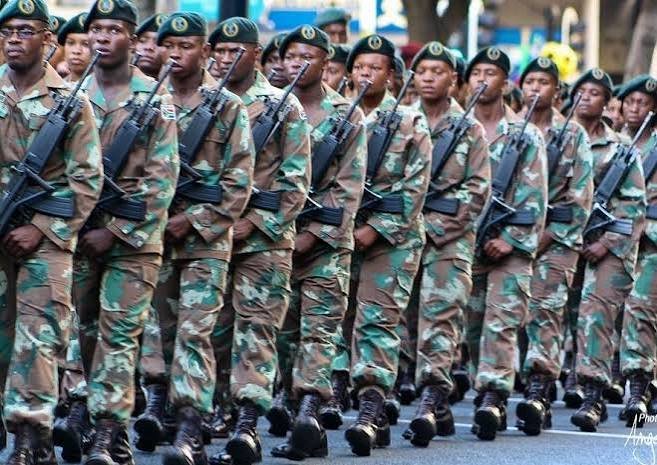
Africa’s military landscape features countries with vastly different defence budgets, troop numbers, equipment and strategic priorities. In the 2026 Global Firepower ranking, Egypt is listed as Africa’s strongest military power, Algeria ranks second, and Nigeria occupies third place. South Africa and Ethiopia complete the continental top five.
The annual assessment compares the conventional military capabilities of 38 African countries using Global Firepower’s PowerIndex system. Its methodology considers more than 60 factors, including manpower, equipment, financial resources, logistics, geography and natural resources.
The results provide a broad picture of the continent’s defence capabilities, although they should not be treated as a definitive prediction of how countries would perform in an actual war.
Top 10 strongest militaries in Africa in 2026
According to Global Firepower’s 2026 African military ranking, the leading countries are:
| African rank | Country | PowerIndex score |
|---|---|---|
| 1 | Egypt | 0.3651 |
| 2 | Algeria | 0.4849 |
| 3 | Nigeria | 0.6097 |
| 4 | South Africa | 0.6843 |
| 5 | Ethiopia | 0.8525 |
| 6 | Morocco | 1.0368 |
| 7 | Angola | 1.1045 |
| 8 | Democratic Republic of the Congo | 1.3051 |
| 9 | Sudan | 1.3563 |
| 10 | Tunisia | 1.7823 |
Source: Global Firepower, 2026 African Military Strength ranking. A lower PowerIndex score represents a stronger position under this system.
Egypt maintains its position as Africa’s leading military power

The country operates land, air and naval forces and has a significant role in security across North Africa and the wider Middle East. Its geographic position, spanning northeastern Africa and the Sinai Peninsula, also gives it strategic importance in regional affairs.
Egypt’s score places it ahead of Algeria, the second-ranked country, in Global Firepower’s 2026 assessment. However, the index measures estimated conventional military potential rather than the likely outcome of a particular conflict.
Algeria ranks second behind Egypt

Algeria takes second place in Africa with a PowerIndex score of 0.4849. The North African country remains one of the continent’s most prominent defence powers, supported by its military resources and strategic position.
Its large territory and borders with several countries make national defence and regional security important considerations. Algeria’s ranking also places it among the leading military powers in the wider African and Mediterranean region.
Although Algeria trails Egypt in this edition, it maintains a substantial position within the continent’s military hierarchy.
Nigeria is Africa’s third-strongest military, according to the index

Nigeria ranks third in Africa with a PowerIndex score of 0.6097, making it the highest-ranked country in West Africa in the 2026 assessment.
The ranking reflects Nigeria’s overall conventional military potential across the factors measured by Global Firepower. The country’s armed forces play a central role in responding to security threats, including insurgency, armed groups and other internal security challenges.
Nigeria’s third-place position puts it ahead of South Africa, Ethiopia and Morocco in this particular ranking. However, the result should not be interpreted as proof that Nigeria would necessarily outperform every lower-ranked country in a real military engagement. Training, intelligence, logistics, leadership and operational readiness can all influence outcomes.
South Africa and Ethiopia round out the top five
South Africa ranks fourth with a score of 0.6843, followed by Ethiopia in fifth place with 0.8525 points.
South Africa’s ranking places it among the continent’s leading military powers, while Ethiopia remains a significant force in the Horn of Africa. Both countries have distinct defence priorities shaped by their geography, security environments and regional responsibilities.
Morocco occupies sixth position, followed by Angola in seventh. The Democratic Republic of the Congo ranks eighth, Sudan ninth and Tunisia tenth.
The top 10 features countries from North, West, Central, East and Southern Africa, demonstrating how military capacity is spread across several regions rather than concentrated in one part of the continent.
Full list: 38 African countries ranked by military strength in 2026
Beyond the top 10, Global Firepower’s ranking includes countries with a wide range of military resources and security needs. The complete list is as follows:
| Rank | Country | PowerIndex |
|---|---|---|
| 11 | Libya | 1.7872 |
| 12 | Kenya | 1.8588 |
| 13 | Chad | 1.8594 |
| 14 | Tanzania | 1.9111 |
| 15 | Mozambique | 1.9769 |
| 16 | Cameroon | 2.1689 |
| 17 | Mali | 2.2598 |
| 18 | Zimbabwe | 2.2801 |
| 19 | Uganda | 2.3252 |
| 20 | Côte d’Ivoire | 2.3884 |
| 21 | Zambia | 2.4461 |
| 22 | Ghana | 2.4566 |
| 23 | South Sudan | 2.4645 |
| 24 | Republic of the Congo | 2.6259 |
| 25 | Eritrea | 2.6841 |
| 26 | Niger | 2.6867 |
| 27 | Namibia | 2.7414 |
| 28 | Mauritania | 2.7919 |
| 29 | Senegal | 2.8925 |
| 30 | Burkina Faso | 2.9213 |
| 31 | Botswana | 2.9993 |
| 32 | Madagascar | 3.0381 |
| 33 | Gabon | 3.0432 |
| 34 | Somalia | 3.7393 |
| 35 | Benin | 3.8963 |
| 36 | Sierra Leone | 3.9201 |
| 37 | Liberia | 3.9275 |
| 38 | Central African Republic | 4.2381 |
How Global Firepower measures military strength
Global Firepower uses its PowerIndex score to compare the conventional military potential of countries. Its assessment draws on more than 60 factors, including:
-
Military manpower: the personnel and human resources available to a country.
-
Equipment: capabilities across land, air and naval forces.
-
Financial resources: economic and defence-related resources that can support military operations.
-
Logistics: infrastructure and other systems that help move and sustain military forces.
-
Natural resources: resources that can contribute to national resilience and military support.
-
Geography: territorial and geographical considerations that affect defence planning.
The index combines these factors into an overall score. A lower score indicates a stronger ranking under Global Firepower’s formula. The organisation also applies adjustments to account for differences between countries and updates its assessment annually.
What the ranking means for Africa
The 2026 figures highlight the continued prominence of Egypt and Algeria in North Africa and Nigeria’s position among the continent’s leading military powers. South Africa and Ethiopia also feature prominently, while Morocco, Angola, the Democratic Republic of the Congo and Sudan complete the next positions in the top 10.
Still, rankings are only one way of comparing armed forces. Military effectiveness depends on more than the quantity of equipment or the resources available to a country. Operational experience, maintenance, command structures, intelligence, troop readiness and the nature of a conflict can all make a difference.
Different organisations can also produce different rankings because their methodologies and measures are not identical. Readers should therefore consider the scoring system behind a list when comparing countries.
Global Firepower’s 2026 African military ranking places Egypt first, Algeria second and Nigeria third. South Africa and Ethiopia occupy fourth and fifth positions, respectively, while 38 African countries appear in the assessment.
For Nigeria, the third-place ranking confirms its strong position within this particular comparison. More broadly, the list provides an overview of Africa’s diverse military capabilities, but it should be viewed as an estimate of conventional military potential rather than a guarantee of battlefield performance.