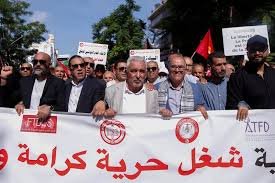
Thousands of people took to the streets of Tunisia’s capital, Tunis, on Saturday, October 17, 2026, in one of the largest demonstrations against President Kais Saied in recent years. Protesters accused the government of weakening democratic institutions, restricting political freedoms and failing to address the country’s worsening economic difficulties.
The demonstration brought together opposition politicians, trade union members, lawyers, doctors, journalists, unemployed people and civil society activists. Their participation highlighted growing frustration over the rising cost of living, deteriorating public services and the concentration of political power in the presidency.
Organised by the influential Tunisian General Labour Union (UGTT) alongside civil society groups and opposition organisations, the protest marked a rare show of unity among groups that have often struggled to mount a coordinated challenge to Saied’s government.
The march took place amid continuing economic pressure on households, with recurring water and electricity cuts and shortages of medicines and other essential goods adding to public discontent.
The demonstrators accused the president of undermining democracy and mishandling the economy, and the rally represented the largest protest against Saied in years.
Opposition Groups Unite Against Kais Saied
The demonstration was significant because it brought together Tunisians from different political and professional backgrounds to express dissatisfaction with the government.
Participants marched along Habib Bourguiba Avenue, a major thoroughfare in central Tunis that played an important role during the 2011 uprising that removed longtime president Zine El Abidine Ben Ali and helped inspire the wider Arab Spring movement.
The protesters raised concerns about political freedoms, the treatment of government critics and the growing difficulties faced by ordinary citizens.
Some called for the release of opposition figures and other critics who have been detained. Others demanded respect for trade union rights and greater protection for people seeking to express political views without fear of punishment.
The demonstration also reflected the frustration of workers and job seekers facing limited economic opportunities and rising living costs.
For the opposition, the ability to mobilise a large crowd represented an important development after years of political divisions weakened efforts to challenge Saied’s leadership.
The rally showed that dissatisfaction with the government extends beyond established political parties to include trade unions, professional groups and citizens concerned about their daily living conditions.
Economic Crisis Fuels Public Anger
Economic hardship was a central issue behind the protest.
Tunisia has faced prolonged financial difficulties, while disruptions to public services have increased pressure on households and businesses. Repeated water shortages and electricity cuts have added to concerns about the reliability of essential infrastructure.
Shortages of medicines and other basic goods have also contributed to public frustration.
For many demonstrators, the economic situation is closely connected to questions about political accountability and the government’s ability to respond to citizens’ needs.
Unemployment, declining purchasing power and the cost of essential items have made daily life increasingly difficult for many families.
The grievances reflect a wider concern that political changes under Saied have not delivered the improvements many Tunisians expected in their economic circumstances.
During the demonstration, participants carried messages expressing dissatisfaction with poverty, unemployment and restrictions on freedoms. Some also highlighted environmental concerns, including pollution.
The protest followed earlier demonstrations over rising prices and shortages, suggesting that public frustration has continued despite the government’s position on its economic policies.
How Tunisia Reached Its Current Political Situation
Saied’s relationship with Tunisia’s political establishment changed dramatically in July 2021, when he suspended parliament, dismissed the government and assumed extensive executive powers.
The president defended his actions as necessary to overcome political deadlock and tackle corruption. However, opponents described the measures as a coup, arguing that they undermined the country’s democratic institutions.
Saied subsequently dissolved parliament, and a new constitution adopted in 2022 strengthened presidential powers.
The changes marked a departure from the political system established after the 2011 revolution, which had brought competitive elections and expanded political participation.
Since then, opposition parties and rights organisations have raised concerns about the independence of institutions and the treatment of political opponents.
Human rights groups have also accused the authorities of intensifying pressure on journalists, civil society organisations and government critics.
Saied has rejected allegations that he is governing as a dictator. He has defended his political decisions and accused opponents of contributing to instability and attempting to exploit the country’s economic problems.
The latest demonstration has brought these longstanding disagreements back into the spotlight, with protesters demanding greater political freedoms alongside improvements in living conditions.
Trade Union Calls for Greater Political Accountability
The UGTT played a central role in organising the demonstration, underlining the continued importance of organised labour in Tunisia’s political life.
The union has a long history of involvement in national affairs and was among the organisations that helped facilitate dialogue during earlier periods of political tension.
At the latest rally, union leader Salah Eddine Salmi criticised the concentration of authority in the presidency and called for greater political accountability.
The union’s participation is significant because its influence extends beyond the traditional opposition parties. Its ability to mobilise workers and supporters gives it considerable weight in debates over government policy and civil liberties.
The demonstration also raised questions about the relationship between the authorities and organised labour, with participants demanding an end to what they described as attacks on trade union rights.
Whether the protest will lead to sustained pressure on the government remains uncertain. However, the turnout demonstrated that dissatisfaction has not been limited to individual political groups.
Protest Echoes Tunisia’s 2011 Revolution
The use of Habib Bourguiba Avenue as the main gathering point added historical significance to Saturday’s demonstration.
The avenue was one of the focal points of the protests that contributed to Ben Ali’s removal in 2011. That uprising became a defining moment in Tunisia’s modern history and helped trigger similar movements across the Arab world.
More than a decade later, demonstrators are again raising questions about political freedoms, economic opportunity and the government’s responsiveness to public concerns.
However, the current situation differs from the circumstances surrounding the 2011 revolution. Tunisia has since experienced years of political transition, economic difficulties and disputes over the country’s system of government.
The latest protest reflects frustration among citizens who believe that the democratic gains associated with the revolution have been weakened while economic problems remain unresolved.
For Saied’s government, the demonstration presents a challenge at a time when opposition groups appear increasingly willing to cooperate over shared concerns.
What the Protest Means for Tunisia’s Future
The demonstration may increase pressure on Saied to address concerns about political freedoms, public services and the economy.
Its size and broad participation suggest that dissatisfaction extends across several sections of society. The involvement of trade unions, professional groups and opposition parties could also make it more difficult for the authorities to dismiss the protest as the activity of a single political faction.
Nevertheless, a large demonstration does not necessarily translate into immediate political change. The government’s response, the opposition’s ability to maintain unity and the development of Tunisia’s economic situation will all influence what happens next.
For many protesters, the central demands remain straightforward: better living conditions, reliable public services, respect for civil liberties and the release of detained government critics.
The demonstration has placed these concerns firmly back on the national agenda and highlighted the growing challenge facing Saied as Tunisia continues to navigate economic uncertainty and political tension.