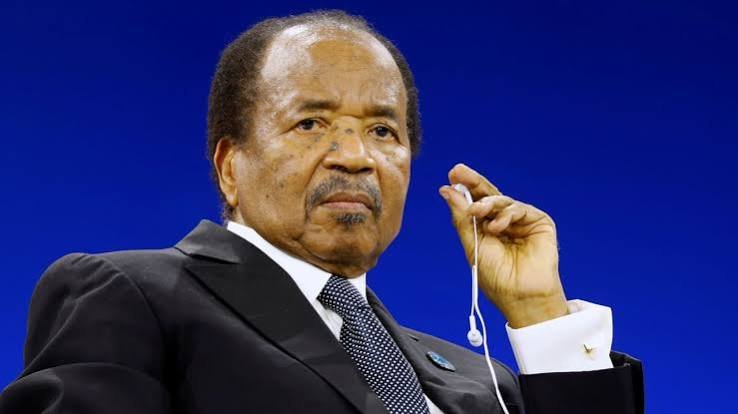
Cameroon’s presidency has dismissed reports circulating on social media claiming that President Paul Biya has died, insisting that the 93-year-old leader is alive and continuing to perform his official duties.
The clarification came on Friday, October 16, 2026, after an online post alleging the president’s death triggered widespread speculation about the country’s political leadership and possible succession arrangements.
Samuel Mvondo Ayolo, director of the Civil Cabinet at the presidency, rejected the claims during comments to French publication Jeune Afrique. He described the reports as false and maintained that there was no reason for the public to be alarmed about Biya’s condition.
The controversy has once again drawn attention to the health of Cameroon’s long-serving president, whose extended absence from the country earlier in 2026 generated questions about his whereabouts, ability to govern and the arrangements for transferring power should he become unable to carry out his responsibilities.
Despite the latest rumours, the presidency says Biya remains active in office.
Viral Social Media Post Triggers Fresh Speculation
The latest controversy began on Thursday, October 15, when an account on X operating under the name Human Rights Forum claimed that Biya had died.
The post further alleged that political figures were discussing plans to identify his successor before an official announcement was made.
The claims quickly gained traction online, attracting hundreds of thousands of views and prompting discussions about the president’s health and the future of Cameroon’s leadership.
Additional posts from the same account reportedly referred to unusual activity around the Unity Palace in Yaoundé, where the president’s official residence and offices are located. However, the allegations circulating online were not accompanied by independently verified evidence establishing that Biya had died.
The rapid spread of the claims illustrates how unverified information about prominent political leaders can gain momentum, particularly when questions already exist about their health and public appearances.
The presidential clarification sought to put an end to the speculation and reassure the public that the country’s leader remained in office.
Presidency Points to Official Decree
In responding to the rumours, Mvondo Ayolo referred to a presidential decree published on October 15 and signed by Biya.
According to the presidential aide, the document demonstrated that the president was continuing to carry out official responsibilities.
He questioned the suggestion that the death of a sitting head of state could be concealed from the public, while criticising the continued circulation of misleading information about Biya’s health.
The presidency maintained that the reports were fabricated and insisted that there was no immediate cause for alarm.
However, the latest statement has not eliminated broader questions surrounding the president’s health and the transparency of information about his activities.
Biya’s limited public visibility during his extended stay abroad had already generated considerable discussion among Cameroonians and political observers.
Biya’s Extended Absence From Cameroon Raised Questions
The death rumours emerged against the background of Biya’s lengthy absence from Cameroon earlier this year.
The 93-year-old president left the country on June 7, 2026, for what officials described as a short private visit to Europe.
He remained in Geneva, Switzerland, for more than 10 weeks before returning to Cameroon on August 20.
His prolonged stay abroad became a subject of public debate, with critics questioning the extent to which government affairs were being managed while the president was outside the country.
Although officials repeatedly maintained that Biya remained capable of performing his duties, his absence prompted opposition figures to demand greater clarity about the country’s political leadership.
Opposition lawmaker Jean Michel Nintcheu called on the Constitutional Council to consider declaring the presidency vacant, reflecting concerns about the implications of a prolonged absence by a head of state.
The council did not take action to declare the office vacant.
Biya’s return to Yaoundé brought an end to his extended stay overseas, but it did not completely resolve questions about his health, the functioning of government or the arrangements for a potential transfer of power.
Questions Over Presidential Succession Continue
Biya’s age and lengthy tenure have intensified discussions about what could happen if he becomes unable to continue governing.
He has led Cameroon since November 1982, making him one of Africa’s longest-serving leaders. He began his eighth presidential term in November 2025 following a disputed election.
In April 2026, lawmakers approved a constitutional amendment restoring the position of vice-president, which had been abolished decades earlier.
The reform established a succession mechanism under which a vice-president could assume the presidency if the office became vacant because of the president’s death, resignation or permanent incapacity.
However, the position remained unfilled in the period covered by recent reports, leaving observers concerned about how a transition would be managed if the need arose.
The issue has become increasingly significant because Cameroon’s political system concentrates substantial authority in the presidency.
A clearly defined and functioning succession arrangement could help reduce uncertainty during a potential leadership transition. Conversely, a prolonged absence of clarity could intensify political tensions.
For opposition groups and other critics, the debate extends beyond Biya’s personal health to questions about institutional stability, accountability and the continuity of government.
Political Uncertainty Extends Beyond Biya’s Health
Cameroon is also confronting wider political and security challenges, including separatist violence in its English-speaking regions and militant activity linked to Boko Haram in the Lake Chad Basin.
These problems place additional demands on the government and make political stability an important concern for the country.
Uncertainty surrounding the president’s health and the future leadership structure can also influence public confidence and perceptions of the country’s political direction.
The presidency’s latest denial may have addressed the immediate claim circulating on social media, but it has not ended the wider debate about governance and succession.
For now, the official position is that Paul Biya is alive, in good health and continuing to work.
The claims of his death remain unverified and have been rejected by a senior presidential aide.
As the situation develops, further attention is likely to focus on the president’s public activities, the appointment of a vice-president and the government’s handling of questions about leadership continuity.