Nigeria’s battle against illegal mining has intensified after authorities identified 374 unauthorised mining locations across 17 states, exposing the scale of the country’s struggle to regulate its mineral resources.
The Federal Government’s enforcement campaign has also resulted in the closure of dozens of sites, hundreds of arrests and several prosecutions, according to figures attributed to the Ministry of Solid Minerals Development.
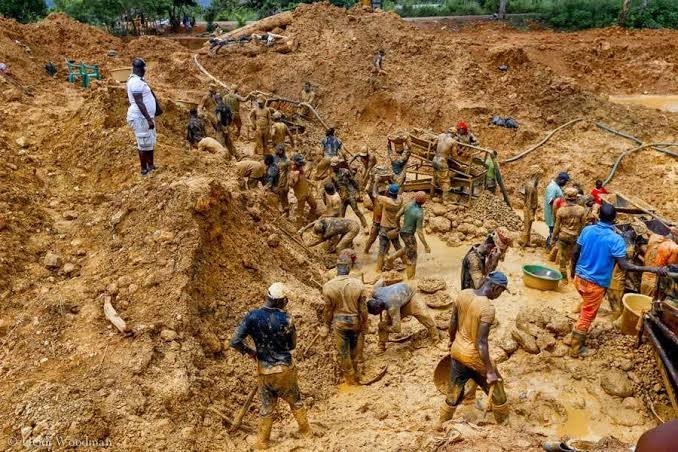
The issue has become more than an economic concern. Illegal mining has been associated with environmental damage, dangerous mining pits, child labour and, in some parts of the country, wider security problems.
374 illegal mining sites identified
According to figures released by the Minister of Solid Minerals Development, Dele Alake, Mining Marshals have identified 374 illegal mining sites across the country.
The enforcement operation has reportedly led to 108 sites being cleared, while 743 suspects were arrested.
Authorities have also prosecuted 165 cases involving 430 accused persons, with five convictions recorded at the time of the report.
The Mining Marshals operate under the Nigeria Security and Civil Defence Corps and were created to strengthen enforcement within the mining sector.
Their responsibilities include identifying unauthorised mining operations, shutting down illegal sites, arresting suspects and helping protect legitimate mining activities.
Illegal mining linked to wider security concerns
The growing scale of unauthorised mining has raised concerns beyond the loss of government revenue.
Security analysts and officials have warned that illegal mining activities in parts of northern Nigeria can intersect with criminal networks and insecurity.
In some areas, illicit mineral trading has reportedly been associated with armed groups involved in kidnapping and other criminal activities.
Authorities have also expressed concerns about foreign nationals participating in unauthorised mining and mineral trading.
The Federal Government has previously announced arrests involving both Nigerian and foreign suspects, while some cases involving suspected links to terrorism have reportedly been referred to security authorities.
Zamfara remains a major mining hotspot
Zamfara is among the states that have faced persistent challenges linked to illegal gold mining.
Mining activity is widespread in areas including Maru, Anka, Bukkuyum, Talata Mafara and Zurmi, where artisanal mining provides income for many rural residents.
However, the presence of unregulated mining operations has created additional security and environmental concerns.
Authorities have also linked some mining areas to violence, while reports have emerged of armed groups demanding payments from miners operating in certain communities. Such allegations remain subject to verification.
Plateau records deadly mining incidents
Plateau State has also experienced several serious mining-related accidents.
Mining operations are concentrated in areas including Barkin Ladi, Jos South, Bassa, Riyom, Wase, Bokkos and Mangu.
A number of people have died in mining-pit collapses and other incidents over recent years.
One of the most serious recent incidents occurred at Kampanin Zurak in Wase Local Government Area in February 2026, where 37 people were reported dead after exposure to toxic gas at a mining site, according to the report.
The state’s authorities have previously attempted to restrict mining activities in several local government areas, but enforcement has remained difficult because many operations take place in remote locations.
Niger State faces its own mining challenges
Niger State has emerged as another major area of concern.
Unauthorised mining has been reported across several local government areas, including Lapai, Katcha, Kontagora, Mariga, Shiroro, Rafi, Suleja, Agwara, Borgu, Munya and Paikoro.
The state possesses a wide range of mineral resources, including gold, lithium, talc, iron ore, mica, manganese and other deposits.
Recent enforcement operations have included the arrest of foreign nationals accused of conducting mining activities without valid licences.
The state also attracted national attention following the deaths of 37 suspected illegal miners while in NSCDC custody. The Federal Government has established an investigative committee to examine the circumstances surrounding those deaths.
Child labour adds another dimension
One of the most serious consequences of poorly regulated mining is the involvement of children.
The United States Department of Labor lists artisanal gold and lithium mining, as well as quarrying, among activities in which Nigerian children have been reported to work.
Children working around mining sites can face dangerous pits, heavy equipment, dust and exposure to potentially toxic substances.
Health experts have warned that exposure to heavy metals such as lead and mercury can have serious consequences, particularly for children whose bodies and organs are still developing.
Beyond physical risks, child labour can also interfere with education and increase children’s vulnerability to exploitation.
A recent investigation in Plateau State, for example, documented teenagers working in hazardous mining environments, highlighting the continuing challenge of keeping children away from dangerous extraction activities.
Environmental damage raises concern
Illegal mining has also affected farmland, vegetation and water sources in several communities.
Mining activities can disturb soil, destroy agricultural land and introduce pollutants into rivers and other water sources.
In some communities, residents have reportedly abandoned farmland because of mining operations, while concerns have also been raised about abandoned pits becoming hazards for people and animals.
Environmental pollution is particularly concerning where communities depend on local rivers and groundwater for domestic use and farming.
Government faces enforcement challenge
Although the Federal Government has increased enforcement efforts, the size and geographical spread of illegal mining make the problem difficult to eliminate.
Mining operations can be established in remote locations, while some miners move from one area to another when enforcement teams arrive.
There is also an economic dimension to the challenge. Many people involved in artisanal mining depend on the activity for their livelihoods.
Experts have therefore argued that enforcement needs to be combined with measures that bring small-scale miners into the formal economy.
Calls for stronger regulation
Security and mining experts have called for improved monitoring of mineral extraction and stronger controls over the movement and sale of minerals.
Digital tracking of mining licences and operational sites could help authorities distinguish between legitimate operations and illegal activities.
There have also been calls for better environmental monitoring, stronger penalties for operators who violate mining laws and alternative livelihood programmes for communities heavily dependent on informal mining.
The United States Department of Labor has also identified gaps in Nigeria’s capacity to prevent and address some forms of child labour, including hazardous work in mining and quarrying.
Nigeria’s mineral wealth faces a major test
The discovery of 374 illegal mining sites across 17 states highlights the scale of the challenge facing Nigeria’s solid minerals sector.
While the country possesses significant deposits of gold, lithium, tin, iron ore and other valuable resources, the continued operation of unauthorised sites risks undermining government revenue, damaging the environment and putting mining communities at risk.
For the government, the challenge is now to strengthen enforcement while creating a safer and more regulated pathway for legitimate artisanal and small-scale miners.
The continuing reports of deaths, hazardous child labour and security concerns show that Nigeria’s illegal mining problem extends well beyond mineral extraction. It has become a wider issue involving public safety, livelihoods, environmental protection and national security.