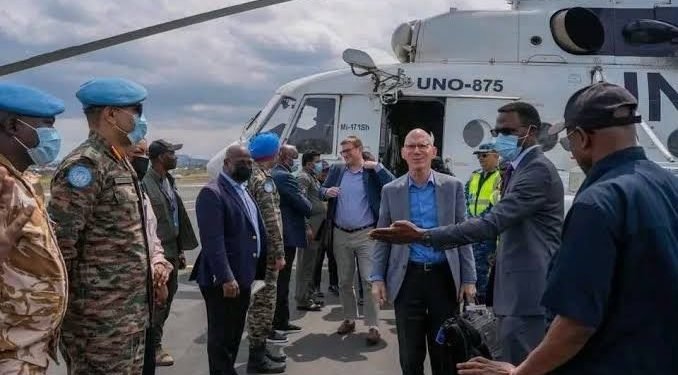
The head of the United Nations peacekeeping mission in the Democratic Republic of Congo (DRC), James Swan, has held talks with former Congolese president Joseph Kabila and other leaders of a newly formed rebel coalition in the eastern city of Goma.
The meeting, which took place on Tuesday, November 3, 2026, comes amid continuing insecurity in eastern Congo and renewed diplomatic efforts to address a conflict that has displaced millions of people.
Kabila leads the Front for the Refoundation of the Nation (FRN), a political and military alliance established last month that brings together groups previously associated with the Congo River Alliance, including the M23 rebel movement.
Swan, who heads the United Nations Organization Stabilization Mission in the Democratic Republic of the Congo (MONUSCO), met Kabila at his residence in Goma. The discussions also involved other senior figures within the coalition.
The engagement is significant because the FRN includes armed groups that control substantial areas of eastern Congo, making communication with its leadership an important consideration for humanitarian access and civilian protection.
MONUSCO mandate among key issues discussed
Following the meeting, FRN vice-president Bertrand Bisimwa said the discussions included the future of MONUSCO, whose current mandate is due for renewal in December.
Bisimwa questioned the effectiveness of the UN mission, arguing that its long presence in the country had not produced the security improvements expected by the population.
He said the coalition believed another renewal would not significantly change the situation and expressed a preference for the UN to continue its planned withdrawal.
MONUSCO has operated in the DRC for decades, supporting efforts to protect civilians and stabilise conflict-affected areas. However, the mission has faced criticism from sections of the Congolese population over its perceived inability to prevent armed groups from expanding their influence.
The Congolese government previously requested the mission’s withdrawal, leading to plans for a gradual reduction of its presence. The deteriorating security situation in the east has continued to complicate those plans.
The latest meeting therefore comes at a sensitive time for the UN, which must consider its mandate and operations while dealing with armed groups that control important population centres and transport routes.
Joseph Kabila’s return to the conflict’s political landscape
Kabila’s leadership of the FRN has added another dimension to the political crisis in the DRC.
He governed the country from 2001 until 2019, when he was succeeded by President Félix Tshisekedi after the December 2018 elections.
The former president’s involvement in the new coalition has intensified tensions between him and the current administration in Kinshasa.
Kabila was sentenced to death in absentia by a Congolese military court last year over charges including treason and war crimes. He has also faced US sanctions over alleged support for armed groups operating in eastern Congo.
The accusations and legal proceedings have made his emergence as the leader of a political-military alliance particularly controversial.
The FRN was formed in October 2026, replacing the previous arrangement involving the Congo River Alliance and M23. Its creation brought several political and armed interests under a new coalition led by Kabila.
The alliance operates in areas where M23 and other armed groups have maintained considerable influence, particularly across North and South Kivu.
M23 remains central to eastern Congo’s insecurity
The M23 movement is one of numerous armed groups involved in the long-running conflict over territory, political influence and mineral resources in eastern Congo.
The group made major territorial advances in 2025, capturing Goma, the capital of North Kivu, and Bukavu, the main city in South Kivu.
The fighting has worsened an already serious humanitarian emergency, forcing millions of people from their homes and disrupting access to essential services.
The Congolese government, the United States and UN experts have accused Rwanda of supporting M23. Kigali has repeatedly denied allegations of military involvement.
The conflict has also attracted regional and international attention because of its potential consequences for neighbouring countries and the wider Great Lakes region.
Despite several diplomatic initiatives, including negotiations involving regional and international mediators, fighting and political disagreements have continued.
UN engagement focuses on civilians and humanitarian access
MONUSCO’s engagement with the FRN leadership reflects the practical difficulties of operating in territory controlled by armed groups.
The UN mission has responsibilities that include supporting civilian protection, facilitating humanitarian access and assisting ceasefire monitoring arrangements.
Maintaining communication with groups controlling territory can be important for delivering aid and reducing the risk of attacks on civilians and humanitarian workers.
However, direct engagement does not necessarily mean recognition or political endorsement of the coalition.
For the UN, the challenge is to carry out its responsibilities while navigating the competing positions of the Congolese government, armed groups and regional actors.
The meeting with Kabila and other FRN leaders provides another channel for discussions, although it remains unclear whether the engagement will produce any immediate changes on the ground.
Uncertain prospects for peace in eastern Congo
The latest talks highlight the difficulty of achieving a lasting settlement in eastern Congo.
While diplomatic initiatives have sought to reduce hostilities, the continued presence of armed groups and disagreements over political authority have made progress difficult.
The future of MONUSCO is also likely to remain a major issue as the United Nations considers its next mandate and the broader direction of its involvement in the country.
For millions of displaced Congolese, the most urgent concerns remain personal safety, access to food and healthcare, and the possibility of returning home.
Whether the meeting in Goma can contribute to those objectives will depend on the willingness of the parties to support meaningful humanitarian arrangements and respect efforts to reduce violence.
For now, Swan’s discussions with the Kabila-led coalition mark an important diplomatic contact, but they do not in themselves signal an end to the conflict.