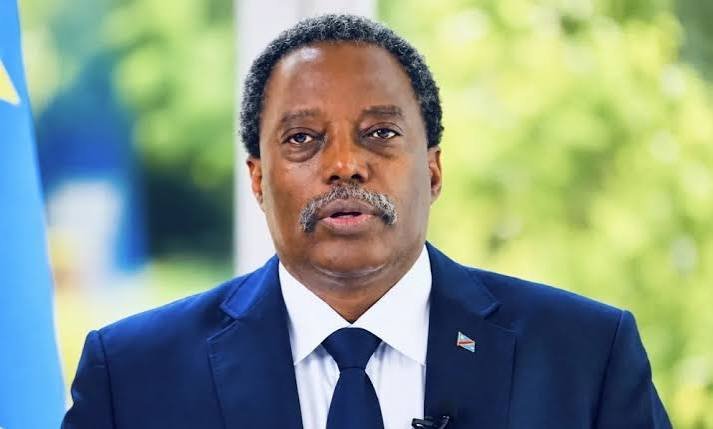
Former Democratic Republic of Congo (DRC) President Joseph Kabila has raised concerns over the country’s political direction, warning that the Central African nation is facing a deepening crisis that threatens its democracy, national unity and security.
In a statement delivered on Friday, October 9, 2026, through his Reconstruct the DRC YouTube channel, Kabila criticised the current administration under President Félix Tshisekedi, arguing that conditions in the country have continued to deteriorate despite repeated calls for political reforms and national reconciliation.
The former president accused the authorities of concentrating political power, weakening democratic institutions and failing to prioritise the welfare of ordinary Congolese citizens. His remarks come as fighting continues in eastern DR Congo, where clashes involving government forces and the AFC/M23 rebel movement have contributed to persistent insecurity.
Kabila’s intervention has renewed attention on the country’s political divisions and the difficulties facing ongoing efforts to find a lasting solution to its security crisis.
Kabila Criticises Tshisekedi’s Leadership
Although Kabila did not directly name Tshisekedi in his address, his criticism was clearly directed at the current government.
He argued that the country’s leadership had become increasingly centralised, with important decisions shaped by the interests of those in power rather than the needs of the population.
According to the former president, this approach has weakened public institutions and undermined the principles of democratic governance. He also accused the administration of encouraging divisions within society through practices he described as tribalism, nepotism and discrimination against minority communities.
Kabila further expressed concern about the management of public resources, alleging that state institutions and government assets were being used for political purposes rather than serving the wider population.
He maintained that the growing gap between the country’s political elite and ordinary citizens was worsening public frustration at a time when many Congolese were already dealing with insecurity and economic hardship.
These allegations reflect Kabila’s assessment of the country’s situation and have not, in themselves, been independently established as facts.
Eastern DR Congo Conflict and Calls for National Dialogue
The security situation in eastern DR Congo remains a major concern, with fighting between government forces and the AFC/M23 rebels continuing despite diplomatic efforts to end the conflict.
Kabila criticised the government’s approach to the war, arguing that continued military confrontation would not resolve the wider political and security challenges facing the country. He questioned whether the authorities had a realistic strategy for achieving victory and accused them of failing to take sufficient advantage of opportunities for negotiations.
The former president also expressed dissatisfaction with the handling of ceasefire arrangements and regional peace initiatives. He pointed to efforts involving organisations from East, Central and Southern Africa, alongside the African Union and other international partners.
Kabila believes a political settlement is necessary to complement security operations and address the deeper causes of instability.
His comments come as diplomatic efforts involving Washington and Doha continue to face difficulties in producing a lasting resolution to the conflict. The fighting has prolonged insecurity in the eastern provinces, where armed groups and competing political interests continue to complicate peace efforts.
Former President Calls for Inclusive National Dialogue
A central part of Kabila’s message was his renewed demand for a comprehensive national dialogue involving political parties, civil society organisations and other relevant stakeholders.
He argued that meaningful discussions are necessary to rebuild trust among Congolese communities, strengthen national unity and restore confidence in democratic institutions.
Kabila maintained that the government should engage with proposals from regional bodies and other mediators rather than allow disagreements to deepen.
His position comes after Tshisekedi announced the launch of a National Dialogue for Peace, Cohesion and the Refounding of the State in August 2026.
The government says the process is intended to address the underlying causes of instability and improve national cohesion. According to the presidency, the initiative is designed to last no longer than three months.
However, the proposed dialogue has generated disagreement among political stakeholders. Kabila’s allies have questioned its structure and demanded assurances that the process will genuinely accommodate opposing views.
The disagreement highlights a broader challenge facing the country: although different political actors acknowledge the need to address the national crisis, they remain divided over how negotiations should be organised and who should participate.
Kabila’s Previous Reform Proposal
The latest statement also builds on a reform programme Kabila presented in May 2025.
His 12-point proposal included ending the conflict, restoring government authority across the country, rebuilding the rule of law and promoting reconciliation among communities.
It also called for action against armed groups, the withdrawal of foreign troops and measures to strengthen democratic governance.
Kabila now argues that the concerns raised in his earlier intervention have not been adequately addressed and that the country’s difficulties have become more serious.
He has indicated that he intends to explain his proposed way forward in further statements in the coming hours, days and weeks.
The announcement suggests that the former president intends to remain involved in the national debate over the country’s political future, although the precise nature of his planned initiatives remains to be seen.
What Kabila’s Warning Means for DR Congo
Kabila’s latest intervention comes at a sensitive time for the Democratic Republic of Congo, where the government faces pressure over security, political reconciliation and the management of state institutions.
His accusations are likely to intensify debate between supporters of the former president and Tshisekedi’s administration. They also draw attention to the challenges of building consensus in a country grappling with armed conflict and longstanding political divisions.
For ordinary Congolese citizens, the most pressing concerns remain the restoration of security, protection of civilians, economic stability and confidence in public institutions.
Whether the latest calls for dialogue will lead to meaningful political engagement remains uncertain. Much will depend on the willingness of the government and opposition figures to agree on a process that accommodates competing interests while prioritising peace and national stability.
For now, Kabila’s warning has added fresh urgency to discussions about the country’s future, with the former president insisting that decisive action is needed to prevent the crisis from becoming more severe.