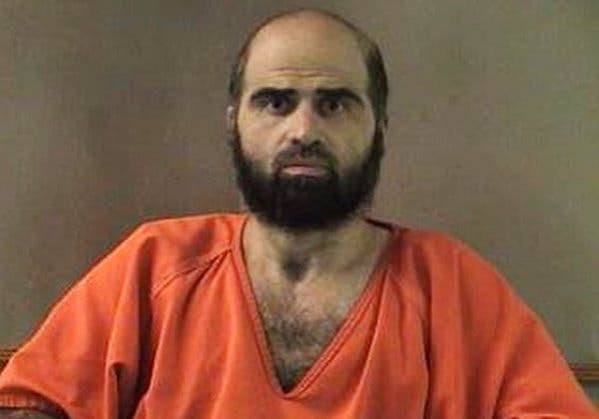
US President Donald Trump has approved the execution of former Army Major Nidal Malik Hasan by firing squad, more than 16 years after he carried out the deadly shooting at Fort Hood, Texas.
The Pentagon confirmed the decision after Defense Secretary Pete Hegseth recommended that Hasan be put to death by a US Army firing squad. Pentagon spokesman Sean Parnell announced the approval on Monday, October 5, 2026.
The Secretary of the Army is expected to determine when and where the execution will take place. However, Trump’s approval does not necessarily mean Hasan will be executed immediately, as further legal proceedings could affect the timetable.
Nidal Hasan’s Fort Hood attack
Hasan, an Army psychiatrist at the time, was responsible for the November 5, 2009, shooting at Fort Hood, one of the largest US military installations in Texas.
He opened fire inside a facility where service members were undergoing medical processing ahead of deployment. The attack left 13 people dead and 32 others wounded.
Hasan was eventually convicted by a military court of 13 counts of premeditated murder and 32 counts of attempted premeditated murder. A military jury sentenced him to death in 2013.
During his court-martial, Hasan represented himself and did little to challenge the prosecution’s case. He acknowledged that he was responsible for the shooting and argued that he had acted in opposition to US military operations involving Muslim countries.
He was shot by a civilian police officer responding to the attack and survived, although he was left partially paralysed. He was subsequently imprisoned at the US Disciplinary Barracks at Fort Leavenworth, Kansas, where he remains on military death row.
Execution would be historic for US military
If carried out, Hasan’s execution would represent a major moment in the history of the US military justice system.
The US military has not executed a prisoner since 1961, when Army Private John Bennett was hanged at Fort Leavenworth. That means Hasan could become the first person executed under the US military justice system in more than six decades.
It would also be the first US military firing-squad execution in decades. The method is extremely uncommon in the United States, although several states have retained it as a legal option for capital punishment.
Hasan is one of only four prisoners currently held on military death row, according to reports. Another military death sentence previously approved by President George W. Bush was halted by a court, illustrating that presidential approval does not necessarily guarantee that an execution will proceed.
Legal challenges could delay execution
Although Trump has now given his approval, Hasan could still seek relief through the civilian federal court system.
Legal proceedings involving military death sentences can continue after the presidential authorization, potentially delaying an execution for an extended period. The exact timing will therefore depend on the remaining legal process as well as decisions by military authorities.
The development comes at a time when the Trump administration has been pushing for broader use of the death penalty and additional execution methods.
The administration has moved to make methods such as firing squads, electrocution and gas asphyxiation available in the federal system alongside lethal injection. The changes have partly been linked to difficulties surrounding lethal-injection drugs and the growing debate over how capital punishment should be carried out.
Trump’s decision also follows renewed controversy over a failed lethal-injection attempt involving Tennessee death-row prisoner Christa Pike. The incident has intensified debate in the United States over execution procedures and the use of capital punishment.
For now, the Army still has to determine the date and location of Hasan’s execution, while possible court action could further affect the process.